What superheat and subcooling tell you
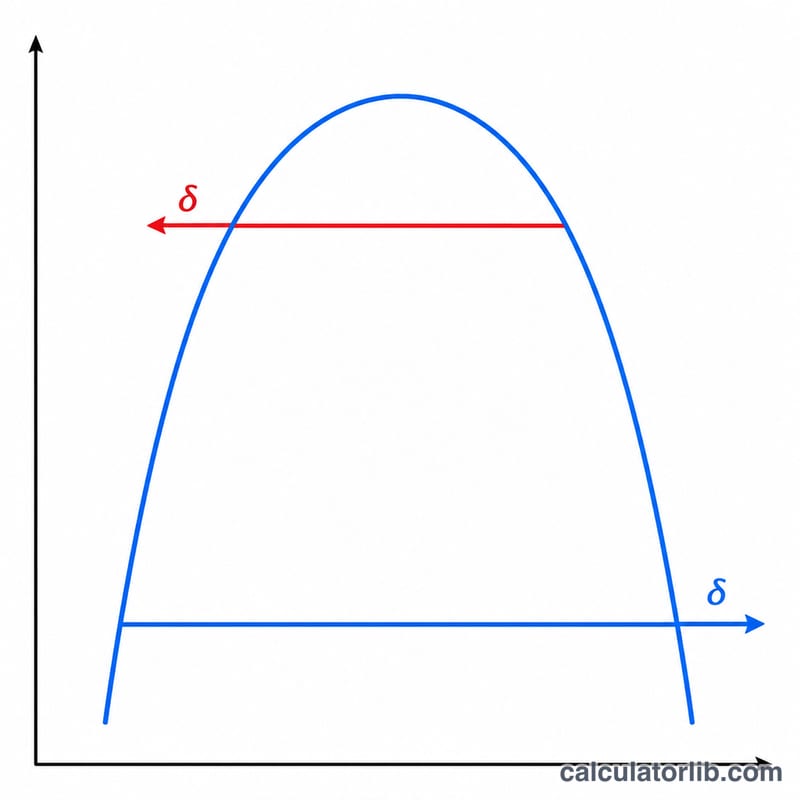
Superheat and subcooling are the two key numbers technicians use to judge refrigerant charge and system health. Superheat is how far the refrigerant vapor leaving the evaporator is above its boiling (saturation) temperature. Subcooling is how far the liquid leaving the condenser is below its condensing temperature. This calculator converts your gauge pressures into saturation temperatures for R-410A, R-22, R-134a or R-404A and then works out both values.
How to use it
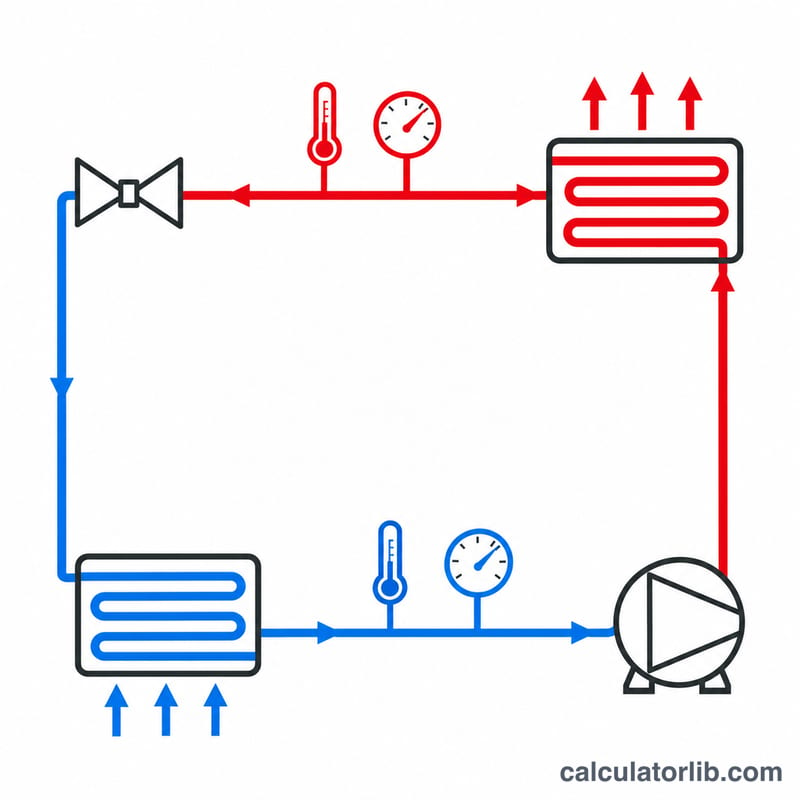
Select the refrigerant, then enter the suction pressure (psig) and the suction line temperature measured near the service valve or evaporator outlet. Next enter the liquid line pressure and the liquid line temperature measured near the condenser outlet. Optionally set your target superheat and subcooling from the manufacturer data plate, and the tool shows how far you are from each target.
The formulas
The saturation temperature \(T_{sat}\) is found from the pressure using a pressure-temperature table, interpolated on the logarithm of absolute pressure (psig plus 14.696).
$$\text{SH} = T_{\text{suction line}} - T_{\text{sat}}(P_{\text{suction}})$$$$\text{SC} = T_{\text{sat}}(P_{\text{liquid}}) - T_{\text{liquid line}}$$Table values are approximate bubble/dew point data. For zeotropic blends such as R-404A, always confirm against the manufacturer chart.
Worked example
An R-410A system reads 118.8 psig on the suction side, which corresponds to \(T_{sat} = 40\,{}^{\circ}\text{F}\). The suction line measures 52 °F.
$$\text{SH} = 52 - 40 = 12\,{}^{\circ}\text{F}$$The liquid pressure is 317.6 psig, equal to a saturation temperature of 100 °F, and the liquid line is 90 °F.
$$\text{SC} = 100 - 90 = 10\,{}^{\circ}\text{F}$$A superheat of 12 °F and subcooling of 10 °F are both typical for a healthy system.
Interpreting Your Superheat and Subcooling Readings
Superheat (SH) is the suction-line temperature minus the evaporator saturation temperature. Subcooling (SC) is the condenser saturation temperature minus the liquid-line temperature. Neither number means much alone: always read SH, SC, suction pressure, head pressure and airflow together, and compare them with the equipment manufacturer's charging chart or nameplate target. Targets vary by model, so the calculator's Target SH and Target SC fields should come from that documentation.
Which number to charge by
- Fixed-orifice / piston systems: charge to the manufacturer's target superheat (usually read from a chart based on indoor wet-bulb and outdoor dry-bulb temperature). Subcooling is a secondary check.
- TXV / EEV systems: the valve holds superheat roughly constant, so charge to the manufacturer's target subcooling. Superheat is a secondary check that the valve is controlling properly.
Reading combinations and likely causes
| Reading | Likely causes | Other clues |
|---|---|---|
| High SH, low SC | Undercharge (the most common cause of this pair) | Low suction and head pressure; bubbles in sight glass if fitted |
| High SH, normal or high SC | Restricted metering device, restricted filter drier or liquid line; TXV underfeeding or hunting | Low suction pressure; temperature drop across the drier or kink |
| Low SH, high SC | Overcharge; on a fixed orifice, also an oversized orifice | High head pressure; risk of liquid floodback to the compressor |
| Low SH, normal SC | Low evaporator airflow (dirty filter or coil, slow blower) or a TXV overfeeding | Low suction pressure; coil icing |
| Low SH, low SC | Weak compressor (valves not pumping fully) or heavy load | High suction pressure with low head pressure |
| High SC (apparent), high head pressure | Non-condensables (air) in the system, or overcharge | Head pressure is higher than the condenser air temperature explains; the pressure-derived saturation temperature is inflated, so calculated SC looks high |
| Low SC, high head pressure | Dirty condenser or poor condenser airflow, with other faults | High condensing temperature relative to outdoor air |
Does low subcooling always mean undercharge?
No. Low subcooling is a symptom, not a diagnosis. Undercharge is a common cause, but low subcooling also occurs with a weak compressor (head pressure too low), a metering device that is too large or stuck open, a TXV that is flooding, or a very high-load condition. Measurement errors matter too: a poorly insulated or badly placed temperature clamp, an uncalibrated gauge, the wrong refrigerant selected, or reading before the system has stabilized (typically 10–15 minutes of operation) can all produce misleading values. If subcooling is low but superheat is also low, adding refrigerant is the wrong move. Check airflow, compressor performance and the metering device first.
This is general information, not professional advice. Refrigerant handling is regulated in many countries and generally requires certified technicians; always follow the equipment manufacturer's instructions and local regulations.
FAQ
What is a normal superheat?
Fixed-orifice systems are charged by superheat, often 10 to 20 °F depending on indoor wet-bulb and outdoor temperature. Always follow the equipment charging chart.
What is a normal subcooling?
Systems with a thermostatic expansion valve are typically charged to 8 to 12 °F of subcooling unless the manufacturer states otherwise.
Does low subcooling always mean undercharge?
Usually, but a dirty condenser, bad compressor valves or metering device faults can also change readings, so check airflow and other symptoms before adding refrigerant.