What the Square Bale Calculator does
The Square Bale Calculator estimates how many small square hay bales a field will produce, or how many you need to buy for a herd, along with the total hay weight and the storage volume those bales occupy. It is built for hobby farmers, horse owners, and small forage operations that bale in traditional two-string squares rather than large round bales.
How to use it
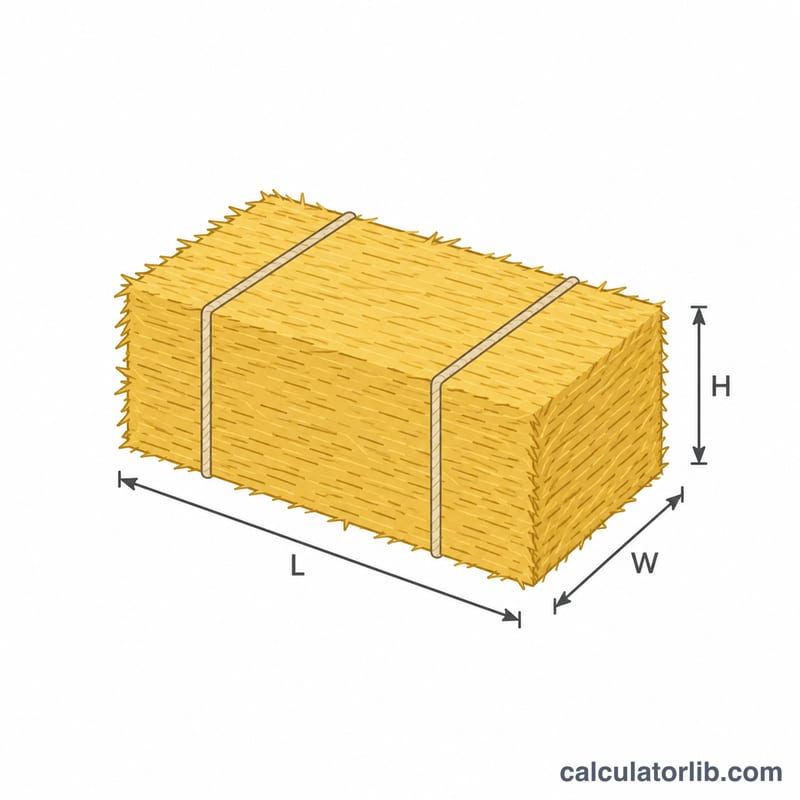
Enter the harvested area in acres and the expected hay yield in tons per acre. Add the average finished weight of a single bale in pounds, then the bale dimensions (length, width, and height) in inches. The calculator converts your tonnage to pounds, divides by bale weight to get a bale count, and multiplies bale volume by that count to size your barn or trailer space.
The formula explained
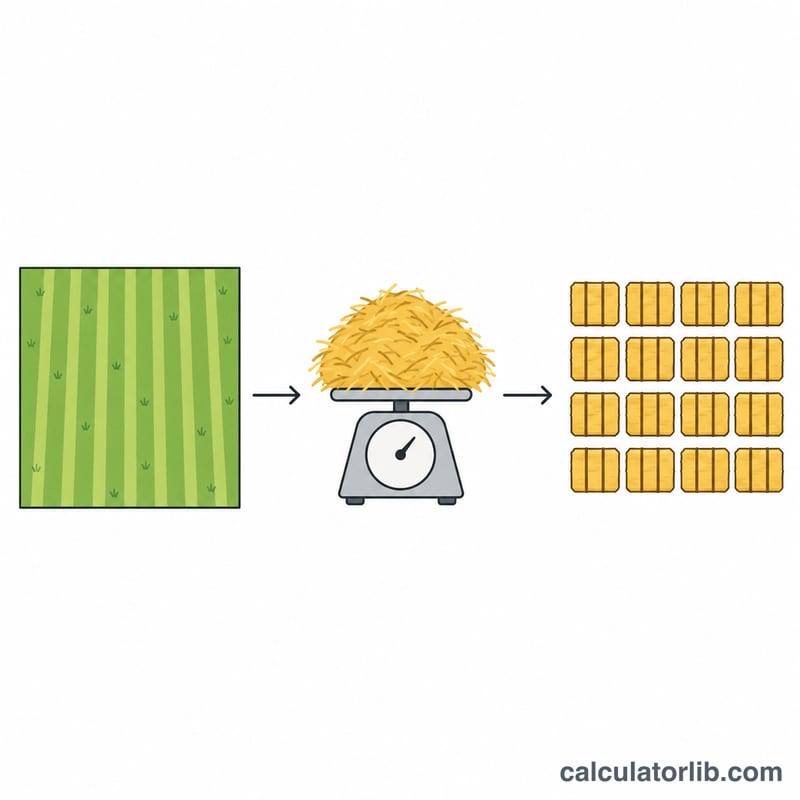
Hay is sold by the ton, so the total crop in pounds is \(A \times Y \times 2000\), where \(A\) is area in acres and \(Y\) is yield in tons per acre. Dividing by the weight of one bale \(W_b\) gives the bale count:
$$\text{Bales} = \frac{A \times Y \times 2000}{W_b}$$Each bale volume in cubic feet is \(V_b = \frac{L \times W \times H}{1728}\), since there are 1728 cubic inches in a cubic foot.
Worked example
Suppose you cut 10 acres yielding 4 tons per acre, with 50 lb bales measuring 36 by 18 by 14 inches:
$$\text{Bales} = \frac{10 \times 4 \times 2000}{50} = 1600$$Volume per bale and total storage become:
$$V_b = \frac{36 \times 18 \times 14}{1728} = 5.25\,\text{ft}^3 \qquad V = 1600 \times 5.25 = 8400\,\text{ft}^3$$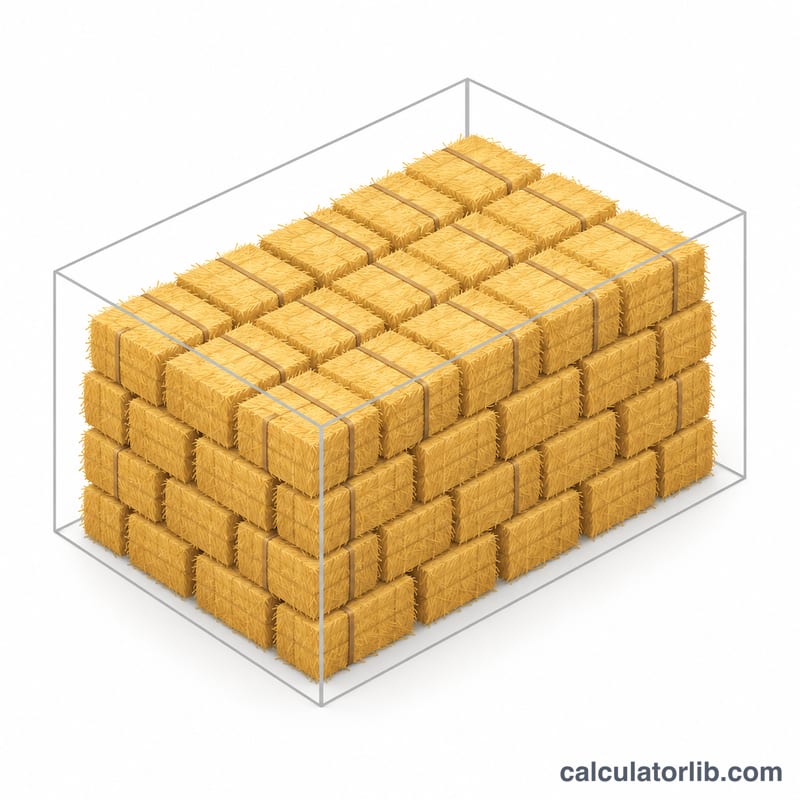
Typical Square Bale Sizes and Weights
Small square bales are named after the number of twine strings that tie them. This calculator uses US customary units: inches for bale size, pounds for bale weight and short tons (2,000 lb) for yield. The sizes below are common in North America. Baler chamber sizes differ by manufacturer, so measure your own bales when you can.
Volume per bale is \(\frac{L \times W \times H}{1728}\) cubic feet, because 1 cubic foot is 1,728 cubic inches. For example, \(\frac{14 \times 18 \times 36}{1728} = \frac{9072}{1728} = 5.25\) ft³.
| Bale type | Typical size (H × W × L, in) | Approx. volume per bale (ft³) | Typical weight range (lb) |
|---|---|---|---|
| Two-string small square | about 14 × 18 × 36–40 | about 5.3–5.8 | roughly 40–70 |
| Three-string small square | about 16 × 22 × 44–48 | about 9.0–9.8 | roughly 75–125 |
All figures are typical ranges, not exact values. Bales of the same size can differ a lot in weight because of:
- Forage type: alfalfa and other legume hay usually packs denser and weighs more than grass hay of the same size. Mixed hay falls in between.
- Moisture: wetter hay weighs more but is less stable in storage. Hay that is very dry and leafy may weigh less.
- Baler density setting: tighter tension packs more hay into the same chamber, so the bales are heavier.
For the most accurate bale count, weigh a few bales from your own field and enter the average as the bale weight.
Practical Tips for Planning Bales and Storage
Example: 10 acres yielding 2 tons/acre, with 50 lb two-string bales measuring 14 × 18 × 36 in:
$$N = \frac{2000 \times 10 \times 2}{50} = \frac{40000}{50} = 800$$The field gives about 800 bales. Those bales take up about \(800 \times 5.25 = 4200\) ft³ of tightly stacked hay. Use the tips below to turn that raw number into a practical plan.
- Plan 10–20% extra bales. Storage losses, uneven yields across the field and bales lighter than expected all lower the usable total. In the example, 10% more is \(800 \times 1.10 = 880\) bales and 20% more is \(800 \times 1.20 = 960\) bales.
- Round up to whole bales. You can't buy or bale part of a bale. If the result comes out as 412.3, plan for 413.
- Add barn space beyond the raw bale volume. The calculated volume assumes bales packed with no gaps. Real stacks need extra room for gaps between bales, aisles for access and handling, and airflow. Leave a generous margin rather than matching the barn exactly to the bale volume.
- Keep hay off the ground and under cover. Stack on pallets, gravel or another dry base so bales don't wick up moisture. Store them in a barn or under a tarp or roof. Rain and ground contact are major causes of spoilage and dry-matter loss.
- Bale at the right moisture. For small square bales, aim for about 15–18% moisture. Wetter hay is more likely to mold, and it can heat up enough to catch fire on its own. Use a hay moisture tester, and check the temperature of freshly stored stacks for the first few weeks.
- Re-check with real numbers. After the first cutting, weigh a few bales and note the actual yield. Then run the calculator again for later cuttings or next season.
FAQ
Does yield vary? Yes. Grass hay often runs 2 to 5 tons per acre per season across multiple cuttings, so use your own field records when possible.
How heavy is a square bale? Two-string squares usually weigh 40 to 70 pounds, while three-string bales can exceed 100 pounds.
Why cubic feet? Knowing total volume helps you confirm a barn, shed, or trailer can physically hold the harvest before you stack it.