What Is the Rock Weight Calculator?
This tool estimates how much a rock or boulder weighs based on its size and the type of stone. Knowing the weight matters when you are moving landscape boulders, loading a truck, sizing rigging and lifting gear, or buying stone by the ton. Because you rarely have a scale big enough for a boulder, the most practical method is to estimate its volume and multiply by the density of the rock.
How to Use It
Pick a shape. For an irregular boulder, treat it as a rectangular block using its longest length, width, and height — this slightly over-estimates, which is safe for lifting. For a rounded boulder choose the spherical option and enter the diameter. Then select the rock type, which sets the density. The calculator returns the weight in pounds, US tons, and kilograms, along with the computed volume.
The Formula
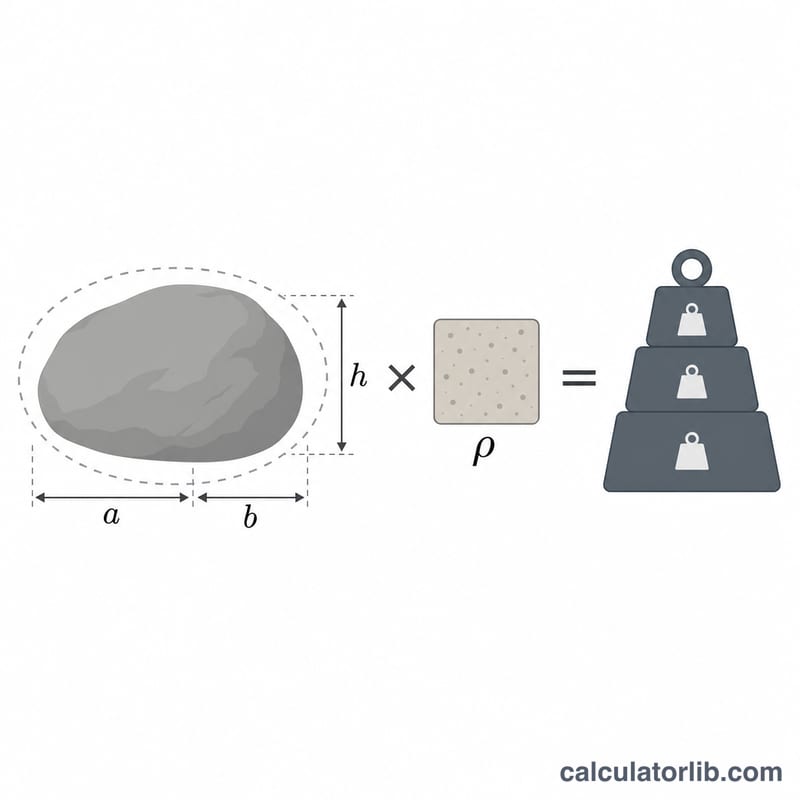
Weight is volume times density:
$$W = V \times \rho$$
where \(W\) = weight, \(V\) = volume in cubic feet, and \(\rho\) = density in pounds per cubic foot. A rectangular block has \(V = L \times W \times H\); a sphere has $$V = \tfrac{4}{3}\pi\left(\tfrac{d}{2}\right)^{3}.$$ Typical densities: granite ≈ 165, basalt ≈ 170, limestone ≈ 150 lb/ft³.
Worked Example
A granite boulder roughly \(2 \times 2 \times 2\) ft. Volume is $$V = 2 \times 2 \times 2 = 8\,\text{ft}^3.$$ With granite at \(165\) lb/ft³: $$W = 8 \times 165 = 1320\,\text{lb} \approx 0.66\,\text{US tons}.$$
Typical Rock Densities by Type
The weight of a rock is its volume multiplied by its density. The table lists typical solid-rock densities. All values are approximate: real stone varies with porosity, moisture content, and mineral composition, so two rocks of the same type can differ by several percent or more. The typical value is a mid-range figure for estimating. Conversions use 1 lb/ft³ ≈ 16.02 kg/m³.
| Rock type | Range (lb/ft³) | Typical (lb/ft³) | Range (kg/m³) | Typical (kg/m³) |
|---|---|---|---|---|
| Granite | 160–175 | 165 | 2,563–2,803 | 2,643 |
| Basalt | 165–180 | 170 | 2,643–2,883 | 2,723 |
| Limestone | 130–170 | 150 | 2,082–2,723 | 2,403 |
| Sandstone | 130–160 | 145 | 2,082–2,563 | 2,323 |
| Marble | 165–175 | 170 | 2,643–2,803 | 2,723 |
| Slate | 168–180 | 174 | 2,691–2,883 | 2,787 |
| Quartzite | 160–170 | 165 | 2,563–2,723 | 2,643 |
| Gneiss | 160–175 | 168 | 2,563–2,803 | 2,691 |
| Dolomite | 160–180 | 170 | 2,563–2,883 | 2,723 |
| Shale | 130–170 | 150 | 2,082–2,723 | 2,403 |
| Loose river rock / gravel (bulk, with air gaps) | 90–110 | 100 | 1,442–1,762 | 1,602 |
Note on river rock: a single solid river cobble or boulder has the density of its parent rock (often granite, quartzite, or similar). The lower figure above applies only to loose piles, where gaps between stones reduce the bulk density. Pounds and tons here are US units (1 US ton = 2,000 lb).
Boulder Weight Comparison by Size and Rock Type
Each weight is volume × density. For a cube or rectangular block, \(V = L \times W \times H\). For a sphere, \(V = \frac{\pi}{6} d^3\). The densities used are granite 165, basalt 170, and limestone 150 lb/ft³. Tons are US short tons (2,000 lb), and kilograms use 1 lb = 0.45359 kg.
| Boulder shape and size | Volume (ft³) | Rock (density) | Weight (lb) | Weight (US tons) | Weight (kg) |
|---|---|---|---|---|---|
| 1 ft cube | 1 | Granite (165) | 165 | 0.083 | 74.8 |
| 1 ft cube | 1 | Basalt (170) | 170 | 0.085 | 77.1 |
| 1 ft cube | 1 | Limestone (150) | 150 | 0.075 | 68.0 |
| 2 ft cube | 8 | Granite (165) | 1,320 | 0.66 | 598.7 |
| 2 ft cube | 8 | Basalt (170) | 1,360 | 0.68 | 616.9 |
| 2 ft cube | 8 | Limestone (150) | 1,200 | 0.60 | 544.3 |
| 3 ft cube | 27 | Granite (165) | 4,455 | 2.23 | 2,020.8 |
| 3 ft cube | 27 | Basalt (170) | 4,590 | 2.30 | 2,082.0 |
| 3 ft cube | 27 | Limestone (150) | 4,050 | 2.03 | 1,837.0 |
| 3 ft diameter sphere | 14.14 | Granite (165) | 2,332.6 | 1.17 | 1,058.1 |
| 3 ft diameter sphere | 14.14 | Basalt (170) | 2,403.3 | 1.20 | 1,090.1 |
| 3 ft diameter sphere | 14.14 | Limestone (150) | 2,120.6 | 1.06 | 961.9 |
Worked check (2 ft granite cube): \(V = 2 \times 2 \times 2 = 8\) ft³, and \(8 \times 165 = 1{,}320\) lb, which is \(1{,}320 \div 2{,}000 = 0.66\) US tons. Weight scales with the cube of the size: doubling every dimension makes a rock 8 times heavier. Natural boulders are irregular, so a bounding box or sphere usually overestimates their weight.
Practical Tips for Moving and Lifting Boulders
- Add a safety margin. Density varies with rock type, porosity, and moisture, and irregular shapes are hard to measure. Add roughly 10–25% to the calculated weight before planning a lift or haul.
- Round up when sizing gear. Choose slings, chains, shackles, and hooks whose rated working load exceeds the padded weight, and allow for the angle of the sling, which increases the load on each leg.
- Check equipment ratings. Confirm the rated capacity of the excavator or loader at the working reach, not just its maximum. Also check the trailer, the truck, and the ramps or surfaces you will cross, and make sure the combined load stays within legal and rated limits.
- Remember how stone is sold. Landscape stone is commonly priced by the ton (in the US, 2,000 lb). A 10–25% error in weight is therefore also an error in cost, so compare your estimate with the supplier's quote.
- Verify critical lifts. For heavy or high-risk lifts, confirm the weight with a scale, such as a weighbridge or crane scale, or ask the supplier or quarry for the actual weight.
- Use qualified people. Rigging and lifting heavy loads should be planned by trained operators following local safety rules and the equipment manufacturer's instructions.
This is general information to help you plan, not professional engineering or safety advice. Always follow the requirements of your equipment, local regulations, and qualified professionals.
FAQ
How accurate is this? It is an estimate. Real rocks are irregular and porous, so densities vary by ±10%. Use the block method for a conservative (heavier) figure.
Which density should I pick? Match the rock type if you know it; otherwise granite (165 lb/ft³) is a reasonable default for hard landscape stone.
What is a US ton here? A short ton equal to 2,000 pounds.