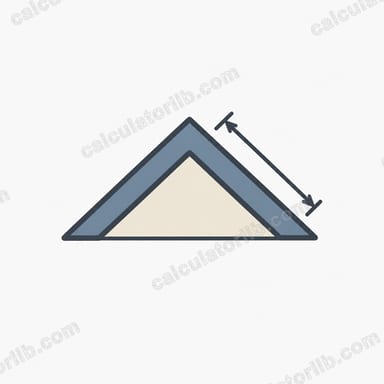
What Is a Roofing Square?
A roofing square is the standard material unit used by roofers and suppliers in the United States and Canada: one square covers exactly 100 square feet of finished roof surface. Shingles, underlayment, and labour are all quoted per square, so an accurate square count is the first step in any re-roof estimate. This calculator turns the footprint of your building plus its pitch into squares, sloped area, and an asphalt shingle bundle count.
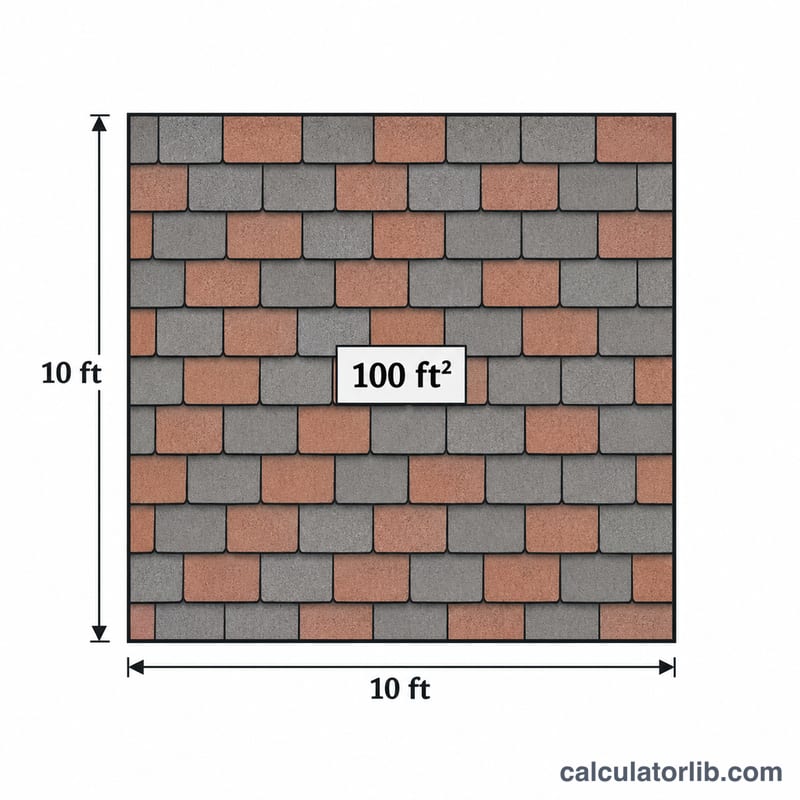
How to Use It
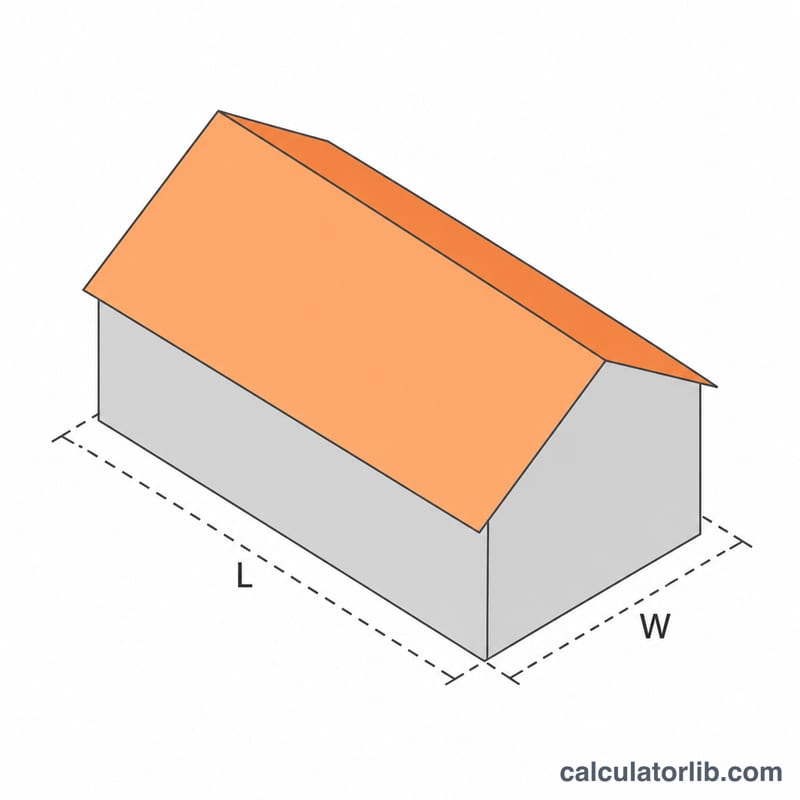
Measure the footprint (plan) dimensions of the roof area at ground level, not along the slope. Enter the length \(L\) and width \(W\) in feet, pick the pitch \(P\) (the rise in inches for every 12 inches of horizontal run, read off a level and tape or a pitch gauge), and set a waste allowance \(w\). Ten percent suits a simple gable roof; 15 to 20 percent is safer for hips, dormers, and complex valleys.
The Formula Explained
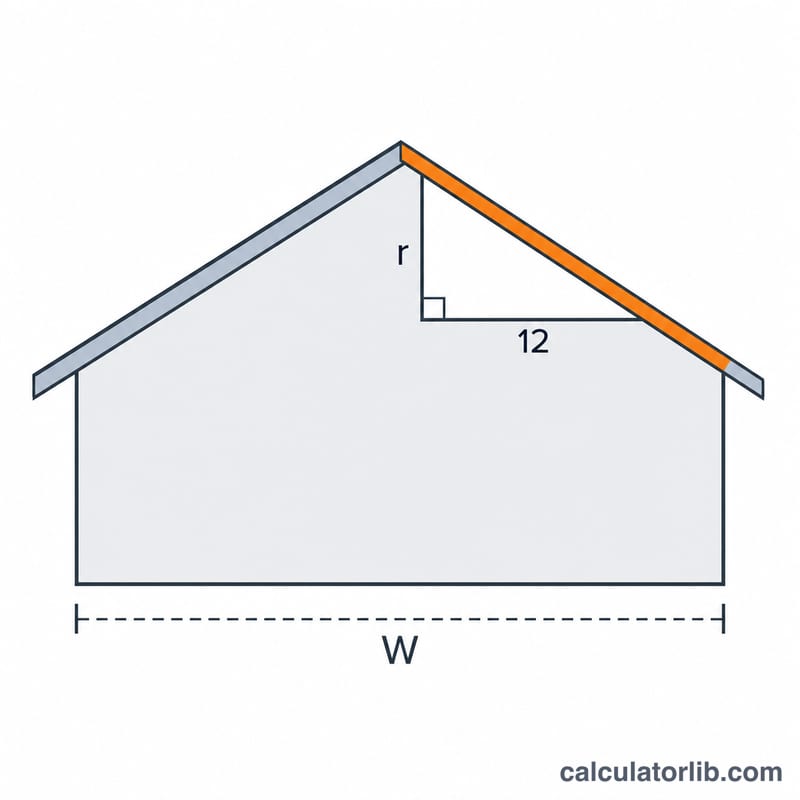
Because a sloped plane is longer than its shadow, plan area must be scaled by a slope multiplier derived from the Pythagorean theorem:
$$M = \frac{\sqrt{P^2 + 12^2}}{12}, \qquad \text{Squares} = \frac{L \times W \times M}{100}$$A flat roof (\(P = 0\)) gives \(M = 1\), while a steep 12/12 roof gives \(M \approx 1.414\) — roughly 41 percent more material than the footprint suggests.
Worked Example
A 40 ft by 30 ft gable roof at 6/12 pitch with a 10 percent waste allowance:
$$M = \frac{\sqrt{6^2 + 144}}{12} = \frac{\sqrt{180}}{12} = 1.118$$$$A = 40 \times 30 \times 1.118 = 1341.6\,\text{sq ft}$$$$S = \frac{1341.6}{100} \times 1.10 = 14.76\ \text{squares}$$At three bundles per square that is 45 bundles to order.
Roof Pitch Multiplier Table
Roof pitch in the US and Canadian convention is written as rise over a 12-inch run (for example 6/12 = 6 inches of rise per 12 inches of horizontal run). Because the roof plane is the hypotenuse of that right triangle, the sloped area is always larger than the flat footprint it covers. The slope factor — the multiplier \(M\) used by this calculator — comes straight from the Pythagorean theorem:
$$M = \frac{\sqrt{P^{2} + 12^{2}}}{12} = \frac{\sqrt{P^{2} + 144}}{12}$$The roof angle from horizontal is \(\theta = \arctan\!\left(\frac{P}{12}\right)\). A roofing square equals 100 square feet of roof surface — a North American trade unit, not an SI one.
| Pitch (rise/12) | Multiplier \(M\) | Roof angle | Walkability |
|---|---|---|---|
| 0/12 | 1.000 | 0.00° | Flat — not shingle territory; membrane roofing |
| 1/12 | 1.003 | 4.76° | Walkable (low slope; special underlayment rules apply) |
| 2/12 | 1.014 | 9.46° | Walkable (low slope) |
| 3/12 | 1.031 | 14.04° | Walkable |
| 4/12 | 1.054 | 18.43° | Walkable |
| 5/12 | 1.083 | 22.62° | Walkable |
| 6/12 | 1.118 | 26.57° | Walkable — practical upper limit for comfortable footing |
| 7/12 | 1.158 | 30.26° | Steep — fall protection and care advised |
| 8/12 | 1.202 | 33.69° | Steep |
| 9/12 | 1.250 | 36.87° | Steep |
| 10/12 | 1.302 | 39.81° | Requires roof jacks/staging and a harness |
| 11/12 | 1.357 | 42.51° | Requires staging and a harness |
| 12/12 | 1.414 | 45.00° | Requires staging and a harness |
| 13/12 | 1.474 | 47.29° | Requires staging and a harness |
| 14/12 | 1.537 | 49.40° | Requires staging and a harness |
| 15/12 | 1.601 | 51.34° | Requires staging and a harness |
| 16/12 | 1.667 | 53.13° | Requires staging and a harness |
| 17/12 | 1.734 | 54.78° | Requires staging and a harness |
| 18/12 | 1.803 | 56.31° | Requires staging and a harness |
The multiplier applies to plan (footprint) area only, and it is independent of building size. A 6/12 roof over a 1,000 sq ft footprint and a 6/12 roof over a 4,000 sq ft footprint both have 11.8% more surface than their footprints — the slope factor is a pure geometric ratio, so it never changes with length, width or the number of gables, as long as every plane shares the same pitch. If a house mixes pitches (a 4/12 porch on a 8/12 main roof, say), split the footprint into regions and multiply each by its own factor.
Worked example. A simple gable house with a 40 ft × 30 ft footprint at 6/12, with 10% waste:
$$S_w = \frac{40 \times 30 \times 1.118}{100} \times \left(1 + \frac{10}{100}\right) = \frac{1{,}341.6}{100} \times 1.10 = 13.42 \times 1.10 = 14.76$$So roughly 14.76 squares of shingles, from 1,200 sq ft of footprint and about 1,342 sq ft of actual roof surface.
Ordering and Rounding Guidance
Squares are a measuring unit; shingles are sold in bundles. The last step of every estimate is turning a decimal square count into a whole-bundle purchase order, and that step always rounds up.
- Convert squares to bundles, then round up to the next whole bundle. Standard 3-tab and most architectural (laminated) shingles are packaged 3 bundles per square. Heavier luxury/designer shingles often run 4 or 5 bundles per square. Always verify the bundles-per-square and coverage printed on the wrapper for the exact product you are buying — it is the only authoritative number.
- Keep one extra bundle on site. Order one spare bundle beyond the rounded total and store it dry for future repairs. Order the whole job at once so all bundles come from the same production run: color blends vary between dye lots, and a patch from next year's lot will read as a different color on the roof.
- Choose waste by roof complexity. As a working rule, use 10% for a simple gable with straight runs, 15% for a hip roof (every hip and ridge means cut-off shingles), and 15–20% where there are multiple valleys, dormers, skylights or chimneys. Steep roofs and roofs needing many starter/cap cuts sit at the high end of each band.
- Order the accessories separately — they are not covered by the square count. Ridge cap, starter strip, drip edge and valley flashing are bought by the linear foot, so measure ridges, hips, eaves, rakes and valleys with a tape rather than deriving them. Underlayment comes by the roll: one roll of 15 lb felt covers roughly 4 squares, and a typical synthetic underlayment roll covers about 10 squares. Ice-and-water membrane at eaves and valleys is a separate line item.
- Budget fasteners. Plan roughly 2–3 lb of 1-1/4 in roofing nails per square at the common 4-nails-per-shingle pattern. High-wind zones and many manufacturer warranties require a 6-nail pattern, which raises both the nail count and the weight proportionally — check the installation instructions on the bundle wrapper, which govern the warranty.
- Re-measure pitch and footprint before you order. A one-step pitch error is a material error of several percent: going from 6/12 (1.118) to 7/12 (1.158) adds about 3.6% to the area, and 9/12 (1.250) to 10/12 (1.302) adds about 4.2%. On a 30-square roof that is a full square — three bundles — of difference. Check the pitch with a level and tape (or a pitch app) in two places, and confirm footprint length and width at the eave line, including overhangs, since the overhang is part of the roof but not of the heated floor plan.
Hip-roof example. A 36 ft × 26 ft hip roof at 4/12 pitch with 15% waste for the hip cuts:
$$S_w = \frac{36 \times 26 \times 1.054}{100} \times 1.15 = \frac{986.6}{100} \times 1.15 = 9.87 \times 1.15 = 11.35$$That is about 11.35 squares. At 3 bundles per square that is 34.05 bundles, so order 35 bundles — plus one spare makes 36 — along with roughly 23–34 lb of nails and about 2 rolls of synthetic underlayment, then measure ridge, hip, eave and rake lengths separately for cap and edge metal.
Scope note. The roofing square (100 sq ft), the rise-over-12 pitch notation and the 15 lb/30 lb felt weights used above are North American trade conventions; metric markets specify roof area in square metres and pitch in degrees or percent, so convert before ordering abroad. This is estimating guidance only — it assumes simple rectangular footprints with uniform pitch and does not account for structural condition, layer count, ventilation or tear-off. Local building code, the manufacturer's written installation instructions and a roofer's on-site measurement take precedence over any calculated figure.
FAQ
How many bundles are in a square? Three bundles cover one square for most 3-tab and architectural asphalt shingles; heavy luxury shingles may need four or five, so check the wrapper.
Should I measure along the slope instead? You can. If you measure the true sloped surface directly, enter pitch 0/12 so the multiplier is 1 and no extra scaling is applied.
Does the result include ridge cap and starter strip? No. Those are sold by linear foot; the waste allowance only covers cutting and overlap losses on the field shingles.