
What Is a Roof Area Calculator?
A roof area calculator estimates the actual sloped surface area of a pitched roof — not just the flat footprint of the building beneath it. Because a roof tilts, its real surface is always larger than the ground it covers. Knowing the true area is essential for ordering shingles, underlayment, metal panels, or estimating labor.
How to Use It
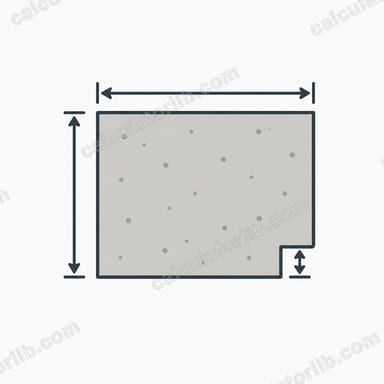
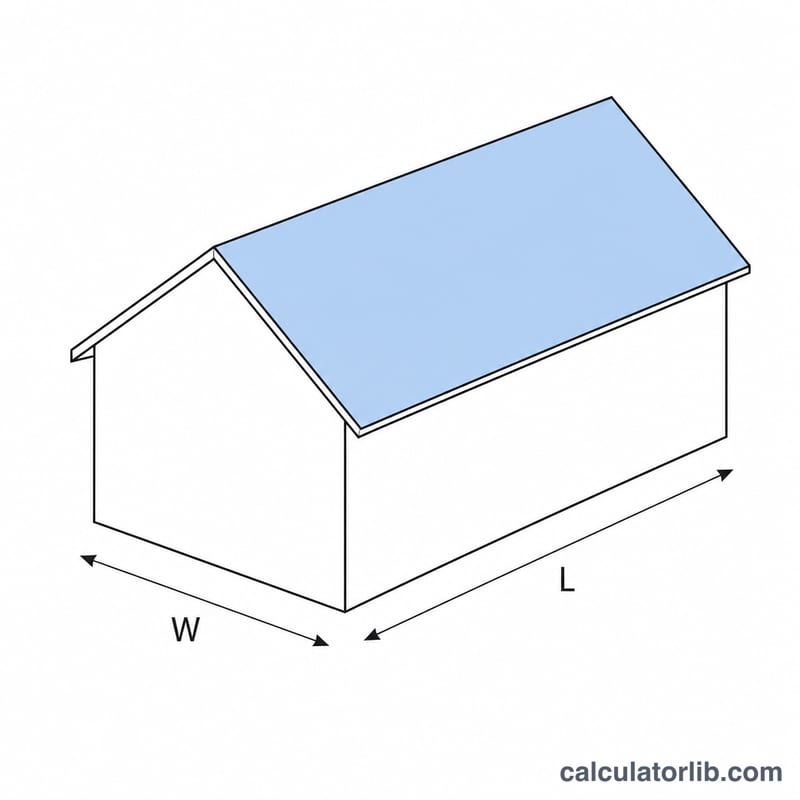
Enter the building's footprint length and width (in feet), then enter the roof pitch as a rise and run. Pitch is commonly written as "rise/12" — a 6/12 roof rises 6 inches for every 12 inches of horizontal run. The calculator returns the total roof surface area in square feet, the flat footprint, the slope multiplier, and the number of roofing squares (100 ft² each).
The Formula Explained
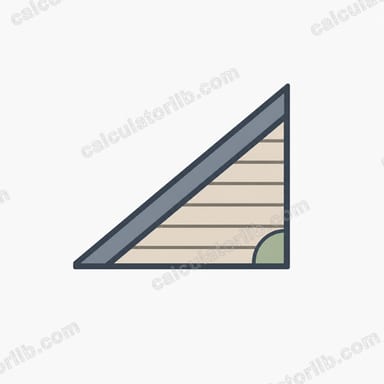
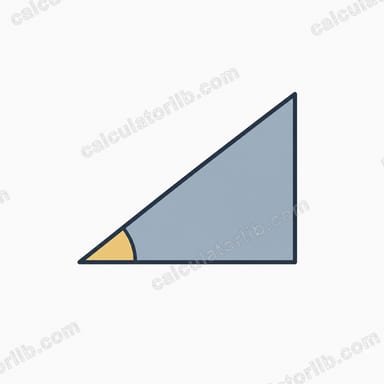
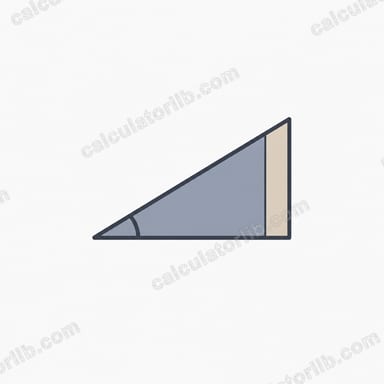
The footprint area is simply Length × Width. The slope multiplier comes from the Pythagorean theorem: a roof slope forms the hypotenuse of a right triangle with legs "run" and "rise." That multiplier is \(\sqrt{1 + (\text{rise}/\text{run})^2}\). Multiplying the footprint by this factor converts flat area into true sloped surface. A 12/12 roof (45°) has a multiplier of about 1.414, meaning the roof surface is ~41% larger than the footprint.
$$\text{Roof Area} = (\text{Length} \times \text{Width}) \times \sqrt{1 + \left(\dfrac{\text{rise}}{\text{run}}\right)^2}$$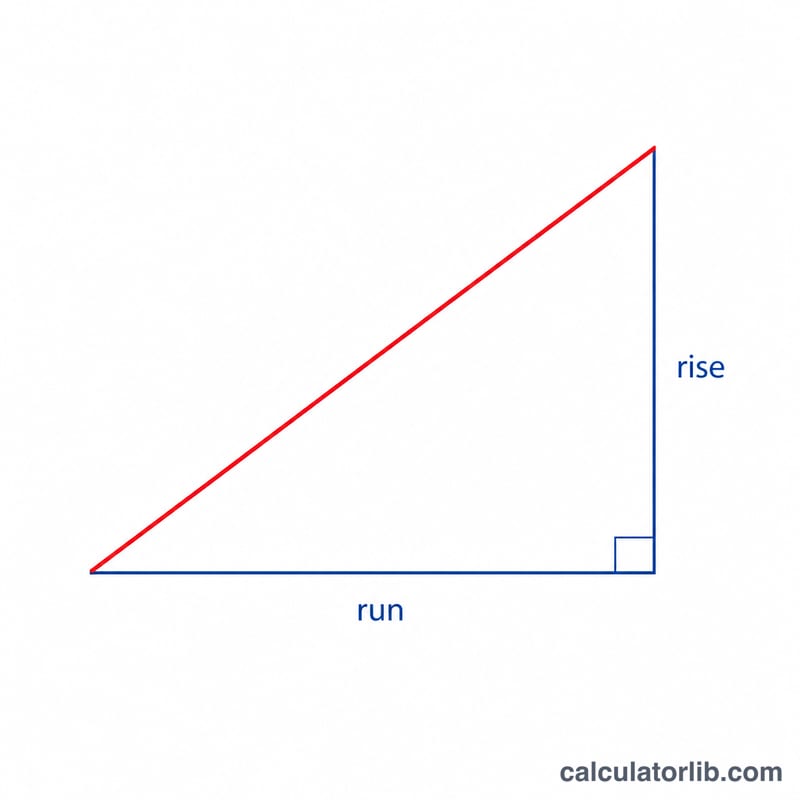
Worked Example
For a 40 ft × 30 ft building with a 6/12 pitch: footprint = 1,200 ft². The slope factor = \(\sqrt{1 + (6/12)^2} = \sqrt{1.25} \approx 1.1180\). Roof area:
$$1{,}200 \times 1.1180 \approx 1{,}341.6 \text{ ft}^2$$or about 13.4 roofing squares.
FAQ
Does this include overhangs? No — use the footprint that the roof actually covers, including eave overhangs, for the most accurate result.
What if my roof has multiple slopes or hips? Calculate each plane's footprint separately and add the results; the slope factor still applies per plane.
How many extra shingles should I buy? Add roughly 10–15% for waste, ridge caps, and cuts beyond the calculated squares.