
What landed cost means
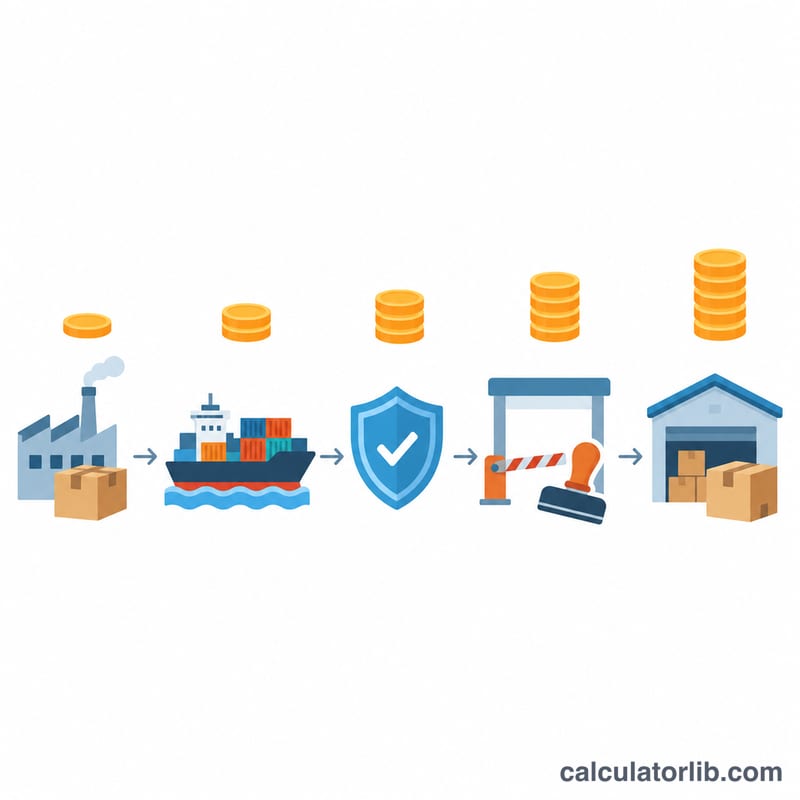
Landed cost is the complete amount you pay to get a product from a supplier to your own warehouse, ready to sell. It is the figure that should drive your selling price, not the invoice price alone. Besides the goods themselves it includes international freight, cargo insurance, import duty, import VAT or sales tax, and the broker, port and handling fees charged at clearance. Ignoring these extras is the most common reason an import that looked profitable on paper loses money.
How to use the calculator
Enter the unit price your supplier charges and the number of units in the shipment, then the freight and insurance for the whole consignment. Add the duty rate and the import VAT or sales tax rate that your customs authority applies to your product classification, and lump brokerage, port and handling charges into other fees. The duty and tax rates are yours to supply, so the tool works for any country and any currency.
The formula explained
With \(C\) = goods value, \(F\) = freight, \(I\) = insurance, \(d\) = duty rate, \(t\) = import tax rate and \(O\) = other fees:
$$\text{Landed} = (C + F + I)(1 + d)(1 + t) + O$$Duty applies to the customs or CIF value \(C + F + I\); import tax applies to that value after duty, which is why the two brackets multiply rather than add. Other fees sit outside the brackets because handling and brokerage charges are normally not part of the dutiable value.
Worked example
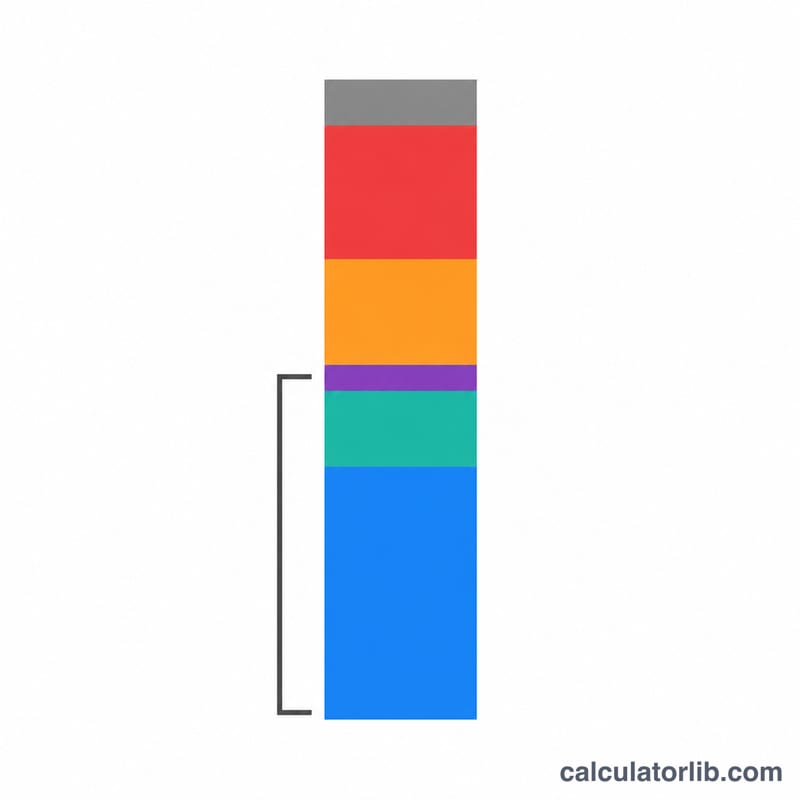
Ten units at 100 each, 250 freight, 50 insurance, 5% duty, 10% import VAT and 120 of fees:
$$C + F + I = 1000 + 250 + 50 = 1300$$$$D = 1300 \times 0.05 = 65 \qquad T = 1365 \times 0.10 = 136.50$$$$\text{Landed} = 1300 + 65 + 136.50 + 120 = 1621.50$$Per unit that is \(1621.50 / 10 = 162.15\), an uplift of 62.15% over the invoice price.
Interpreting Your Landed Cost
The calculator returns two figures that answer different questions. The total landed cost is the full cash outlay to get the whole shipment into your warehouse: goods, freight, insurance, duty, import VAT/tax and any other fees. The per-unit landed cost divides that total by the quantity and is the number you actually use as a cost basis, because margins and markups are computed per item sold, not per container.
Why the invoice price is the wrong cost basis
Using the supplier's unit price understates cost by everything that happens after the factory gate. Once you have the per-unit landed cost \(L\) and a selling price \(P\), the two standard arithmetic relationships are:
$$\text{Gross margin} = \frac{P - L}{P}, \qquad \text{Markup} = \frac{P}{L} - 1$$Margin is expressed as a share of revenue; markup is expressed as a share of cost. They are not interchangeable — the same pair of numbers gives a larger markup than margin whenever \(P > L\).
Worked reading of the output
Take 500 units at a unit cost of 12.00, freight 1,800, insurance 120, a duty rate of 6.5%, VAT at 20% and other fees of 450 (broker, THC, inland delivery), all in one currency:
$$CV = 12 \times 500 + 1{,}800 + 120 = 7{,}920$$$$\text{Total} = 7{,}920 \times 1.065 \times 1.20 + 450 = 8{,}434.80 \times 1.20 + 450 = 10{,}571.76$$$$L = \frac{10{,}571.76}{500} = 21.14$$So the per-unit landed cost is 21.14 against an invoice price of 12.00. The uplift over invoice price is \(21.14 / 12.00 - 1 \approx 76\%\). That percentage is simply a ratio, and its size is driven mainly by two things: the freight-and-insurance-to-goods ratio (here 1,920 on 6,000, or 32%, which is high — typical of bulky, low-value goods) and the duty rate. Dense, high-value goods shipped by sea often land within a few percent of invoice; light, bulky, high-duty goods can exceed 50-100%. A large uplift is not an error signal in itself; it tells you which cost line to attack.
This is a cost figure, not a customs declaration
The total here is a cost-accounting number for inventory valuation and pricing arithmetic. It is not the value you declare to customs. Under CIF-style valuation the dutiable/customs value is \(C + F + I\) — in the example, 7,920 — and it excludes the "other fees" bucket, because broker charges, terminal handling and domestic delivery are generally not part of the value on which duty is assessed. Exactly which charges enter the customs value is set by each country's valuation rules (for example, some jurisdictions assess duty on an FOB basis instead of CIF), so check the rules of the importing country rather than assuming the formula above matches your declaration.
Recoverable VAT inflates the number without being a cost
In VAT/GST systems, import VAT paid by a registered business is normally recoverable as input tax, and some regimes allow reverse-charge or deferred accounting so it is never paid out at the border at all. In those cases the VAT line is a cash-flow and working-capital item, not a true cost, and leaving it in the field inflates your cost basis and understates your computed margin. To get a cost basis for margin work, enter tax_rate = 0; the same shipment then lands at 17.77 per unit. Keep the VAT-inclusive figure for cash planning, and the VAT-exclusive figure for margin. If the tax is genuinely non-recoverable to you — an unregistered importer, a non-deductible sales tax, or goods used for exempt activity — then it does belong in the cost basis.
Incoterms decide what is already in the invoice price
The single most common error is double-counting freight. The Incoterm agreed with the supplier determines which legs the invoice price already contains:
- EXW — price covers the goods at the seller's premises only; enter origin charges, main freight, insurance, duty and tax yourself.
- FOB — origin handling and export clearance are included up to loading; main freight and insurance are still yours to enter.
- CIF/CIP — freight and insurance are already inside the invoice price, so the
shippingandinsurancefields should be left at zero (or used only for charges not covered, such as destination handling) while duty and tax remain yours. - DAP/DDP — most or all of the chain is embedded in the price; under DDP duty and import tax are the seller's responsibility, so adding a duty rate again would inflate the result.
In short: enter each cost exactly once, and only the costs that fall on you under your term. The calculator performs arithmetic on the numbers you supply — it cannot detect a charge entered twice. Nothing here is pricing, tax or financial advice; it describes what the formula computes. For duty rates, valuation rules and VAT recovery in a specific country, consult a licensed customs broker or tax adviser.
Key Import Cost Terms Defined
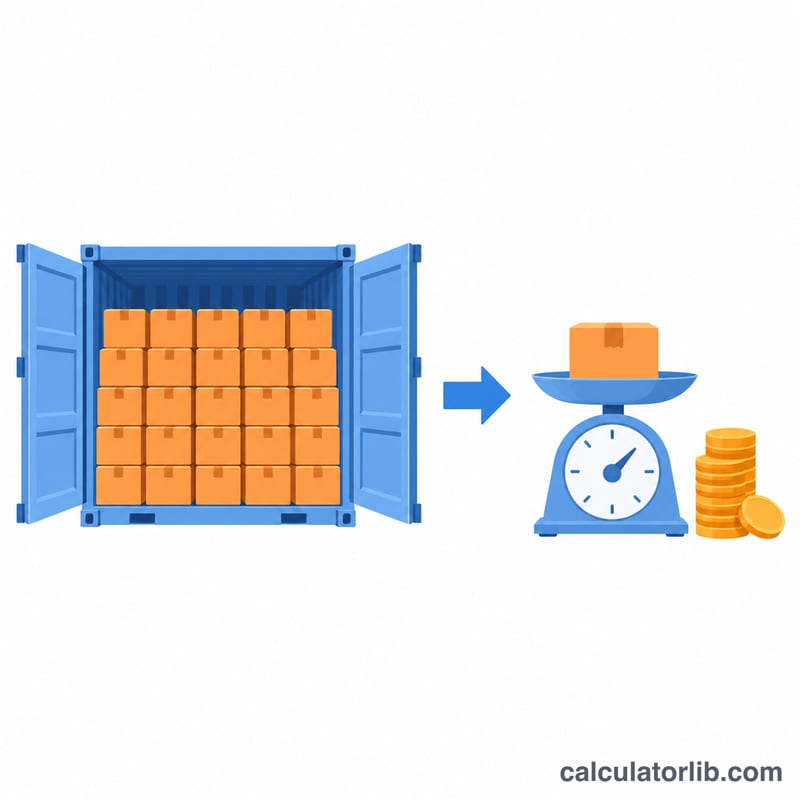
Each entry notes whether the item normally sits inside the dutiable value (the base that duty is charged on) or in the other fees bucket, so you can map it straight onto a calculator field. Treatment is set by the importing country's valuation rules, so verify against the specific regime you are importing into.
| Term | Definition | Where it goes |
|---|---|---|
| Landed cost | The total cost of getting goods from the supplier to your own premises, including goods value, transport, insurance, duty, taxes and handling fees. | The output, not an input |
| Goods / invoice value (C) | The price actually paid or payable to the supplier for the merchandise, before transport. In this tool it is entered as unit cost × quantity. | Inside dutiable value → product_cost, quantity |
| International freight (F) | The charge for moving the cargo from the country of export to the country of import (ocean, air, rail or road main leg). | Inside dutiable value under CIF valuation → shipping |
| Cargo insurance (I) | Premium for insuring the shipment against loss or damage in transit, usually quoted as a small percentage of goods value plus freight. | Inside dutiable value under CIF valuation → insurance |
| CIF value | Cost, Insurance and Freight: \(C + F + I\). Many countries use this as the customs value for ad valorem duty. | The dutiable base itself |
| FOB value | Free On Board: goods value plus origin costs up to loading on the vessel, excluding main freight and insurance. Some countries assess duty on an FOB basis instead of CIF. | A narrower dutiable base in FOB-valuation countries |
| Customs / dutiable value | The declared value on which duty is calculated, determined by the importing country's valuation rules — typically CIF or FOB, and generally excluding post-importation charges. | Excludes other_fees |
| Duty rate (d) | The tariff percentage applied to the customs value, set by the importing country's tariff schedule for the product's classification and sometimes by its country of origin. | duty_rate |
| Ad valorem duty | Duty charged as a percentage of value (as opposed to a specific duty charged per unit of weight, volume or piece). This calculator models ad valorem duty. | duty_rate; specific duties go in other_fees |
| Import VAT / import sales tax (t) | Consumption tax charged at importation, normally assessed on the customs value plus duty, which is why the formula multiplies after duty. | tax_rate |
| Reverse charge / deferred VAT accounting | Mechanisms in some VAT regimes that let a registered importer account for import VAT on its return instead of paying it at the border, removing the cash outlay. | Set tax_rate to 0 for a cost basis |
| HS code / tariff classification | The Harmonized System commodity code (6 digits internationally, extended nationally) that identifies the product and therefore determines its duty rate. | Determines duty_rate; not a cost |
| Customs broker / brokerage fee | A licensed agent who files the import declaration on your behalf; the brokerage fee is their service charge, typically a flat amount per entry. | Other fees → other_fees |
| Terminal handling charge (THC) | The terminal's fee for lifting and moving containers between vessel and yard, billed at origin, destination or both. | Destination THC → other_fees; origin THC may already be in a FOB/CIF price |
| Port / wharfage fee | A port authority charge for use of the quay and port facilities, usually per container or per tonne. | Other fees → other_fees |
| Demurrage and detention | Penalty charges for delay: demurrage for leaving a container inside the terminal beyond the free days, detention for keeping it outside the terminal too long before returning it. | Other fees (avoidable) → other_fees |
| Other fees (O) | The catch-all for charges that are real costs but outside the duty base: brokerage, THC, port fees, customs bonds, inland delivery, bank and document fees, demurrage. | other_fees, added after duty and tax |
| Incoterms | Standard trade terms (published by the International Chamber of Commerce) that allocate transport cost, risk and clearance duties between seller and buyer: EXW (buyer takes everything from the seller's door), FOB (seller to vessel loading), CIF (seller pays freight and insurance to destination port), DAP (seller delivers to the named place, duty unpaid), DDP (seller also pays duty and import taxes). | Decides which fields you fill vs. leave at 0 |
| De minimis threshold | A value limit below which a country waives duty and sometimes import tax on a shipment. Thresholds, and whether they still apply, differ sharply by country and change over time, so check current rules for your destination. | If it applies, set duty_rate (and possibly tax_rate) to 0 |
| Per-unit landed cost | Total landed cost divided by the number of saleable units — the cost basis for margin and markup arithmetic and for inventory valuation. | The main output → divided by quantity |
FAQ
Is import VAT really a cost? If you are VAT-registered you can usually reclaim it, so for margin work set the tax rate to zero and treat it as cash flow only. If you cannot reclaim it, leave it in.
Why is duty charged on freight? Most customs regimes value goods on a CIF basis, so transport and insurance to the border form part of the dutiable value. Countries using FOB valuation charge duty on the goods alone, so enter freight and insurance but expect a slightly lower duty figure there.
What else belongs in other fees? Customs broker charges, port and terminal handling, container unloading, inland delivery, bank transfer fees and any inspection or certification costs.