What is the Weld Cost Calculator?
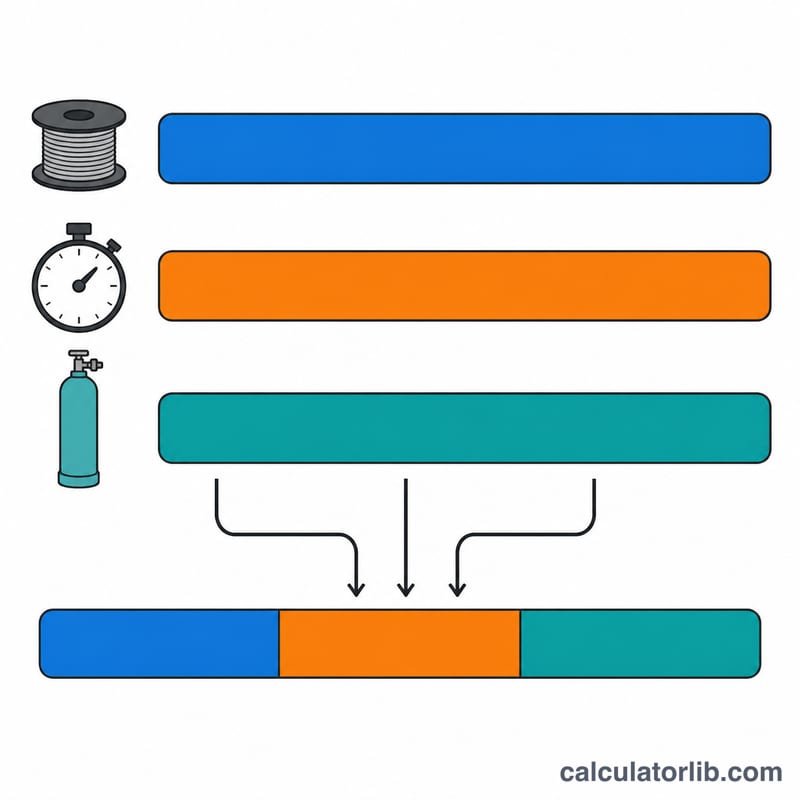
The Weld Cost Calculator estimates the total cost of a welding job by combining three real-world drivers of expense: the filler metal (electrode or wire) consumed, the labor time required, and the shielding gas or other consumables used. Whether you are quoting a fabrication contract, budgeting a repair, or comparing welding processes, breaking the job into these components gives a clear, defensible price.
The formula explained
The total cost is the sum of three products:
$$C_{total} = (W_f \times P_f) + (H \times R) + (V_g \times P_g)$$where \(W_f\) = filler metal weight in kg, \(P_f\) = filler price per kg, \(H\) = labor time in hours, \(R\) = labor rate per hour, \(V_g\) = gas or consumable volume, and \(P_g\) = price per unit of that consumable. Each product is a component cost: material \(C_{mat} = W_f \times P_f\), labor \(C_{lab} = H \times R\), and gas \(C_{gas} = V_g \times P_g\).
How to use it
Enter the estimated filler metal weight and its price, the hands-on labor hours and your shop labor rate, then the volume of shielding gas or consumables and their unit price. The calculator returns the total and a line-by-line breakdown so you can see which component dominates the cost.
Worked example
Suppose a job uses 5 kg of filler at $8/kg, takes 3 hours at a $45/hour rate, and consumes 10 units of gas at $2.50/unit:
$$C_{mat} = 5 \times \$8 = \$40$$$$C_{lab} = 3 \times \$45 = \$135$$$$C_{gas} = 10 \times \$2.50 = \$25$$$$C_{total} = \$40 + \$135 + \$25 = \$200$$The job costs $200, with labor being the largest share.
Welding Reference Data: Deposition Efficiency & Consumption Factors
Use these typical figures to estimate deposited weld metal, convert it into purchased filler (\(W_f\)) after losses, and gauge shielding-gas volume (\(V_g\)). The ranges below are general industry values for carbon and low-alloy steel; always defer to your welding procedure specification (WPS), the consumable manufacturer's data sheet, or the governing code (for example AWS D1.1 in the United States) for a specific job.
Deposition efficiency by process
Deposition efficiency is the mass of metal actually deposited divided by the mass of filler consumed. To size purchased filler, divide the deposited weld metal by this efficiency: \(W_f = \dfrac{\text{deposited metal}}{\text{efficiency}}\).
| Process | Typical deposition efficiency | Main losses |
|---|---|---|
| SMAW (stick) | ~60–65% | Electrode stub, slag, spatter |
| GMAW (solid wire, MIG) | ~90–95% | Spatter (lower in short-circuit, higher in spray) |
| FCAW (flux-cored) | ~80–85% | Slag/spatter; self-shielded is often a few points lower |
| GTAW (TIG) | ~95–100% | Minor rod stub loss, negligible spatter |
Typical shielding-gas flow rates
Multiply the flow rate by arc-on time to get gas volume for the calculator: \(V_g = \text{flow rate} \times \text{arc-on time}\). Larger nozzles, higher currents, and drafty conditions push flow toward the upper end.
| Process | Flow rate (CFH) | Flow rate (L/min) |
|---|---|---|
| GTAW (TIG) | 15–25 | 7–12 |
| GMAW short-circuit | 25–35 | 12–16 |
| GMAW spray transfer | 35–50 | 16–24 |
| FCAW (gas-shielded) | 35–45 | 16–21 |
Approximate filler metal per length (equal-leg fillet weld)
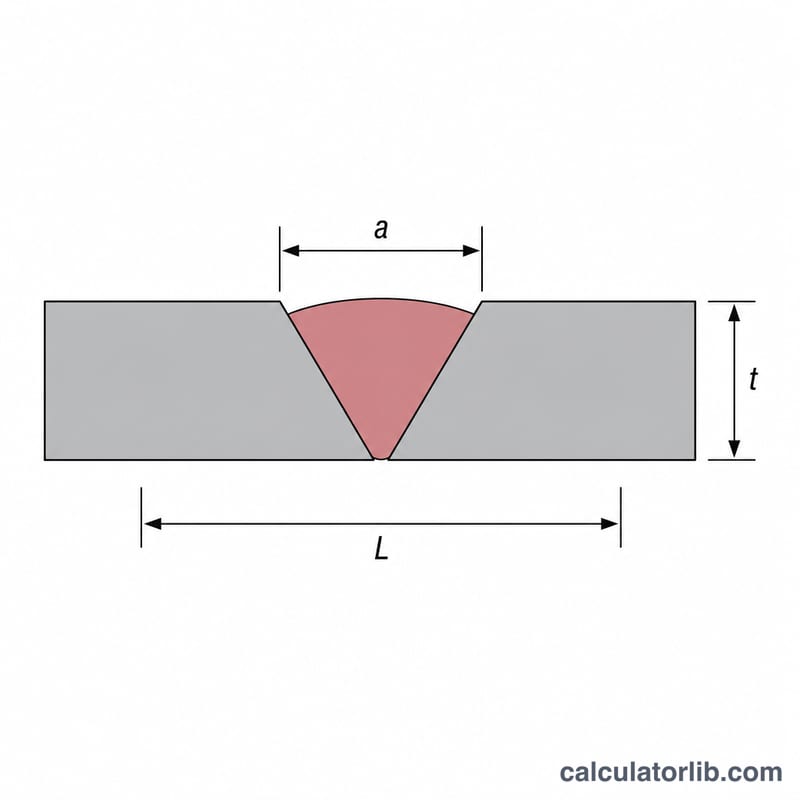
The theoretical deposited weld metal for a triangular equal-leg fillet of leg \(a\) is its cross-sectional area times length times material density. For carbon steel (density \(\rho \approx 7.85\) g/cm³), with leg \(a\) in centimetres, the deposit per unit length is:
$$\frac{a^2}{2}\times \rho$$For a 6 mm (0.6 cm) leg: \(\dfrac{(0.6)^2}{2}\times 7.85 = 0.18 \times 7.85 \approx 1.41\) g/cm, i.e. about 0.141 kg/m. The table lists common leg sizes (theoretical deposit only — it excludes weld reinforcement/convexity and deposition losses, so add for both):
| Fillet leg | Deposited metal (kg/m) | Deposited metal (lb/ft) |
|---|---|---|
| 3 mm | ~0.035 | ~0.024 |
| 5 mm | ~0.098 | ~0.066 |
| 6 mm | ~0.141 | ~0.095 |
| 8 mm | ~0.251 | ~0.169 |
| 10 mm | ~0.393 | ~0.264 |
These figures assume steel; scale by density for other metals (austenitic stainless steel ≈ 8.0 g/cm³, aluminum ≈ 2.7 g/cm³). To get filler to purchase, multiply the deposited weight by weld length, add reinforcement, and divide by the process deposition efficiency above.
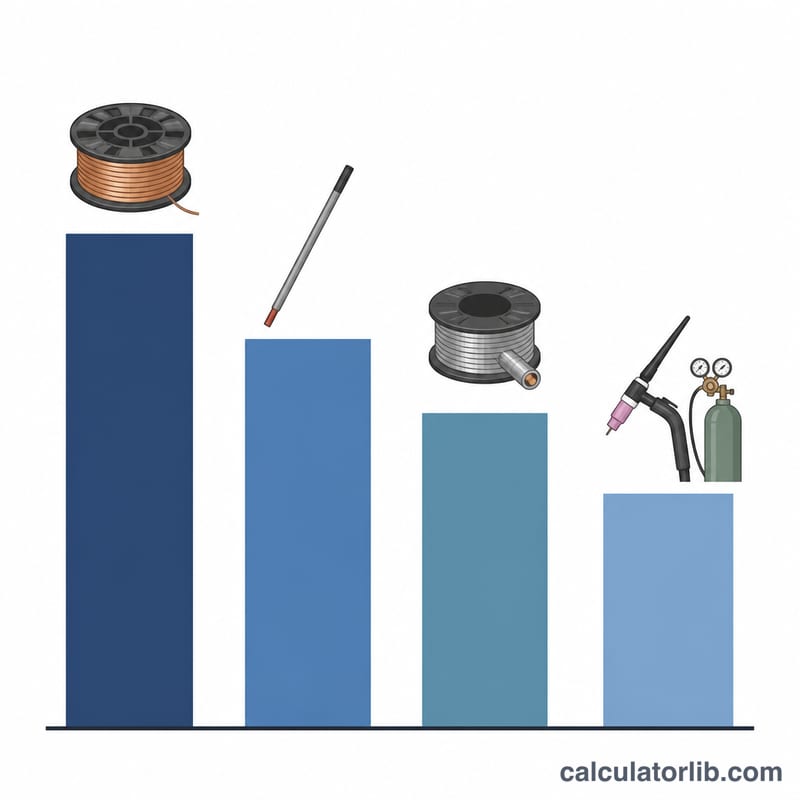
Practical Estimating Recommendations
The calculator returns a net weld cost — filler, labor, and gas only. Turning that into a reliable estimate and a quote takes a few extra steps.
- Pad filler for real-world losses. The formula uses the filler you actually buy, not the metal that ends up in the joint. Convert deposited weld metal to purchased filler by dividing by the deposition efficiency, or simply add ~10–20% to cover stub loss, spatter, and reel/rod waste before entering \(W_f\).
- Buy gas in realistic increments. Shielding gas is sold by the cylinder, so round \(V_g\) up to whole-cylinder or supplier purchase increments, and include pre-flow, post-flow, and any line/purge gas — these add up over many short welds.
- Layer overhead and margin on top of \(C_{total}\). A sellable quote is the net cost plus shop overhead (rent, power, consumables like tips, nozzles and grinding discs), machine/equipment cost or depreciation, and your profit margin. For example, with \(W_f = 1.6\) kg at $5/kg, \(H = 1.5\) h at $40/h, and \(V_g = 30\) ft³ at $0.50/ft³:$$\text{Total} = (1.6 \times 5) + (1.5 \times 40) + (30 \times 0.50) = 8 + 60 + 15 = \$83$$giving a net weld cost of $83. Applying, say, 30% overhead/equipment and a 15% margin (83 × 1.30 × 1.15) lifts the quoted price to roughly $124.
- Compare processes based on what dominates the breakdown. If filler and gas dominate, a higher-efficiency, lower-gas process (GMAW or GTAW) can cut material cost; if labor (arc-on time) dominates, a higher-deposition-rate process such as FCAW or spray GMAW reduces hours. Re-run the calculator per process to see which lowers the total.
This is general cost-estimating information, not professional financial advice. Confirm current filler, gas, and labor rates with your suppliers and a qualified estimator, and validate parameters against your WPS before committing to a price.
FAQ
Does this include overhead and profit? No. It estimates direct job cost. Add your markup, machine, and overhead rates on top of the total.
What units should I use for gas? Any consistent pair works — cubic feet, cubic meters, or hours — as long as the price matches the same unit.
Can I use it for wire-fed processes? Yes. Enter the wire spool weight consumed as the filler weight and its price per kg.