What a Hop Stand IBU Calculator Does
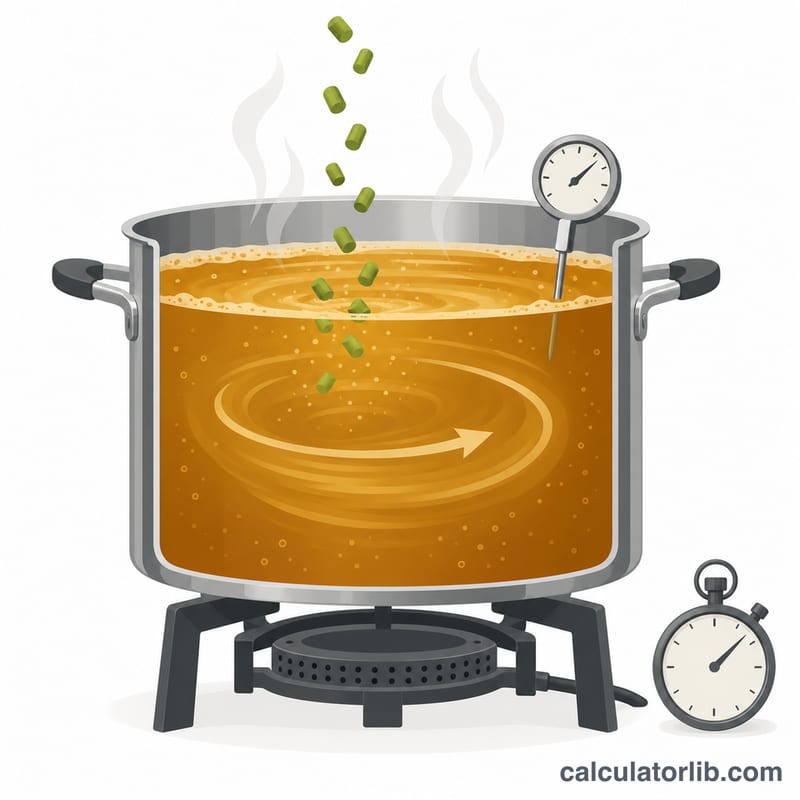
A hop stand, also called a whirlpool addition, is hop matter steeped in hot wort after the boil has been shut off. Because alpha acids keep isomerising below boiling point, just far more slowly, a hop stand contributes real and measurable bitterness that many recipe sheets simply ignore. This tool estimates that contribution in IBU from the hop weight, alpha acid percentage, post-boil volume, steep time, steep temperature and wort gravity. It applies to any brewery anywhere, since it describes hop chemistry rather than a local rule.
How to Use It
Choose your unit system, then enter the hop weight and the alpha acid figure printed on the hop package. Post-boil volume is the amount of wort the hops are actually sitting in. For temperature, use the wort temperature at the start of the stand: a chilled whirlpool at 80 °C behaves very differently from a flameout addition at 96 °C. Steep time is the number of minutes before the wort is chilled through or run off to the fermenter.
The Formula Explained
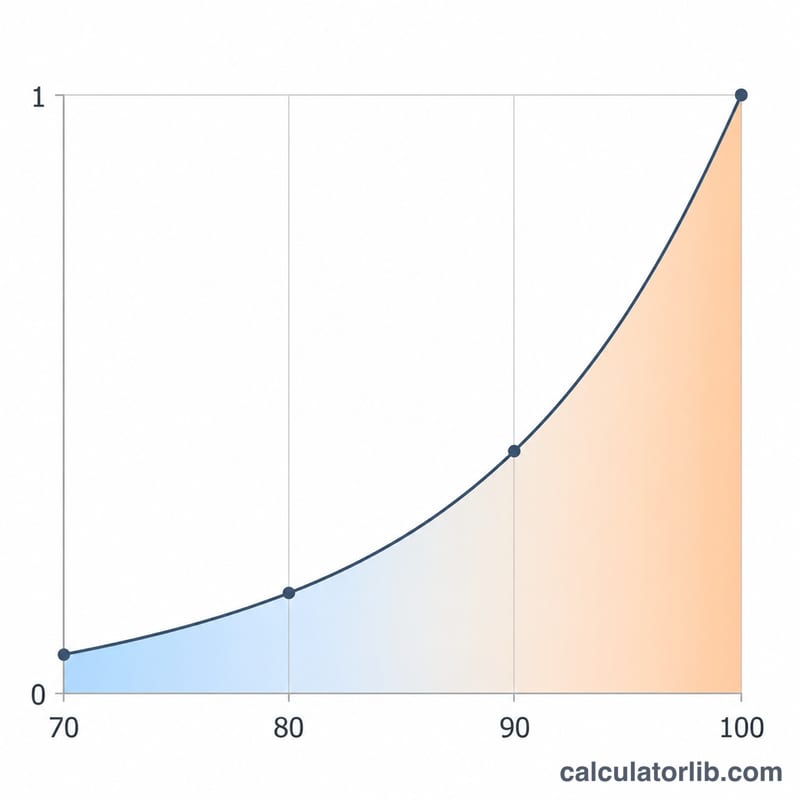
The model is Tinseth utilisation with the boil rate constant scaled by an Arrhenius temperature factor taken from hop isomerisation kinetics:
$$\text{IBU} = 1.65 \times 0.000125^{(G-1)} \times \frac{1 - e^{-0.04 f_T t}}{4.15} \times \frac{A \times m \times 1000}{V}$$$$f_T = e^{11858 \left( \frac{1}{373.15} - \frac{1}{T_K} \right)}$$Here \(G\) = wort specific gravity, \(t\) = steep minutes, \(A\) = alpha acid as a decimal, \(m\) = hop mass in grams, \(V\) = volume in litres and \(T_K\) = stand temperature in kelvin. At 100 °C the factor \(f_T = 1\) and the equation collapses to standard Tinseth for a boil addition.
Worked Example
50 g of 10% alpha hops in 20 L at 80 °C for 30 minutes at gravity 1.060:
$$f_T = e^{11858 \left( \frac{1}{373.15} - \frac{1}{353.15} \right)} = 0.1653$$$$U = 1.65 \times 0.000125^{0.06} \times \frac{1 - e^{-0.04 \times 0.1653 \times 30}}{4.15} = 0.0417$$$$\text{IBU} = 0.0417 \times \frac{0.10 \times 50 \times 1000}{20} = 10.4$$Interpreting Your Hop Stand IBU
One IBU is defined as 1 mg/L of isomerised alpha acid (iso-alpha-acid) equivalent in the finished beer. The number this calculator returns is therefore an estimate of how many mg/L of bittering substance your whirlpool charge contributes — and it is only the whirlpool's share. To get a whole-beer figure you add the IBU from your first-wort, boil and flameout additions.
Reading the magnitude
- Under about 5 IBU: a rounding-level contribution. It will not meaningfully change perceived balance; the addition is doing aroma work, which is usually the point of a cool stand.
- About 5–10 IBU: detectable as a slight firming of the finish, especially in a low-gravity or lightly bittered beer.
- About 10–25 IBU: a material shift in perceived balance. At this level the whirlpool is a genuine bittering addition and you should reduce your boil hops to compensate if you have a target in mind.
- Above about 25 IBU: the stand is carrying most of the beer's bitterness. This is common in heavily whirlpooled IPAs but is also where the model's error is largest.
Worked example
100 g of 12% alpha-acid hops, stood 20 minutes at 80 °C in 20 L of 1.050 wort:
$$f_T = e^{11858\left(\frac{1}{373.15}-\frac{1}{353.15}\right)} = e^{-1.800} = 0.165$$Utilisation:
$$U = \frac{1.65 \cdot 0.000125^{\,0.050}\left(1-e^{-0.04\,(0.165)(20)}\right)}{4.15} = \frac{1.65 \cdot 0.638 \cdot 0.1239}{4.15} = 0.0314$$Bitterness:
$$\text{IBU} = 0.0314 \times \frac{10 \cdot 12 \cdot 100}{20} = 0.0314 \times 600 \approx 18.9$$So this addition contributes roughly 18.9 IBU — firmly in the band where it reshapes the beer's balance rather than merely garnishing it. The same hops held at 65 °C instead would contribute only a few IBU.
Why the number is an estimate, not a measurement
- Tinseth is a utilisation model. It was fitted to typical boil additions and then extended to hop stands by temperature correction. It is a planning tool for comparing recipes, not an analytical result.
- It tends to overpredict at high hop loads. Large charges saturate the wort, a substantial fraction of the alpha acid is lost with the hop material and trub rather than isomerising, and isomerisation itself becomes incomplete. A whirlpool at 8–10 g/L will often measure well below its calculated IBU.
- Lab IBU measures something slightly different. The standard spectrophotometric method reads absorbance at 275 nm of an acidified iso-octane extract, which also picks up non-isomerised hop compounds — un-isomerised alpha and beta acids, oxidised resins and polyphenols. Heavily late-hopped beers can therefore return a lab IBU noticeably higher than they taste, and lab value, calculated value and perceived bitterness can all diverge.
- Harshness is not in the number. Heavy late and whirlpool hopping extracts polyphenols and can produce an astringent, grassy or drying harshness that no IBU figure captures. A beer at 30 calculated IBU from a 10 g/L whirlpool can taste rougher than one at 45 IBU from a clean 60-minute addition.
Practical takeaway: use the figure for relative decisions — comparing two recipes, deciding how much boil hopping to drop when you add a whirlpool, or checking that a cool stand really is as low-impact as you assumed. Treat it as having an uncertainty of tens of percent, and calibrate against your own brewhouse by tasting the same recipe across a couple of batches rather than trusting the second decimal place.
FAQ
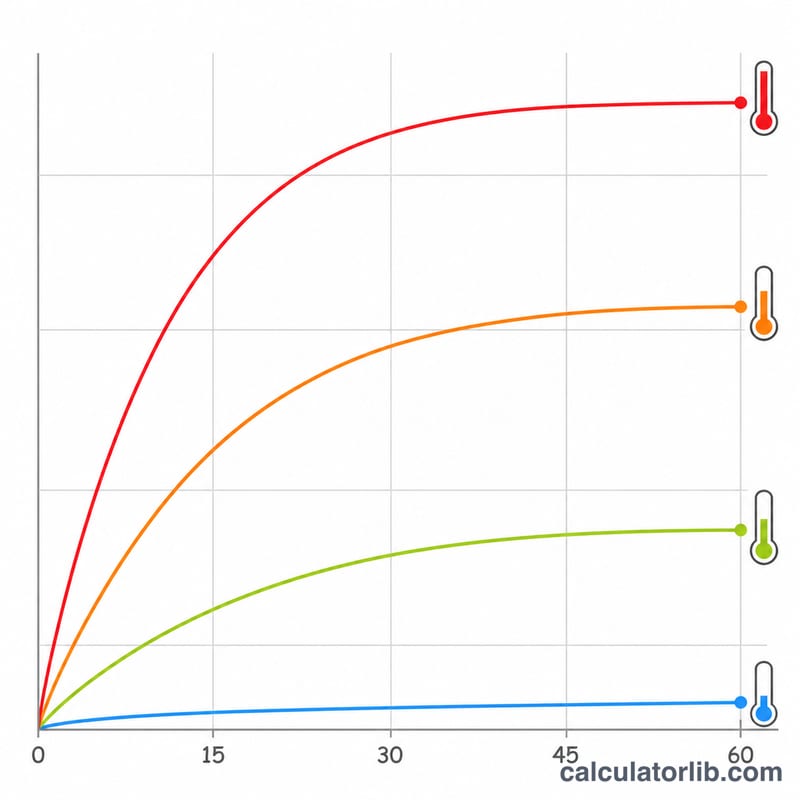
Does a stand at 70 °C add any bitterness at all? A little. The temperature factor drops to roughly 7% of the boiling rate, so a 30-minute stand behaves like about two minutes of boiling.
Should I add this to my boil IBU? Yes. Bitterness contributions are additive, so sum the hop stand figure with every boil addition for the total.
Why is my measured IBU lower than predicted? Utilisation models assume complete extraction with no losses. Large whirlpool charges, trub and hop absorption, dry hopping and yeast stripping during fermentation commonly cut the result by 10 to 30 percent.