What this calculator does
This tool applies the United States AISC 360 Specification (Chapter J, weld shear rupture) and reports results in US customary units: inches, ksi and kips. It converts a fillet weld geometry (leg size and effective length) plus an electrode classification into the shear load the weld can carry, in both LRFD and ASD format, and compares that capacity with an applied load. Assumptions: equal-leg fillet weld, matching filler metal, load through the weld group centroid, and no reduction for long welds, fatigue or eccentricity.
How to use it
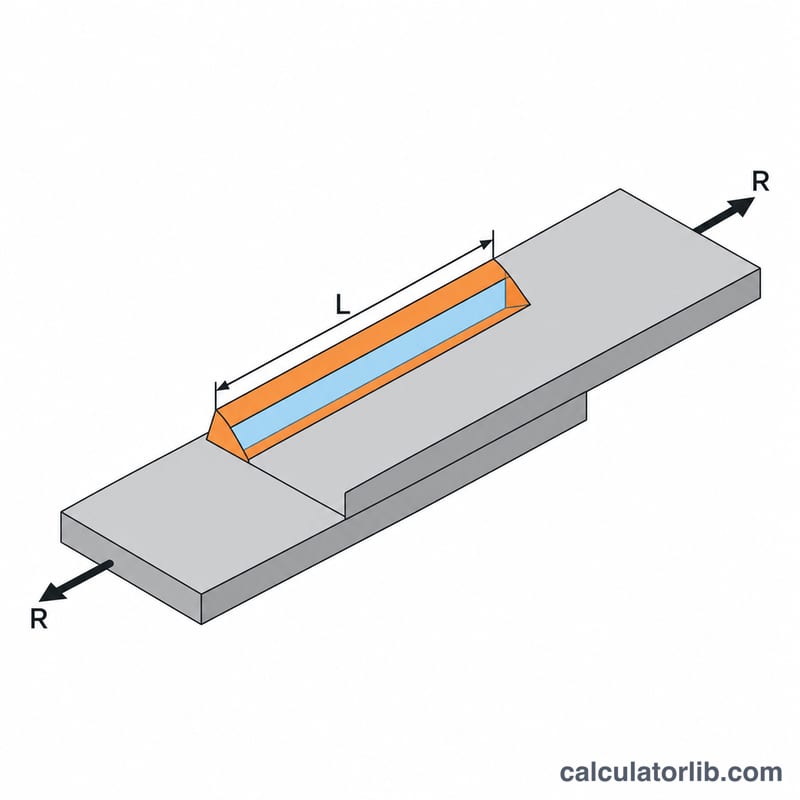
Enter the weld leg size \(w\) in inches (for example 0.25 for a 1/4 in fillet), the total effective length \(L\) in inches, pick the electrode (E70XX gives \(F_{EXX}=70\) ksi), choose LRFD or ASD, and optionally enter the applied load in kips to see the utilization ratio.
The formula explained
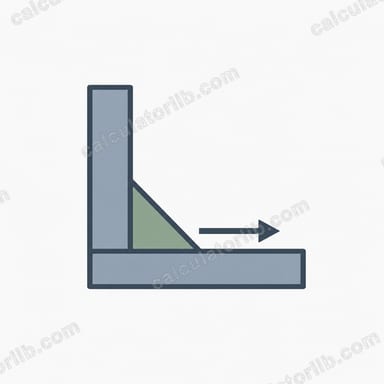
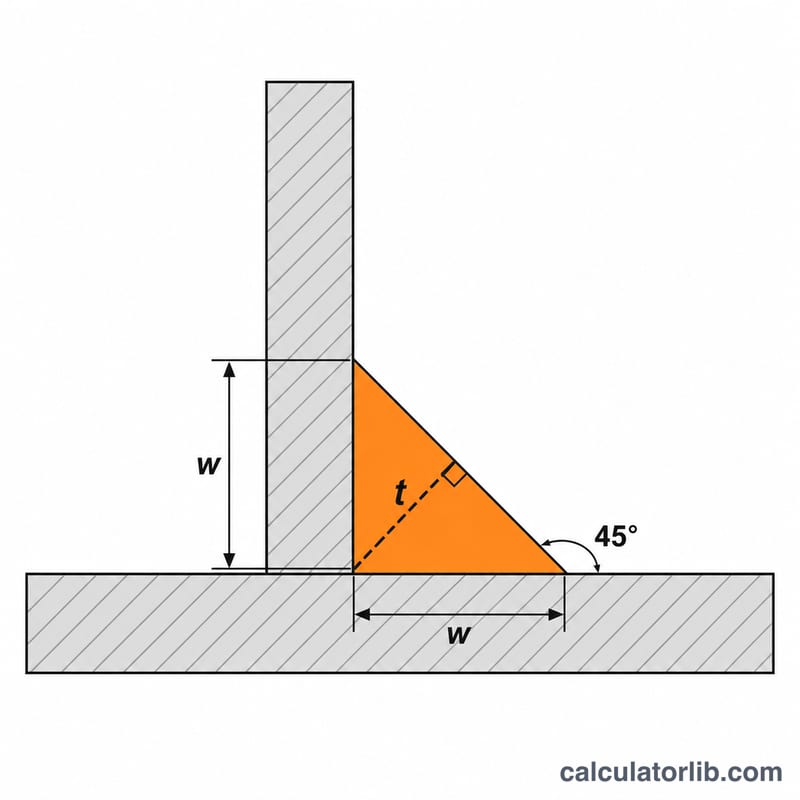
A fillet weld fails by shear across its throat, which for an equal-leg weld is \(0.707w\). The nominal strength is therefore
$$R_n = 0.60\,F_{EXX} \times 0.707\,w\,L$$where \(0.60F_{EXX}\) is the shear strength of the deposited filler metal. Design strength is \(\phi R_n\) with \(\phi = 0.75\) (LRFD), or \(R_n/\Omega\) with \(\Omega = 2.00\) (ASD).
Worked example
A 1/4 in fillet, 10 in long, welded with E70XX electrodes and checked by LRFD:
$$R_n = 0.60 \times 70 \times 0.707 \times 0.25 \times 10 = 74.24\ \text{kips}$$$$\phi R_n = 0.75 \times 74.24 = 55.68\ \text{kips}$$That is \(5.57\) kips per inch of weld, so a 20 kip factored load gives a utilization of \(20/55.68 = 35.9\%\) and the joint is comfortably adequate.
Electrode Strengths and Weld Capacity per Inch
Fillet weld strength in the US AISC 360 Specification (Chapter J2.4, with electrode classifications in Table J2.5) is governed by the shear rupture strength of the weld metal, taken as \(F_{nw} = 0.60\,F_{EXX}\) acting on the effective throat area. For an equal-leg fillet the effective throat is \(0.707w\), so the nominal capacity is:
$$R_n = 0.60\,F_{EXX} \cdot 0.707\,w\,L$$The electrode classification number is simply the minimum tensile strength of the deposited filler metal in ksi, which sets \(F_{EXX}\).
Table 1 — Electrode classification vs. \(F_{EXX}\) and weld-metal shear strength
| Electrode classification | \(F_{EXX}\) (ksi) | \(0.60F_{EXX}\) (ksi) |
|---|---|---|
| E60XX | 60 | 36.0 |
| E70XX | 70 | 42.0 |
| E80XX | 80 | 48.0 |
| E90XX | 90 | 54.0 |
| E100XX | 100 | 60.0 |
| E110XX | 110 | 66.0 |
E70XX is the everyday choice for ASTM A36 and A992 steel, so the per-inch table below is given for \(F_{EXX} = 70\) ksi. The LRFD column is \(\phi R_n / L = 0.75 \cdot 0.60F_{EXX} \cdot 0.707w\) with \(\phi = 0.75\); the ASD column is \(R_n / \Omega\) with \(\Omega = 2.00\).
Table 2 — E70XX design strength per inch of weld
| Leg size \(w\) | Decimal (in) | Effective throat \(0.707w\) (in) | LRFD \(\phi R_n/L\) (kip/in) | ASD \(R_n/\Omega L\) (kip/in) |
|---|---|---|---|---|
| 1/8 in | 0.125 | 0.0884 | 2.78 | 1.86 |
| 3/16 in | 0.1875 | 0.1326 | 4.18 | 2.78 |
| 1/4 in | 0.250 | 0.1768 | 5.57 | 3.71 |
| 5/16 in | 0.3125 | 0.2209 | 6.96 | 4.64 |
| 3/8 in | 0.375 | 0.2651 | 8.35 | 5.57 |
| 1/2 in | 0.500 | 0.3536 | 11.14 | 7.42 |
| 5/8 in | 0.625 | 0.4419 | 13.92 | 9.28 |
Sample substitution for the 1/4 in row, per inch of length:
$$\phi R_n = 0.75 \times 42.0\ \text{ksi} \times 0.707 \times 0.25\ \text{in} \times 1\ \text{in} = 5.57\ \text{kip}$$Scaling is linear in both \(w\) and \(L\): to get the capacity of any weld, multiply the per-inch value by the total effective weld length. For another electrode, scale by \(F_{EXX}/70\) — an E80XX weld of the same geometry is \(80/70 = 1.143\) times as strong.
Assumptions behind these numbers. They apply to equal-leg fillet welds made with matching filler metal, with the throat taken as \(0.707w\) (no deep-penetration credit). Longitudinal and transverse loading are both evaluated at \(0.60F_{EXX}\), which is the simple and always-permitted approach of AISC 360 Section J2.4(a); the optional directional-strength method of J2.4(b) can give a higher capacity for transversely loaded welds and weld groups and is not applied here. These values are from the US AISC 360 Specification and do not apply to welds designed to Eurocode EN 1993-1-8, CSA S16, AS/NZS 1554 or other national standards, which use different throat conventions and resistance factors.
FAQ
Do I still need to check the base metal? Yes. The connected plate can shear or tear before the weld does, so check base-metal shear rupture and block shear separately.
What length do I enter for a weld on both sides? Add the lengths: two 6 in welds equal 12 in of effective length.
Why 0.707? It is \(\sin 45^{\circ}\), the ratio of throat to leg for a 45-degree equal-leg fillet.