What this calculator does
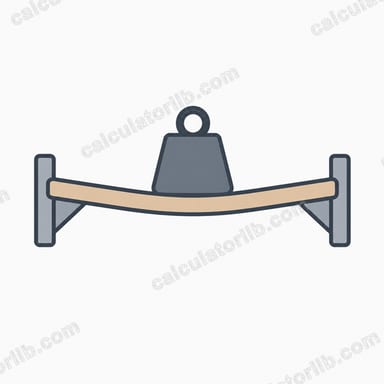
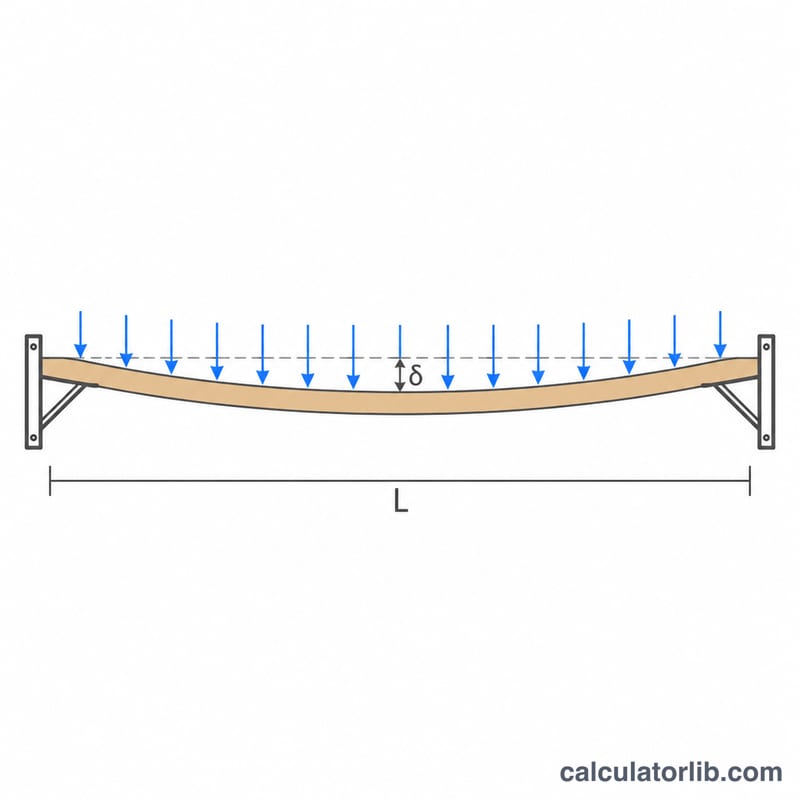
A shelf is a beam. Load it and it bends, and once the mid-span dip passes roughly one part in 180 of the span the eye starts to read it as a sagging shelf. This tool estimates that dip in millimetres from four things you can measure: the clear span between supports, the shelf depth, the shelf thickness, and the total weight you intend to put on it. Pick the material and the calculator supplies a typical modulus of elasticity, or enter your own.
How to use it
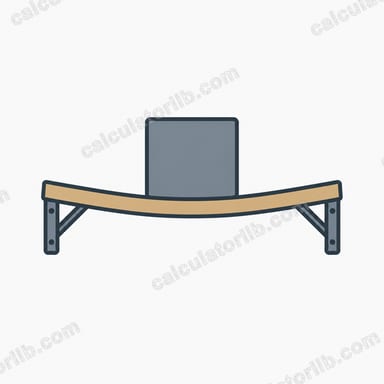
Measure the clear span between supports, not the full board length. Enter depth and thickness in millimetres, then the total load in kilograms. Choose evenly spread for books, files or crockery, or concentrated at mid-span for the worst case of one heavy object in the middle. Compare the result with the allowable figure: sag under half of it looks dead flat, while anything over it needs a shorter span, a thicker board, or a stiffening lip glued to the front edge.
The formula explained
For a simply supported board under an evenly spread load:
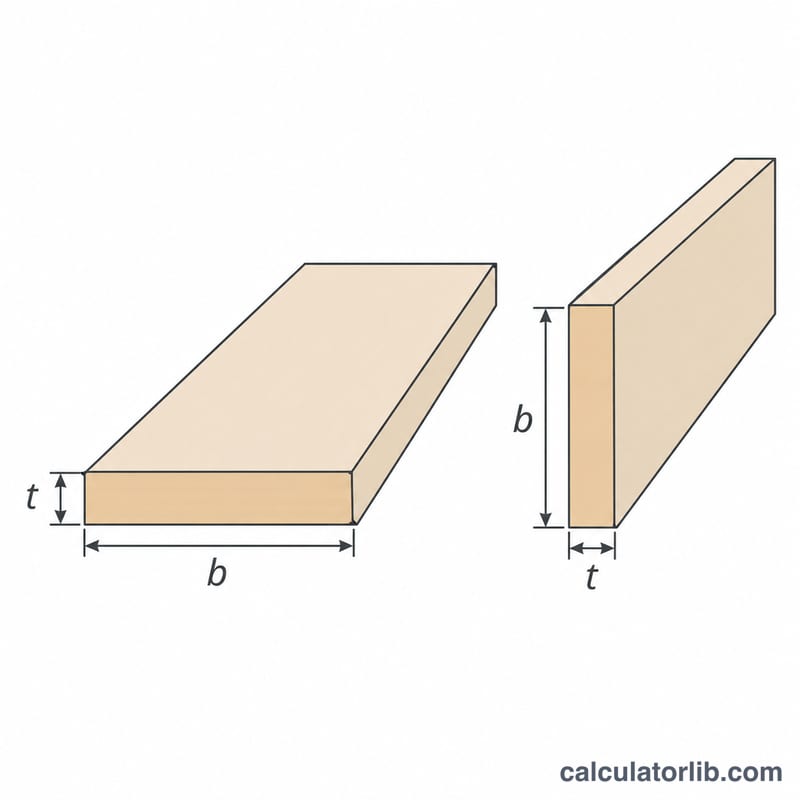
$$\delta = \frac{5 W L^{3}}{384 E I}, \qquad I = \frac{b t^{3}}{12}$$Here \(\delta\) = sag in mm, \(W\) = total load as a force in newtons (kilograms × 9.80665), \(L\) = span in mm, \(E\) = modulus of elasticity in MPa, \(b\) = shelf depth in mm and \(t\) = thickness in mm. For a single mid-span point load the factor \(\tfrac{5}{384}\) becomes \(\tfrac{1}{48}\). Span is cubed, so a 20 percent longer shelf sags about 73 percent more.
Worked example
An 18 mm particleboard shelf, 300 mm deep, spanning 900 mm, holding 20 kg of books:
$$I = \frac{300 \times 18^{3}}{12} = 145{,}800\ \text{mm}^4$$$$W = 20 \times 9.80665 = 196.13\ \text{N}$$$$\delta = \frac{5 \times 196.13 \times 900^{3}}{384 \times 2400 \times 145{,}800} = 5.32\ \text{mm}$$The allowable sag is \(900/180 = 5\) mm, so this shelf is just over the limit and will bow visibly.
Modulus of Elasticity for Common Shelf Materials
Shelf sag is inversely proportional to the product \(E I\), so the stiffness modulus \(E\) of the board material matters as much as its thickness. The values below are indicative design values for estimating deflection, drawn from the typical ranges quoted for ordinary shelving materials. They are not grade-certified figures: a specific particleboard, plywood or timber batch can fall well outside its range, and any load-bearing design should use the modulus declared by the manufacturer or determined by the relevant panel-testing standard (in Europe, bending modulus to EN 310, with product requirements in EN 312 for particleboard and EN 622 for fibreboard; in the United States, ANSI A208.1 for particleboard and MDF).
| Material | Typical \(E\) (MPa = N/mm²) | Sustained-load creep multiplier (indicative) | Notes |
|---|---|---|---|
| Particleboard / chipboard | 2,000–2,900 (use ≈2,400) | 1.5–2.0 | The most common and the most sag-prone shelf board; creeps noticeably under permanent load. |
| Melamine-faced chipboard (MFC) | 2,400–3,000 | 1.5–2.0 | The thin melamine facing adds negligible stiffness; treat it as chipboard of the same thickness. |
| MDF | 3,000–3,600 | 1.5–2.0 | Stiffer and far more uniform than chipboard, but still a creep-sensitive panel. |
| Plywood (softwood or birch), span parallel to face grain | 7,000–10,000 | 1.2–1.6 | Highest stiffness when the span runs along the face grain — orient shelves this way. |
| Plywood, span across the face grain | roughly 40–60% of the along-grain value | 1.2–1.6 | Only the plies running along the span contribute much; 3-ply boards are the most directional. |
| Softwood (pine, spruce), along grain | 8,000–10,000 | 1.0–1.2 | Solid timber is three to four times stiffer than chipboard of the same thickness. |
| Hardwood (oak, beech), along grain | 10,000–13,000 | 1.0–1.2 | Stiffness across the grain is a small fraction of this, so always span along the grain. |
| Solid-surface (acrylic/polyester resin) | ≈7,000–9,000 (check manufacturer data) | 1.5–2.0 | Thermoplastic-type materials sag under sustained load and warm conditions; follow the maker's support-spacing table. |
| Annealed float glass | ≈70,000 | ≈1.0 | Glass does not creep at room temperature. Toughening or laminating changes strength, not stiffness — \(E\) stays ≈70,000 MPa. |
| Aluminium alloy | ≈69,000 | ≈1.0 | About one-third the stiffness of steel; extruded shelf sections get their rigidity from shape, not modulus. |
| Steel | ≈200,000 | ≈1.0 | Stiffest common shelf material; sag in steel shelving usually comes from thin, open sections rather than low \(E\). |
The calculator returns the immediate elastic deflection. For a shelf that carries its load permanently — books, files, crockery — multiply that result by the creep multiplier in the table to approximate the sag after months or years. Wood-based panels are the critical case: the European timber code EN 1995-1-1 (Eurocode 5) handles this with a deformation factor \(k_{def}\), which is largest for particleboard and fibreboard and smallest for solid timber and plywood. Metals and glass can be treated as non-creeping at normal indoor temperatures.
Sag Across Common Shelf Scenarios
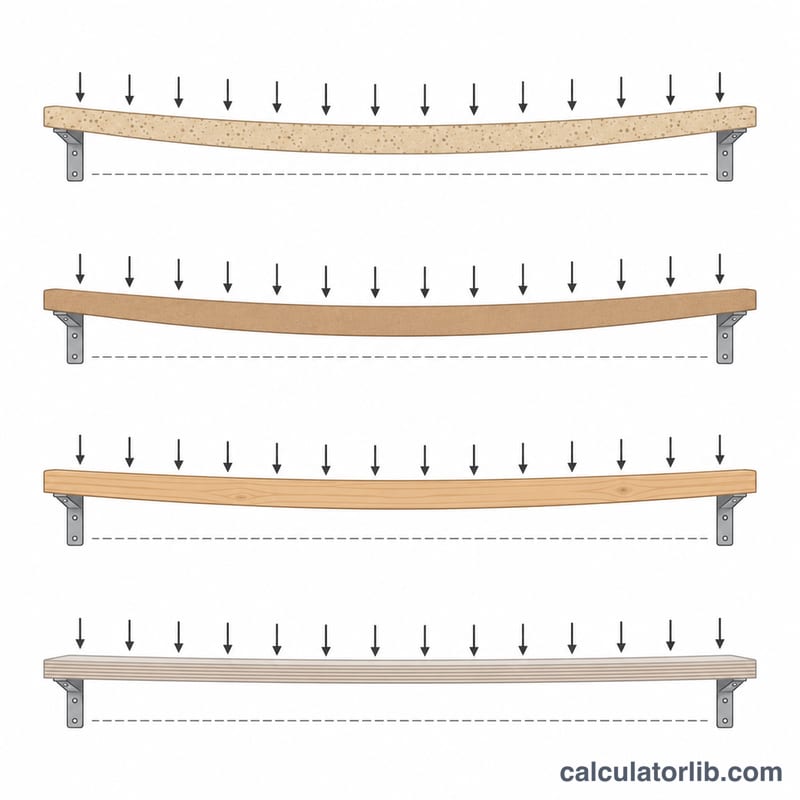
Every figure below is computed with the same equations the calculator uses, for a simply supported shelf: a uniformly distributed load gives \(\delta = \frac{5}{384}\cdot\frac{W L^{3}}{E I}\), a single mid-span point load gives \(\delta = \frac{W L^{3}}{48 E I}\), with \(I = \frac{b t^{3}}{12}\) and \(W = m \times 9.80665\) N. Depth is held at 300 mm and the load at 20 kg throughout, so only span, thickness and material change. The allowable column is the L/180 serviceability limit — a widely used joinery rule of thumb for shelves and cabinetry, not a legal building-code requirement (structural floor members in the US IBC, for example, are checked against tighter limits such as L/240 or L/360).
| # | Material (\(E\), MPa) | Span (mm) | Thickness (mm) | Load | Sag (mm) | L/180 allowable (mm) | Result |
|---|---|---|---|---|---|---|---|
| 1 | Particleboard (2,400) | 600 | 18 | 20 kg uniform | 1.58 | 3.33 | Pass |
| 2 | Particleboard (2,400) | 800 | 18 | 20 kg uniform | 3.74 | 4.44 | Pass (little margin) |
| 3 | Particleboard (2,400) | 900 | 18 | 20 kg uniform | 5.32 | 5.00 | Fail |
| 4 | Particleboard (2,400) | 1200 | 18 | 20 kg uniform | 12.61 | 6.67 | Fail badly |
| 5 | MDF (3,300) | 900 | 18 | 20 kg uniform | 3.87 | 5.00 | Pass |
| 6 | Plywood, along face grain (8,000) | 900 | 18 | 20 kg uniform | 1.60 | 5.00 | Pass |
| 7 | Pine (9,000) | 900 | 18 | 20 kg uniform | 1.42 | 5.00 | Pass |
| 8 | Pine (9,000) | 900 | 25 | 20 kg uniform | 0.53 | 5.00 | Pass |
| 9 | Particleboard (2,400) | 800 | 18 | 20 kg at mid-span | 5.98 | 4.44 | Fail |
Row 3 shown in full, so the arithmetic can be checked by hand:
Second moment of area: \(I = \dfrac{300 \times 18^{3}}{12} = \dfrac{300 \times 5832}{12} = 145{,}800\ \text{mm}^4\)
Load in newtons: \(W = 20 \times 9.80665 = 196.13\ \text{N}\)
$$\delta = \frac{5}{384}\cdot\frac{196.13 \times 900^{3}}{2400 \times 145{,}800} = \frac{5}{384}\cdot\frac{1.4298\times10^{11}}{3.4992\times10^{8}} = 0.013021 \times 408.6 = 5.32\ \text{mm}$$Three patterns fall out of the table. First, span dominates everything: because \(L^{3}\) is in the numerator, going from 600 mm to 1200 mm multiplies sag by eight (1.58 mm to 12.61 mm) while the L/180 allowance only doubles. Shortening a span is always the cheapest fix. Second, thickness is the next most powerful lever — \(t^{3}\) means 18 mm to 25 mm cuts sag to about 37% of its value (rows 7 and 8). Third, material choice is worth a factor of three to four at the same geometry: 3.87 mm in MDF versus 1.42 mm in pine over the identical 900 mm span. A concentrated mid-span load is exactly 1.6 times worse than the same mass spread evenly (compare rows 2 and 9), which is why a single heavy object in the middle of an otherwise acceptable shelf is what finally makes the dip visible.
These numbers are the instantaneous elastic sag only. Applying the creep multipliers from the previous table changes the verdicts for the panel materials: row 2 at 3.74 mm passes today, but at a creep factor of 1.8 it drifts toward roughly 6.7 mm over years of carrying books, which is well past the 4.44 mm limit. Solid timber, plywood and metal shelves barely move after loading, so their initial result is close to their final one.
FAQ
How much sag is acceptable? L/180 is the usual shelving rule of thumb; L/360 is a stricter target for display shelves and long runs.
Why does my chipboard shelf keep drooping? Particleboard and MDF creep under sustained load, so long-term sag can reach 1.5 to 2 times the elastic value here. Size such shelves with margin.
What is the cheapest fix? Add a support to halve the span, or glue a 40 to 50 mm batten along the front edge. Both beat simply swapping to a stiffer material.