What this calculator does
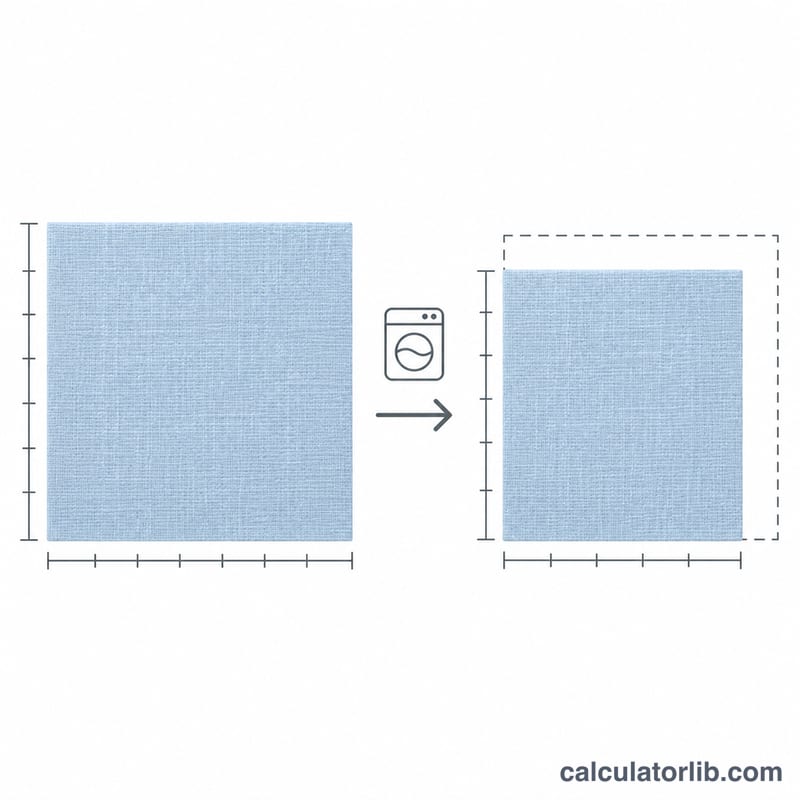
Almost every natural fibre fabric gets smaller the first time it is washed. Cotton, linen, rayon and wool all relax or felt in water, and a garment cut from unwashed cloth can come out a full size too small. This tool turns a simple swatch test into two numbers you can act on: the shrinkage percentage of the cloth, and the length you must buy so the finished piece still measures what you planned.
How to use it
Mark a known distance on the fabric before washing (a 100 cm or 36 inch span works well), wash and dry it exactly the way you will care for the finished item, then measure the same marks again. Enter both figures plus the finished size you need. Measure along one grain direction at a time: lengthwise shrinkage is usually larger than widthwise, so run the calculation twice if both matter.
The formula
With \(L_0\) = pre-wash measurement and \(L_1\) = post-wash measurement, shrinkage is the lost fraction of the original:
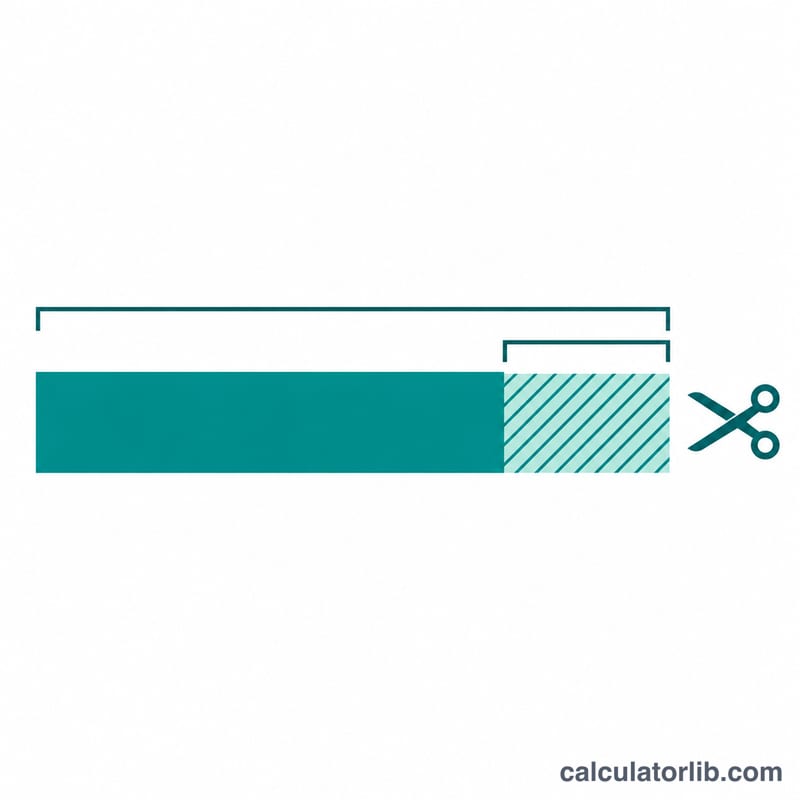
$$S = \frac{L_{0} - L_{1}}{L_{0}} \times 100\%$$To end up with a finished size \(L_f\) you cannot simply add \(S\) percent, because the shrinkage applies to the larger uncut length. You divide instead:
$$L_{buy} = \frac{L_{f}}{1 - \dfrac{S}{100}}$$Worked example
A 100 cm marked span measures 96 cm after one hot wash and tumble dry:
$$S = \frac{100 - 96}{100} \times 100\% = 4\%$$For a 200 cm finished curtain panel:
$$L_{buy} = \frac{200}{1 - 0.04} = 208.33\,\text{cm}$$So buy about 208.3 cm, which is 8.3 cm of extra fabric, not the 8 cm that adding 4% would suggest.
Typical Shrinkage Rates by Fabric Type
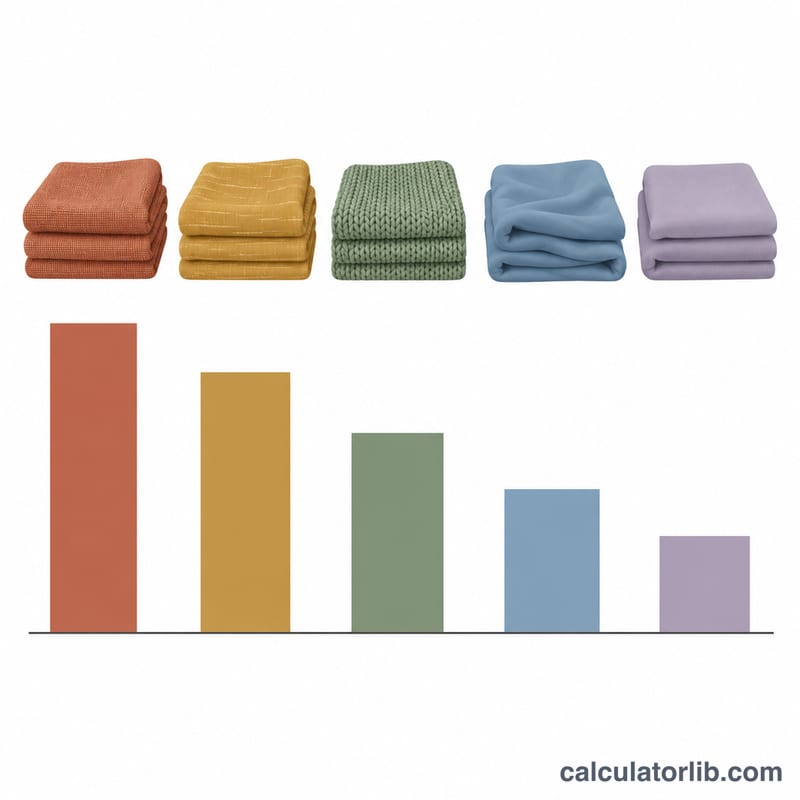
The figures below are indicative planning ranges, not specifications. Residual shrinkage depends on the individual mill, the yarn twist, the finish, how tightly the goods were stretched on the frame, and above all on how the piece is laundered. The only reliable number for the cloth in front of you is a swatch test: cut a generous sample, mark a square of known size on it with tailor's tacks or a washable marker, wash and dry it exactly the way the finished item will be treated, then measure again. A 50 cm marked line that comes back at 47.5 cm is 5% shrinkage along that direction.
Measure length (warp, or the wale direction in knits) and width (weft/course) separately — they almost always differ, and in wovens the lengthwise figure is usually the larger one because that is the direction the cloth was tensioned during finishing.
| Fabric | Lengthwise (warp/wale) | Widthwise (weft/course) | Care notes |
|---|---|---|---|
| Quilting cotton, woven, pre-shrunk | 1–3% | 1–2% | Low end on cold wash and line dry; expect the top of the range with a hot wash plus tumble dry. |
| Unwashed / loomstate (greige) cotton, no shrink finish | 4–10% | 2–6% | Most of it appears in the very first hot wash; always pre-wash before cutting. |
| Cotton flannel | 5–10% | 3–6% | Brushed, loosely spun yarns compact heavily; hot wash and tumble dry can reach or exceed the top figure. |
| Cotton jersey / interlock knit | 5–12% | 3–8% | Much of this is relaxation shrinkage from knitting tension. Tumble drying adds several points; lay flat to dry to stay low. |
| 100% linen, pre-washed / garment-washed | 1–3% | 1–3% | Fairly stable, but continues to creep slightly over the first few washes. |
| 100% linen, unwashed | 4–10% | 3–6% | Hot wash plus tumble dry gives the worst case; warm wash and line dry keeps it nearer 4–5%. |
| Rayon / viscose (incl. bamboo viscose) | 3–10% | 2–6% | Weak when wet and distortion-prone. Hot water and agitation can push past 10%; many bolts are labelled dry-clean for this reason. |
| Wool, woven (suiting, flannel, tweed) | 1–5% | 1–4% | These numbers assume cool hand wash or professional sponging/pressing. Agitation plus heat causes felting, not ordinary shrinkage. |
| Wool, knit (non-superwash) | 5–30%+ (felting) | 5–30%+ (felting) | Hot water plus agitation felts the fibre irreversibly and unpredictably — no range can be planned around it. Hand wash cool and dry flat, or choose superwash/machine-washable wool (then roughly 1–4%). |
| Polyester, 100% (heat-set) | 0–2% | 0–2% | Dimensionally very stable; avoid high dryer heat, which can shrink or glaze the fibre. |
| Poly-cotton blends (e.g. 65/35, 50/50) | 1–4% | 1–3% | Shrinkage comes almost entirely from the cotton portion, so the higher the cotton content, the higher the figure. |
| Silk, woven (habotai, charmeuse, crepe) | 2–6% (crepe to ~10%) | 1–4% | Crepe and heavily twisted yarns shrink most on washing. Dry cleaning keeps change minimal. |
| Denim, sanforized | 1–3% | 1–2% | Warm wash and line dry stays at the bottom of the range; repeated hot tumble drying reaches the top. |
| Denim, raw / unsanforized ("shrink-to-fit") | 5–10% | 3–6% | Designed to shrink on the first soak; a hot soak plus tumble dry gives the maximum, a cold soak noticeably less. |
Where a bolt is labelled pre-shrunk, mill-washed, compressive-shrunk or sanforized, the finish has already removed most of the latent shrinkage and residual change is typically capped around 1–3% (sanforizing — a proprietary compressive-shrinkage process — is usually quoted at the tighter end, about 1%). That is a cap on the first-wash figure, not a guarantee of zero: cumulative change over many hot washes can still exceed it, and the label tells you nothing about the other direction if only one was tested.
Laundering shrinkage is measured against published test methods rather than by eye. ISO 6330 (domestic washing and drying procedures) with ISO 5077 (determination of dimensional change) is the international pair; AATCC 135 is the equivalent US method published by the American Association of Textile Chemists and Colorists. Mill labelling conventions and the wash temperatures treated as "normal" differ by country, so a figure quoted on a bolt abroad may have been tested under a different cycle than the one you will actually use.
How Much Fabric to Actually Order
Once you know the shrinkage percentage \(s\) (as a decimal) and the length you need after washing, the purchase length is
$$L_{\text{buy}} = \frac{L_{\text{desired}} }{1 - s}$$Note that you divide — you do not simply add the percentage back. For a finished length of 250 cm from a cotton that measured 100 cm before washing and 94 cm after, giving 6% shrinkage:
$$L_{\text{buy}} = \frac{250\ \text{cm}}{1 - 0.06} = \frac{250}{0.94} = 265.96\ \text{cm}$$That 2.66 m is the floor, not the order. Build the real figure up from it:
- Round up to the increment the shop actually cuts. Metric shops generally cut in 10 cm steps (so 2.66 m becomes 2.70 m); shops working in yards commonly cut in quarter-yards, and some bolts and online sellers only cut whole metres or yards. Always round up — rounding down spends the entire shrinkage allowance before you start.
- Add a cutting-and-squaring allowance on top. Bolts are rarely cut square, selvedges can be distorted, and the cut ends fray and need trimming after pre-washing. Allow roughly 5–10 cm (2–4 in) at each end, more for loosely woven or badly off-grain goods. This is separate from the shrinkage allowance and should not be borrowed from it.
- Add a full pattern repeat for prints, plaids and stripes. Matching across seams needs up to one extra repeat per matched piece — and remember the repeat itself shrinks, so a 32 cm repeat on a fabric that shrinks 6% lengthwise becomes about 30 cm after washing. Measure the repeat after pre-washing before you cut, and never assume the pre-wash repeat length still applies.
- Buy the whole quantity from one bolt and one dye lot. Shrinkage behaviour varies between lots even for the same catalogue number, because finishing tension and wash conditions differ batch to batch — and colour often varies too. Topping up later with "the same fabric" can land you with pieces that finish at different sizes.
- Pre-wash the entire cut before cutting pieces whenever the finished item will be laundered repeatedly. The calculated allowance covers the first wash; cotton, flannel, linen and knits typically give up a further 1–2% over subsequent washes. Pre-washing moves that change ahead of cutting, where it costs nothing, and also pre-shrinks the pattern repeat, the grain and any interfacing or lining you intend to combine with it.
- Use the larger of the lengthwise and widthwise results when width is tight. Usable width after washing is \(W_{\text{after}} = W_{\text{before}} \times (1 - s_{\text{width}})\), and if your layout needs nearly the full width, a 4% width loss can force a complete relayout — buying extra length is usually the only remedy, since you cannot buy extra width. Check the shrunken width against your widest pattern piece before ordering.
- Treat a negative result as a measuring question, not a licence to buy short. A negative shrinkage means the swatch grew, which genuinely happens with relaxation in knits, bias-cut pieces and some linens. But it is far more often caused by measuring a damp or stretched swatch, by pulling the tape taut, or by the swatch having distorted on the line. Re-measure fully dry, flat and unstretched on a hard surface; if growth is real, allow for it in the pattern (shorter pieces, stay tape, a stabilised hem) rather than ordering less than the finished length.
A practical rule of thumb: where the swatch test is impossible and the shrinkage is unknown, assume the top of the indicative range for the fibre rather than the middle. Over-ordering leaves offcuts for facings, pockets and test seams; under-ordering by 5 cm can mean re-cutting the whole project.
FAQ
How much shrinkage is normal? Most quality wovens fall between 1% and 5%. Loose cotton knits, flannel and unfinished linen often reach 7% to 10%, and untreated wool can exceed that.
Does fabric keep shrinking? The bulk happens on the first wash. A second wash usually removes another small amount, so pre-shrinking twice is worth it for tailored projects.
Why did my swatch get bigger? Knits and bias-cut pieces can relax and gain length while losing width. The calculator reports that as a negative percentage, which means a smaller buy length than the finished size, so re-measure after the fabric is fully dry before trusting it.