What is the Fabric Consumption Calculator?
The Fabric Consumption Calculator estimates how much fabric you need to cut a given number of garments from a pattern. It turns pattern dimensions, the usable fabric width, the order quantity and a wastage allowance into a total fabric length in meters and a fabric area in square meters. This helps designers, tailors and production planners buy the right amount of material and control costs.
How to use it
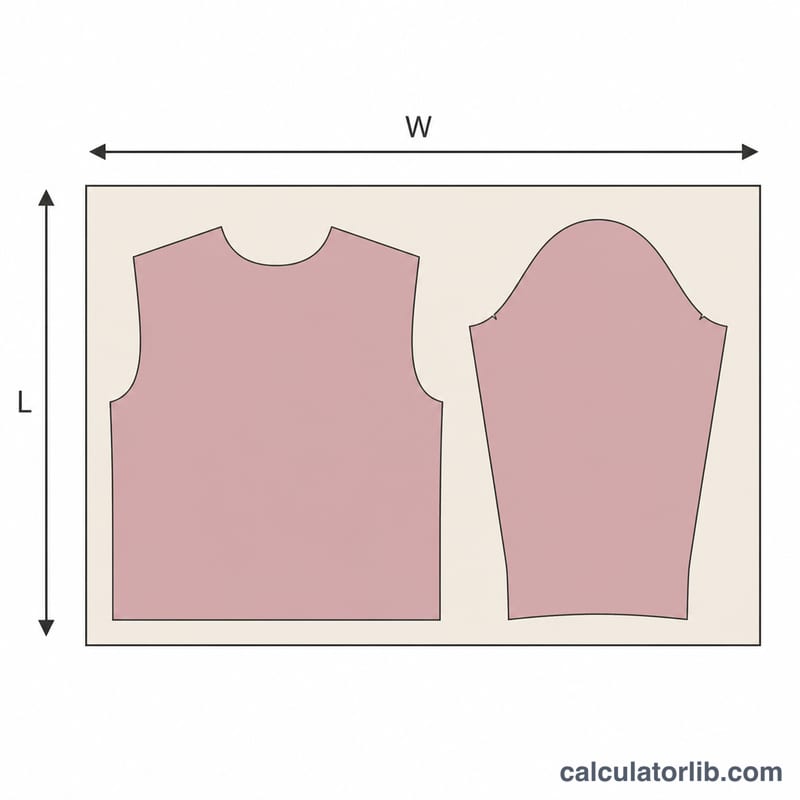
Enter the pattern length and pattern width (the bounding size of one layout piece), the fabric width of your roll, the number of garments you want to produce, and a wastage allowance to cover cutting loss, shrinkage and defects. The calculator nests pieces across the fabric width and reports the total yardage.
The formula explained
First we find how many pieces fit across the fabric width, using \(FW\) = fabric width and \(W\) = pattern width:
$$n = \left\lfloor \frac{FW}{W} \right\rfloor$$Then the total length uses \(Q\) = quantity, \(L\) = pattern length and \(P\) = wastage percent:
$$L_{total} = \left\lceil \frac{Q}{n} \right\rceil \times L \times \left(1 + \frac{P}{100}\right)$$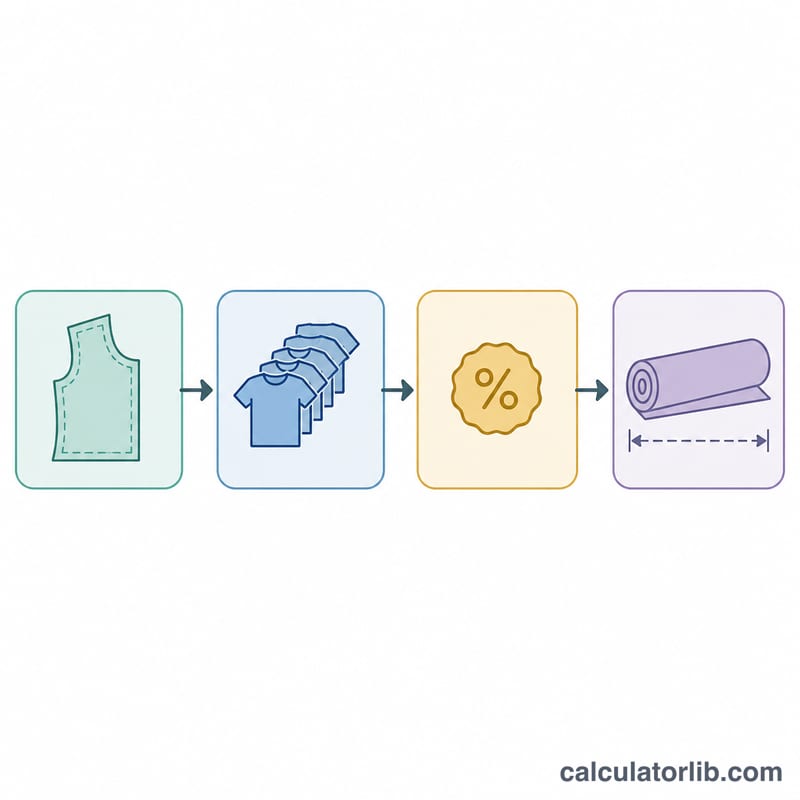
Worked example
Suppose the pattern is 100 cm long and 50 cm wide, the fabric is 150 cm wide, you need 6 garments, and you add 10% wastage.
$$n = \left\lfloor \frac{150}{50} \right\rfloor = 3$$$$\text{rows} = \left\lceil \frac{6}{3} \right\rceil = 2$$$$L_{total} = 2 \times 100 \times \left(1 + \frac{10}{100}\right) = 220\,\text{cm} = 2.2\,\text{m}$$Fabric Unit Conversions: Centimeters, Meters, Inches and Yards
Patterns are often drafted in centimeters, while fabric is sold by the meter or the yard. The exact relationships are 1 in = 2.54 cm, 1 yd = 36 in = 0.9144 m, and 1 m ≈ 1.0936 yd.
| Centimeters | Meters | Inches | Yards |
|---|---|---|---|
| 10 cm | 0.10 m | 3.94 in | 0.109 yd |
| 50 cm | 0.50 m | 19.69 in | 0.547 yd |
| 91.44 cm | 0.9144 m | 36 in | 1 yd |
| 100 cm | 1 m | 39.37 in | 1.094 yd |
| 150 cm | 1.5 m | 59.06 in | 1.640 yd |
| 200 cm | 2 m | 78.74 in | 2.187 yd |
Common fabric widths
| Labeled width (in) | Exact (cm) | Usually quoted as (cm) |
|---|---|---|
| 36 in | 91.44 | 91 or 90 |
| 44/45 in | 111.76 / 114.3 | 112 / 114 |
| 54 in | 137.16 | 137 |
| 58/60 in | 147.32 / 152.4 | 147 / 152 |
Always use the usable width between the selvedges, which can be a little narrower than the labeled width.
Area conversion
1 m² ≈ 1.196 yd², and 1 yd² ≈ 0.8361 m². To convert area, multiply by the square of the length factor, not by the length factor itself.
Example: 2.2 m in yards
\(2.2\,\text{m} \times 1.0936 \approx 2.406\,\text{yd}\), or equivalently \(2.2 \div 0.9144 \approx 2.406\). Rounded up for buying, that is about 2.41 yd, and many shops would round it to 2½ yd.
Typical Wastage Allowances by Fabric and Garment Type
Wastage covers cutting loss between pattern pieces, end-of-roll loss, shrinkage, and extra fabric for matching. The ranges below are common industry rules of thumb, not a formal standard. Actual figures vary by factory, marker efficiency, and how the pieces nest.
| Fabric or situation | Typical wastage allowance |
|---|---|
| Plain solid, non-directional fabric | about 5-10% |
| Stripes, checks, or prints that need matching | about 10-20% |
| Napped or directional fabric (velvet, corduroy, one-way prints) | about 10-15% |
| Knits that may shrink or twist | about 5-10% |
| Small or complex garments with many pieces and curves | often higher than the figures above |
- A tight, computer-optimized marker can push waste to the low end. Hand-laid layouts on narrow fabric usually land higher.
- Pre-wash a sample if shrinkage is a concern, and measure it rather than guessing.
- For home sewing, rounding up to the next ¼ or ½ yard often adds a useful buffer.
Scenario Comparison: How Fabric Width and Wastage Change Yardage
Same pattern in every row: 100 cm long × 50 cm wide, 6 garments. Pieces per row is \(p=\lfloor \text{fabric width} / 50 \rfloor\), and rows is \(n=\lceil 6/p \rceil\). Total length is \(L = n \cdot 100/100 \cdot (1+\text{wastage}/100)\) in meters. Area here is total length × fabric width.
| Fabric width | Pieces per row | Rows | Wastage | Total length (m) | Area (m²) |
|---|---|---|---|---|---|
| 90 cm | 1 | 6 | 5% | 6.30 | 5.670 |
| 90 cm | 1 | 6 | 10% | 6.60 | 5.940 |
| 90 cm | 1 | 6 | 15% | 6.90 | 6.210 |
| 112 cm | 2 | 3 | 5% | 3.15 | 3.528 |
| 112 cm | 2 | 3 | 10% | 3.3 | 3.696 |
| 112 cm | 2 | 3 | 15% | 3.45 | 3.864 |
| 150 cm | 3 | 2 | 5% | 2.10 | 3.150 |
| 150 cm | 3 | 2 | 10% | 2.20 | 3.300 |
| 150 cm | 3 | 2 | 15% | 2.3 | 3.450 |
What the table shows
- Width matters most. At 10% wastage, moving from 90 cm to 150 cm fabric cuts the length from 6.6 m to 2.2 m, a drop of about 67%, because three pieces fit across instead of one.
- Wastage scales linearly. Each 5-point step adds 5% of the base length: 0.30 m on 6 m, 0.15 m on 3 m, and 0.10 m on 2 m.
- Area is a fairer cost comparison if fabrics are priced per square meter. Even by area, the 150 cm fabric uses less (3.30 m² vs 5.94 m² at 10%), because less is lost to unused width.
These results assume a simple layout in which pieces sit side by side. Real markers can interlock pieces and may do better or worse.
FAQ
Why include a wastage allowance? Real cutting always loses fabric to ends, edges, defects and shrinkage. A 5-15% allowance keeps estimates realistic.
What if a pattern piece is wider than the fabric? The calculator uses at least one piece per width, so you will still get a valid, conservative length estimate.
Does it account for print direction or nap? No. Directional fabrics can raise consumption, so add extra wastage for one-way prints, stripes or napped fabric.