What is the Container Fill Calculator?
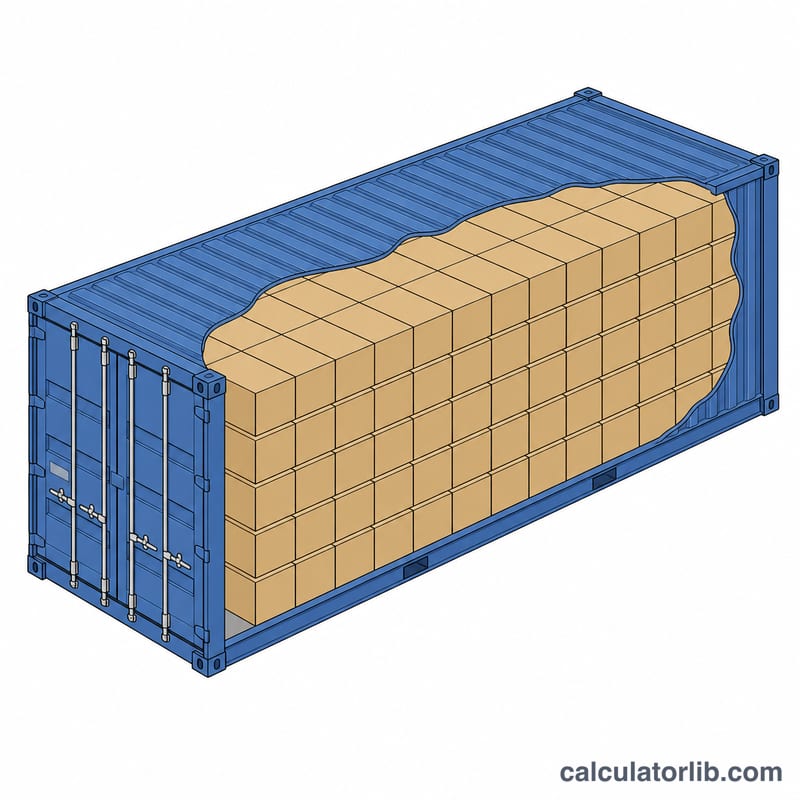
The Container Fill Calculator estimates how many rectangular cartons fit inside a shipping container and how much of the container volume they occupy. It is a fast planning tool for logistics teams, exporters and warehouse staff who need to optimize loading and cut freight cost before booking a shipment.
How to use it
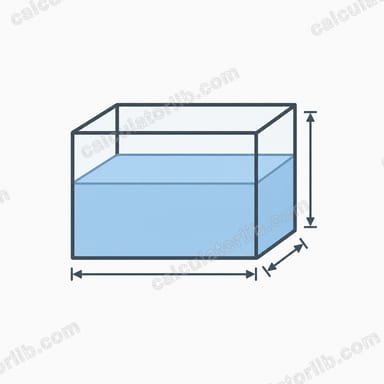
Enter the internal length, width and height of the container in centimetres, then the dimensions of a single carton. Finally set a loading efficiency percentage \(E\) that accounts for gaps, pallets, bracing and irregular stacking. A value of \(85\%\) is a realistic default for mixed loads.
The formula explained
Both the container and the carton are treated as rectangular boxes, so each volume is length times width times height:
$$V = L \times W \times H$$The theoretical count is the container volume divided by the carton volume. Multiplying by the efficiency and rounding down gives a realistic estimate, where \(N\) = number of cartons and \(E\) = efficiency percent:
$$N = \left\lfloor \frac{V_{container}}{V_{carton}} \times \frac{E}{100} \right\rfloor$$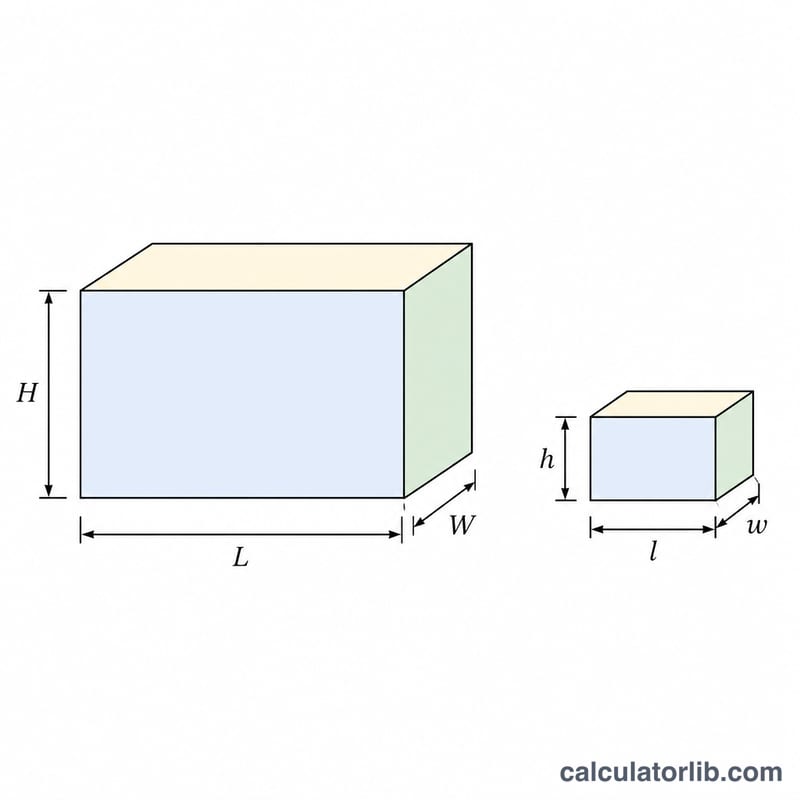
Worked example
A container measuring \(600 \times 240 \times 240\) cm has a volume of:
$$V_{container} = 600 \times 240 \times 240 = 34{,}560{,}000\,\text{cm}^3$$A carton of \(60 \times 40 \times 40\) cm holds \(96{,}000\,\text{cm}^3\). At \(85\%\) efficiency:
$$N = \left\lfloor \frac{34{,}560{,}000}{96{,}000} \times 0.85 \right\rfloor = \lfloor 306 \rfloor = 306$$FAQ
Why use an efficiency factor? Real cartons rarely tessellate perfectly, so raw volume division overstates capacity. The factor corrects for wasted space.
Does it consider weight limits? No. It is a volume estimate only; always check the container payload weight limit separately.
Can I use it for pallets? Yes, treat the pallet stack as the carton dimensions and lower the efficiency to reflect aisle and door clearance.