What is the Concrete Block Fill Calculator?
When building a load-bearing or reinforced masonry wall, the hollow cores (voids) of concrete masonry units (CMU) are often filled with concrete or grout to add strength and support rebar. This calculator estimates how much concrete you need by multiplying the number of blocks by the void volume in each block, then adding an optional waste allowance for spillage and over-pour.
How to Use It
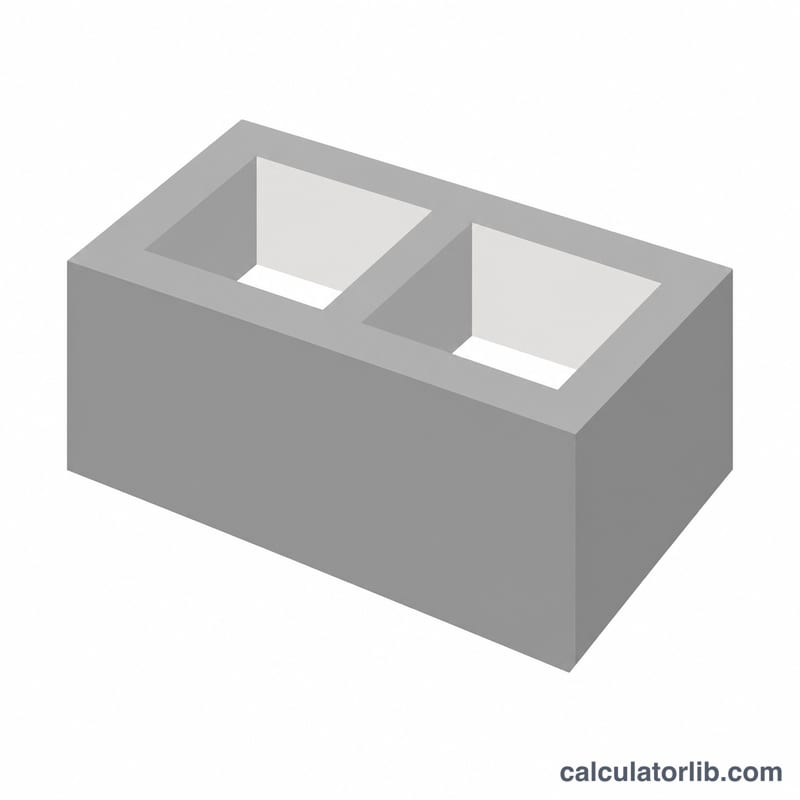
Enter the total number of blocks to be filled, the void volume per block in cubic feet, and an optional waste percentage. The calculator returns the base fill volume, the total including waste, and the equivalent in cubic yards (the unit ready-mix concrete is usually ordered in).
A standard 8×8×16 inch hollow block has roughly 0.256 cubic feet of void space, but this varies by manufacturer and block type, so use your supplier's spec when available.
The Formula Explained
The core formula is fill volume = number of blocks × void volume per block. The waste factor multiplies this by (1 + waste/100). To convert to cubic yards, divide cubic feet by 27, since one cubic yard equals 27 cubic feet.
$$V_{\text{yd}^3} = \frac{\text{Blocks} \times \text{Void Volume (ft}^3\text{)} \times \left(1 + \frac{\text{Waste (\%)}}{100}\right)}{27}$$
Worked Example
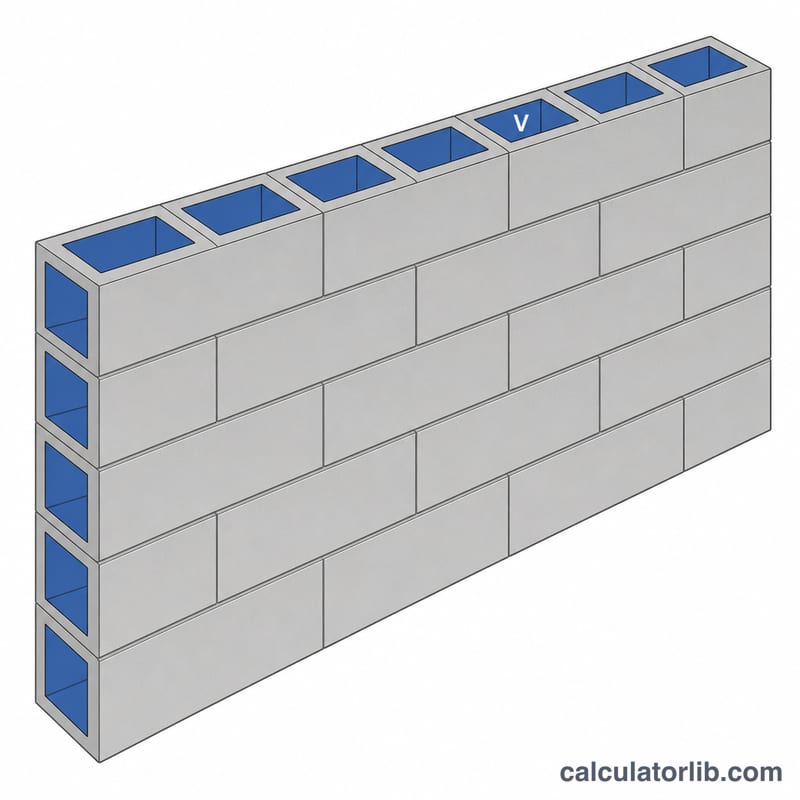
Suppose you have 100 blocks, each with a void volume of 0.256 ft³, and you add a 10% waste allowance. Base volume = \(100 \times 0.256 = 25.6\) ft³. With waste = \(25.6 \times 1.10 = 28.16\) ft³. In cubic yards = \(28.16 \div 27 \approx 1.043\) yd³.
Typical CMU Void Volumes by Block Size
The table gives approximate fill volume per standard 16-inch-long concrete masonry unit (actual size about 15⅝ in long × 7⅝ in high). It is based on common face-shell thicknesses of roughly 1 to 1¼ in. "Fully hollow" treats the block as one open cavity with no center web. "Typical 2-core" is the usual unit with a center web and tapered cores. Values vary by manufacturer, face-shell thickness, and core taper, so treat them as planning estimates only.
| Nominal block width | Fully hollow (ft³ per block) | Typical 2-core (ft³ per block) | Approx. ft³ per 100 blocks (2-core) |
|---|---|---|---|
| 4 in | ≈ 0.09 | ≈ 0.08 | ≈ 8 |
| 6 in | ≈ 0.18 | ≈ 0.16 | ≈ 16 |
| 8 in | ≈ 0.30 | ≈ 0.26 | ≈ 26 |
| 10 in | ≈ 0.41 | ≈ 0.37 | ≈ 37 |
| 12 in | ≈ 0.53 | ≈ 0.47 | ≈ 47 |
As a rule of thumb, 100 standard 8-inch 2-core blocks need about 26 ft³ (roughly 1 yd³) of fill if every cell is filled, before waste. Always confirm the actual void or core volume on the block supplier's spec sheet, because the value you enter into the calculator drives the whole result.
Ordering and Pouring Tips
- Round up. Round the calculated volume up to the next ¼ or ½ cubic yard so you do not run short in the middle of a pour.
- Small jobs. Bagged mix can be more practical. An 80 lb bag of concrete yields about 0.6 ft³, so 26.88 ft³ needs roughly 26.88 ÷ 0.6 ≈ 45 bags.
- Minimum loads. Ready-mix suppliers often have minimum loads or short-load fees, so ask before ordering a small volume.
- Use a fluid mix. CMU fill is normally a fluid, high-slump concrete or grout, typically about 8 to 11 inch slump for CMU grout. Use the mix and slump the engineer specifies.
- Fill only what the design requires. If the design calls for grout only in cells with rebar, enter only the number of blocks or cells being filled. Follow local code and the engineer's specifications for spacing, consolidation, and lift heights.
- Allow for waste. Spillage, uneven cores, and mortar droppings in the cells all add to the volume you need. A 5% to 10% allowance is common.
This is general information, not engineering advice. Structural requirements vary by project and jurisdiction.
Fill Volume Scenarios
All rows assume a void volume of 0.256 ft³ per block. The formula is \(V_{\text{yd}^3} = \frac{ \text{Blocks} \times 0.256 \times (1 + \text{Waste}/100)}{27}\). For example, 100 blocks with 10% waste: \(100 \times 0.256 \times 1.10 = 28.16\) ft³, and \(28.16 \div 27 \approx\) 1.04 yd³.
| Blocks | Waste | Volume (ft³) | Volume (yd³) |
|---|---|---|---|
| 50 | 5% | 13.44 | 0.50 |
| 50 | 10% | 14.08 | 0.52 |
| 100 | 5% | 26.88 | 1.00 |
| 100 | 10% | 28.16 | 1.04 |
| 250 | 5% | 67.20 | 2.49 |
| 250 | 10% | 70.40 | 2.61 |
| 500 | 5% | 134.40 | 4.98 |
| 500 | 10% | 140.80 | 5.21 |
| Partial fill: 50% of 500 blocks (250 blocks' worth) | 10% | 70.40 | 2.61 |
For a partial fill, such as grouting every other core, enter the equivalent number of fully filled blocks (for example, 500 blocks × 50% = 250) or reduce the void volume per block accordingly.
FAQ
What is the void volume of a standard block? An 8-inch CMU has about 0.25–0.26 ft³ of void. Always confirm with your block's spec sheet.
Should I add a waste factor? Yes — 5% to 10% is common to account for spillage, uneven cores, and over-pour.
Do I fill every core? Not always. Many designs only fill cells containing rebar; count only the blocks (or cells) you intend to fill.