
What Is the Grout Calculator?
The Grout Calculator estimates how much grout you'll need to fill the joints between tiles in a flooring or wall project. By accounting for your tile size, joint width, tile thickness, and the total surface area, it gives a practical volume estimate so you can buy the right amount of grout the first time.
How to Use It
Enter the total tile area you're covering in square feet, then the individual tile length and width in inches, your planned grout joint width in inches, and the tile thickness in inches. The calculator converts the area to square inches, computes the joint volume, and reports the result in cubic inches, cubic feet, and an approximate weight in pounds.
The Formula Explained
The core formula is:
$$V = A \times \frac{L + W}{L \times W} \times G \times T$$
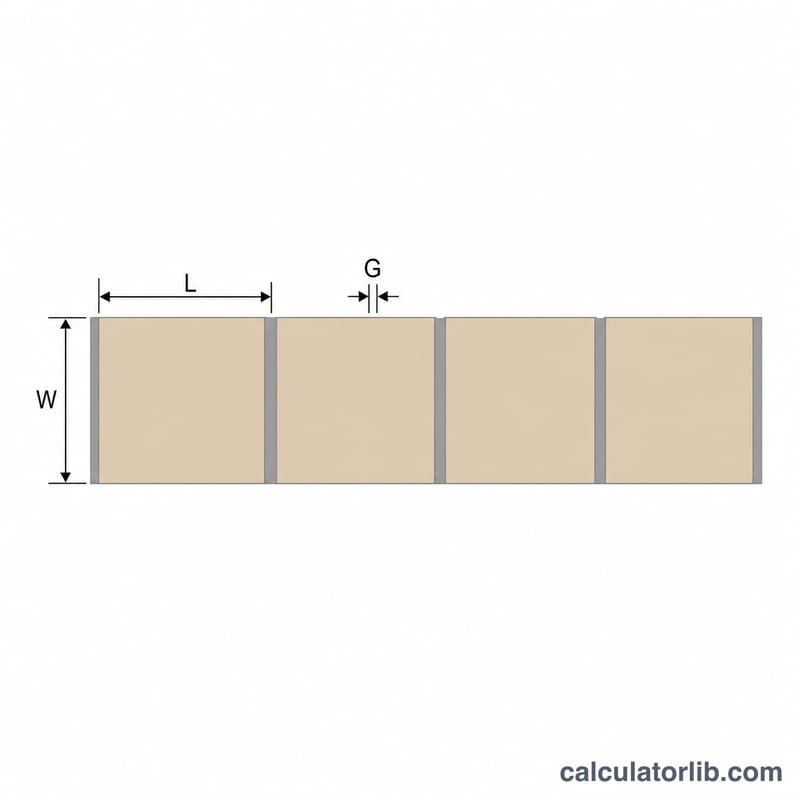
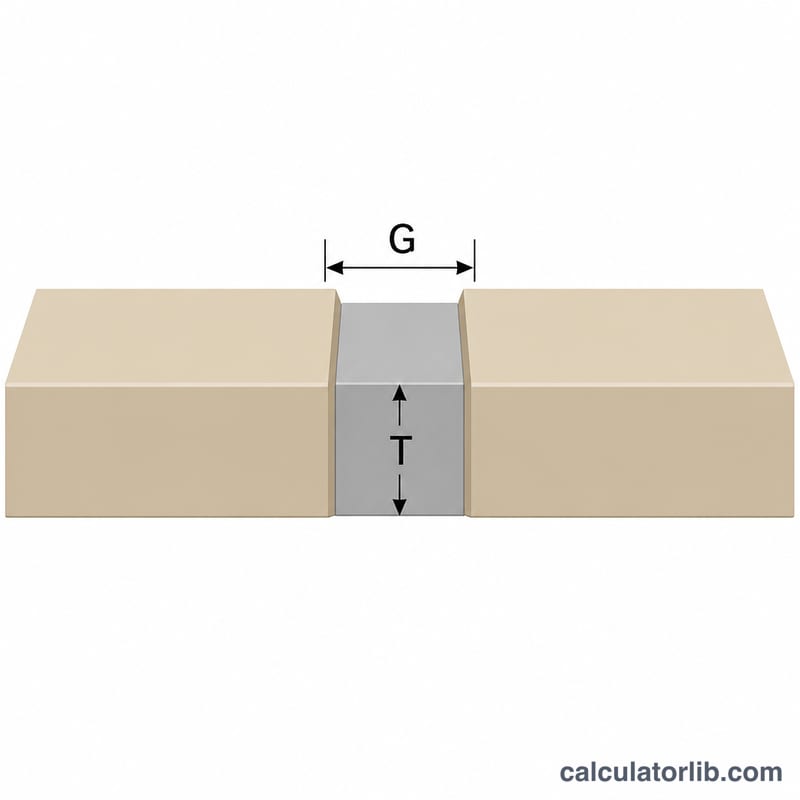
Here A is the tile area (in square inches), L and W are the tile length and width, G is the grout joint width, and T is the tile thickness. The term \(\frac{L + W}{L \times W}\) represents the linear length of grout joints per unit of tile area — smaller tiles have proportionally more joints and therefore need more grout.
Worked Example
Suppose you are tiling 100 sq ft with 12 in × 12 in tiles, a 0.125 in joint, and 0.375 in thick tiles. First convert area: \(100 \times 144 = 14{,}400\) sq in. The joint factor is \(\frac{12 + 12}{12 \times 12} = \frac{24}{144} = 0.16667\). Then $$V = 14{,}400 \times 0.16667 \times 0.125 \times 0.375 \approx 112.5 \text{ cubic inches}$$ or about 8.4 lbs of grout.
FAQ
Should I buy extra grout? Yes — add 5–10% for waste, mixing loss, and uneven joints.
Does tile shape matter? Smaller tiles need more grout per area because they have more joint length, which the formula captures.
How accurate is the weight estimate? It uses an average sanded-grout density (\(\sim 0.075 \text{ lb/in}^3\)); always check your product's bag coverage chart for final amounts.