What is the Warp Yarn Calculator?
The Warp Yarn Calculator estimates how much yarn you need to prepare the warp for a woven fabric. Weaving requires two yarn systems: the lengthwise warp and the crosswise weft. Before weaving begins, every warp end must be measured, wound, and beamed, so knowing the total warp yarn length and weight up front prevents costly shortages and helps you order the right quantity of yarn.
How to use it
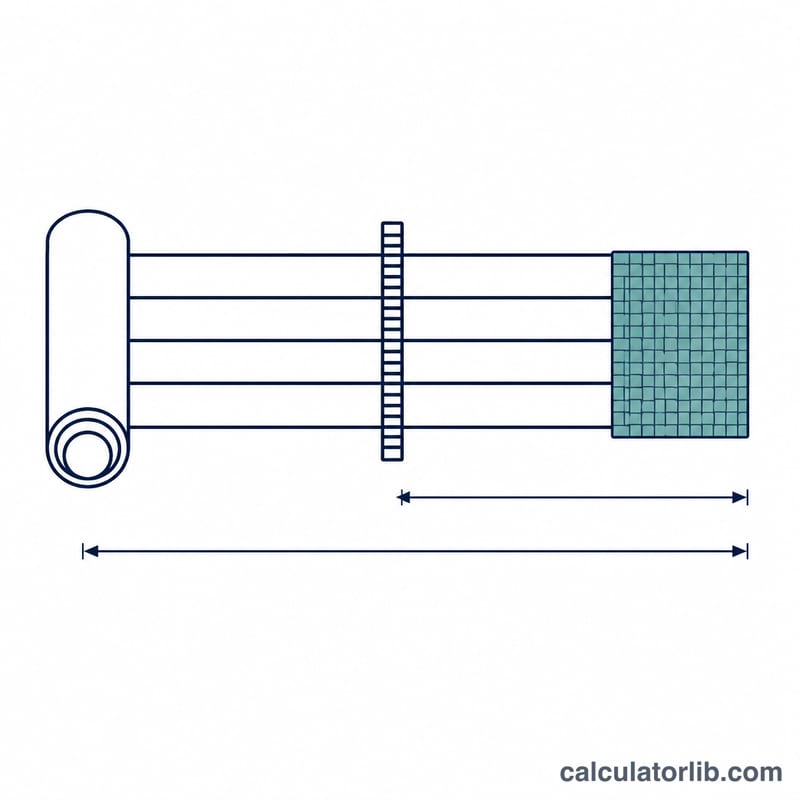
Enter four values: the finished fabric warp length \(L\) in metres, the number of warp ends \(N\) (individual threads across the fabric width), the warp take-up \(T\) as a percentage, and the yarn count in Tex (grams per 1000 m). The calculator returns the warp length per end, the total warp yarn length, and the total warp yarn weight in kilograms.
The formula explained
Because the warp interlaces with the weft, each warp end is slightly longer than the fabric it produces. This extra length is the take-up \(T\). The warp length per end is \(L\,(1 + T/100)\), and the total length is that value times the number of ends. Weight follows from the linear density:
$$W = \frac{N \times L \times \left(1 + \frac{T}{100}\right) \times \text{Tex}}{10^{6}}$$
where \(N\) = number of warp ends, \(L\) = fabric length in metres, \(T\) = take-up percent, and Tex = grams per 1000 m.

Worked example
Suppose \(L = 100\) m, \(N = 2000\) ends, \(T = 10\%\), and Tex \(= 20\). The warp length per end is
$$100 \times (1 + 0.10) = 110\,\text{m}$$
The total warp yarn length is \(2000 \times 110 = 220{,}000\,\text{m}\), and the weight is
$$W = \frac{220{,}000 \times 20}{10^{6}} = 4.4\,\text{kg}$$
FAQ
What is warp take-up? It is the percentage of extra warp length consumed by crimp as the warp bends over the weft during weaving. Higher take-up means more yarn is needed per metre of fabric.
What is Tex? Tex is a direct yarn count equal to the mass in grams of 1000 m of yarn. A higher Tex means a coarser, heavier yarn.
Does this include waste? No. Add a separate loom-waste and knotting allowance (commonly 3-10%) on top of this estimate for a real production run.