
What is the Yarn Substitution Calculator?
When you want to make a knitting or crochet pattern but use a different yarn than the one listed, you can't just buy the same number of skeins. Skeins (balls or hanks) vary widely in length, so a pattern calling for 8 skeins of a 220-yard yarn needs the same total yardage — not the same skein count — from your substitute. This calculator converts the pattern's required yardage into the number of skeins of your chosen yarn.
How to use it
Enter three numbers: the number of skeins the pattern calls for, the yards per skein of the pattern's original yarn, and the yards per skein of your new yarn (check the ball band). The calculator multiplies the first two to find the total yardage the project needs, then divides by your new yarn's yardage and rounds up to a whole skein.
The formula explained
First, total yards required = pattern skeins \(\times\) pattern yards per skein. Then new skeins = ceil(total yards \(\div\) new yards per skein). We round up because yarn is sold in whole skeins and running short mid-project — especially with a different dye lot — is the worst outcome.
$$\text{New Skeins} = \left\lceil \frac{\text{Pattern Skeins} \times \text{Yards/Skein (Pattern)}}{\text{Yards/Skein (New)}} \right\rceil$$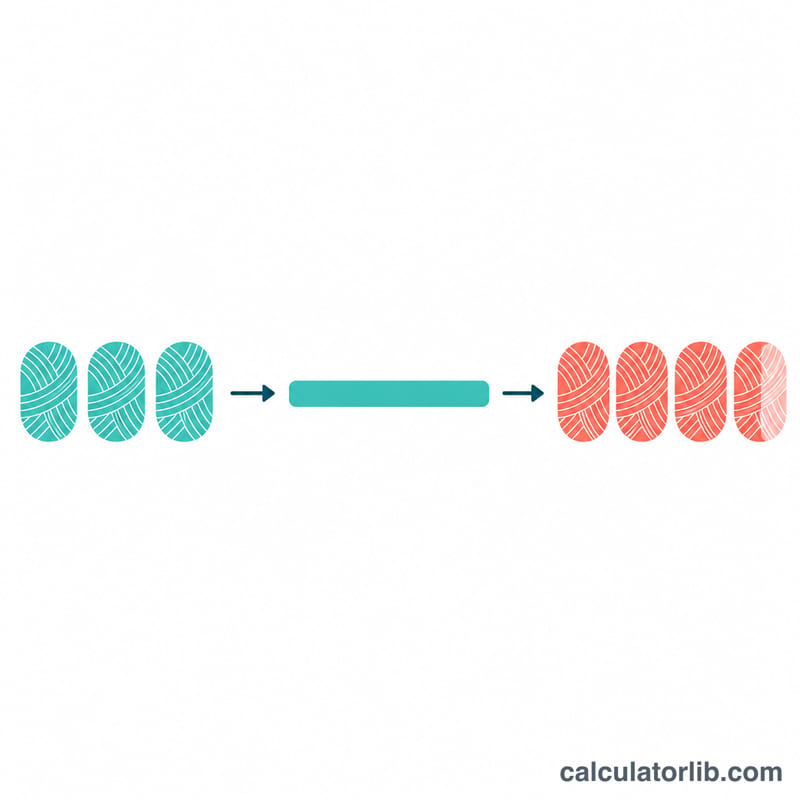
Worked example
A sweater pattern calls for 8 skeins of a yarn with 220 yards each, so it needs \(8 \times 220 = 1{,}760\) yards. Your substitute yarn comes in 175-yard skeins. \(1{,}760 \div 175 = 10.06\), which rounds up to 11 skeins. You'll buy \(11 \times 175 = 1{,}925\) yards, giving a comfortable buffer.
FAQ
Should I buy an extra skein anyway? Yes — buying one spare from the same dye lot protects you against gauge differences, mistakes, and frogging.
What if my yarn is measured in meters? Convert meters to yards first (\(1\text{ m} \approx 1.094\text{ yd}\)), or use meters consistently for all three inputs — the math works in any unit.
Does gauge matter? This tool matches yardage, not gauge. Always knit a swatch to confirm your substitute yarn achieves the pattern's stitch and row gauge.