

What this calculator does
Ceramic glaze recipes are almost always written in percentages of dry materials, where the base ingredients add up to 100% (colorants and additives may push the total above 100). This tool converts those percentages into exact gram weights for whatever batch size you want to mix, then estimates the water needed to bring the dry mix to a usable slurry.
How to use it
Enter your target batch dry weight in grams — this is the combined weight of the core glaze materials you want to end up with. Type each ingredient's percentage from your recipe into the percentage fields. Finally set a water ratio: a value of 0.8 means you add 80 g of water for every 100 g of dry material, a common starting point for dipping glazes. The result shows the grams to weigh out for each ingredient, the total dry weight, the water, and the combined batch.
The formula explained
For each ingredient the weight is simply (percent ÷ 100) × batch dry weight.
$$\text{Ingredient}_i = \frac{\text{Percent}_i\,(\%)}{100} \times \text{Batch (g)}$$If a glaze calls for 40% feldspar and you mix a 1000 g batch, you weigh \(0.40 \times 1000 = 400\) g of feldspar. Water is computed independently as batch × water ratio so you can adjust consistency without changing the dry recipe.
$$\text{Water} = \text{Batch (g)} \times \text{Water Ratio}$$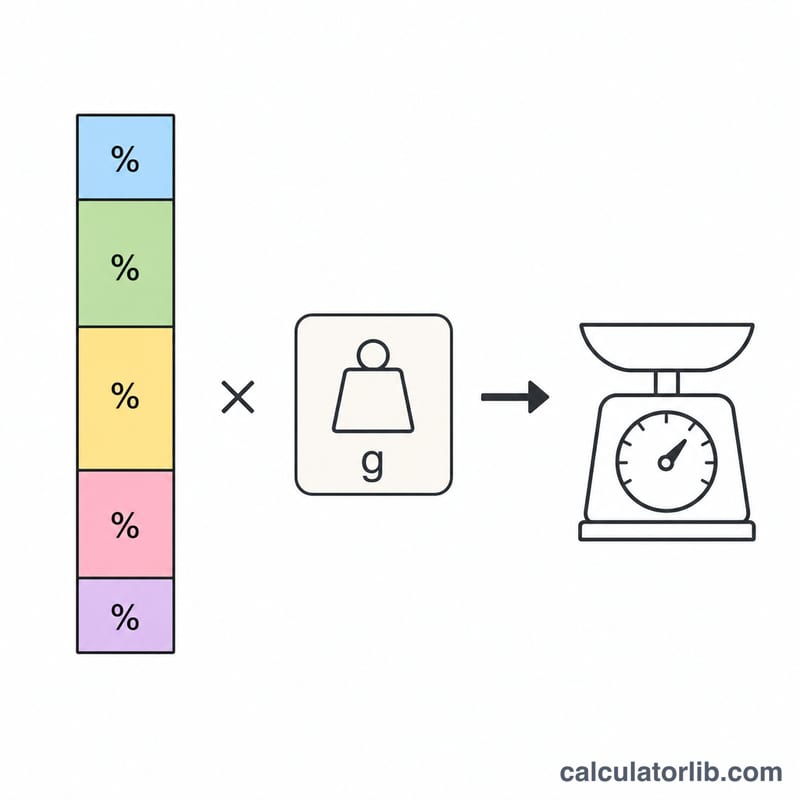
Worked example
Batch = 1000 g, water ratio = 0.8, ingredients 40 / 30 / 20 / 10%. You get 400 g, 300 g, 200 g and 100 g — totalling 1000 g dry. Water = \(1000 \times 0.8 = 800\) g. Total wet batch = 1800 g.
$$\begin{gathered} \text{Total Batch} = \text{Total Dry} + \text{Water} \\[1.5em] \text{where}\quad \left\{ \begin{aligned} \text{Total Dry} &= \frac{p_1 + p_2 + p_3 + p_4}{100} \times \text{Batch} \\ \text{Water} &= \text{Batch} \times \text{Water Ratio} \end{aligned} \right. \end{gathered}$$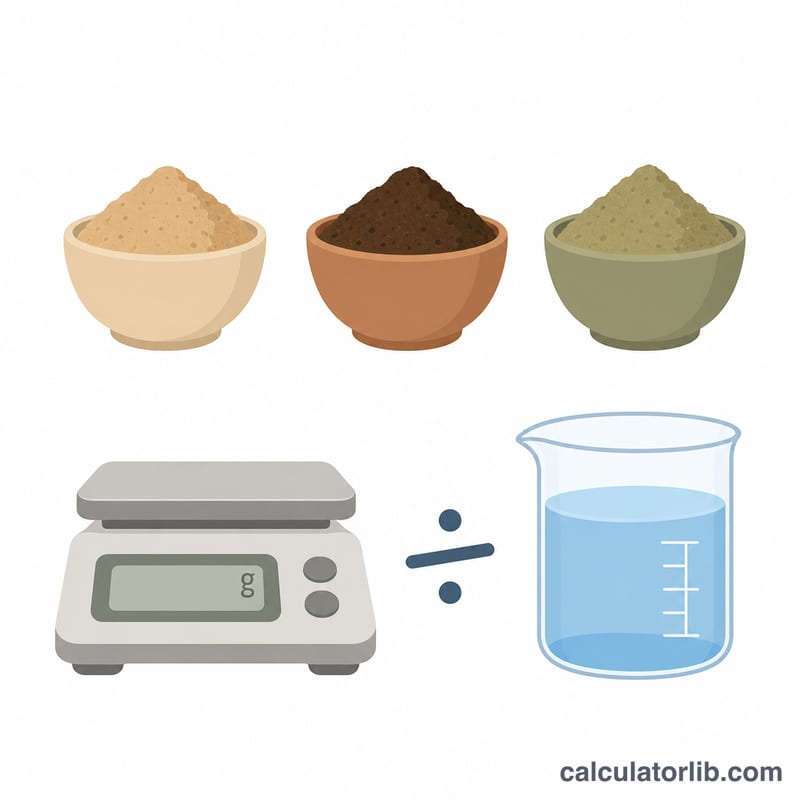
FAQ
Why do percentages sometimes exceed 100%? Colorants, opacifiers and suspenders are added on top of the 100% base, so a recipe total of 105–115% is normal. The calculator simply scales whatever you enter.
How much water should I add? Start around 0.7–0.9× the dry weight, then adjust to the consistency of cream. Thicker for brushing, thinner for spraying.
Do I need to use all four ingredient fields? No — leave unused fields at 0 and they contribute nothing to the totals.