What Is the Pancake Recipe Calculator?
The Pancake Recipe Calculator instantly scales a classic pancake batter to exactly the number of pancakes you need. Instead of guessing how to halve or triple a recipe, just enter how many people you are feeding and how many pancakes each person will eat — the tool returns the precise flour, milk, eggs, sugar, baking powder, butter and salt for your batch.
How to Use It
Enter the number of servings (people) and the number of pancakes per serving. The calculator multiplies these to find the total pancakes, then scales every ingredient from a tested 12-pancake base recipe. No measuring conversions or mental math required.
The Formula Explained
The core idea is simple proportional scaling. First, total pancakes = servings × pancakes per serving. Then each ingredient amount = base amount for 12 pancakes × (total pancakes ÷ 12). The 12-pancake base recipe uses 240 g flour, 360 ml milk, 2 eggs, 25 g sugar, 10 g baking powder, 30 g melted butter and 3 g salt.
$$\text{Ingredient} = \text{Base} \times \frac{\text{Servings} \times \text{Pancakes per Serving}}{12}$$ $$\text{where}\quad \left\{ \begin{aligned} \text{Flour} &= 240\,\text{g} \\ \text{Milk} &= 360\,\text{ml} \\ \text{Eggs} &= 2 \\ \text{Sugar} &= 25\,\text{g} \\ \text{Baking Powder} &= 10\,\text{g} \\ \text{Butter} &= 30\,\text{g} \\ \text{Salt} &= 3\,\text{g} \end{aligned} \right.$$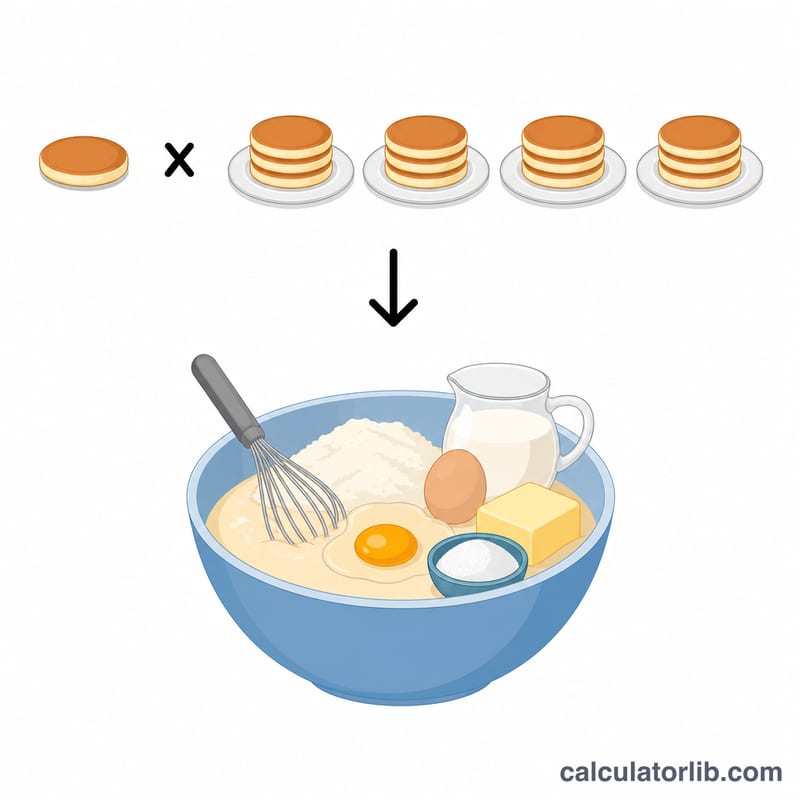
Worked Example
Suppose you have 4 servings and 3 pancakes per serving. Total pancakes = \(4 \times 3 = 12\), so the batch factor is \(12 \div 12 = 1\). That gives the base recipe exactly: 240 g flour, 360 ml milk, 2 eggs, 25 g sugar, 10 g baking powder, 30 g butter, 3 g salt. For 6 servings at 4 pancakes each (24 pancakes) every amount simply doubles.
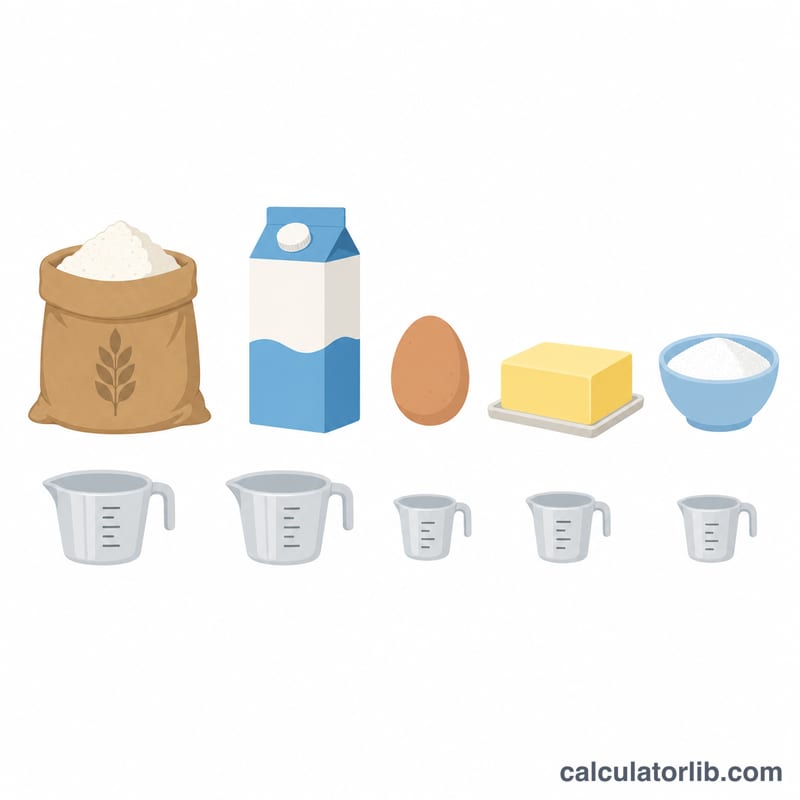
Ingredient Amounts for Common Batch Sizes
The calculator scales a base recipe that makes 12 pancakes. The batch factor is \(\text{factor} = \frac{\text{servings} \times \text{pancakes per serving}}{12}\), and every ingredient is the base amount multiplied by that factor. Base amounts: 240 g flour, 360 ml milk, 2 eggs, 25 g sugar, 10 g baking powder, 30 g butter, 3 g salt.
| Servings × pancakes each | Total pancakes | Batch factor | Flour (g) | Milk (ml) | Eggs | Sugar (g) | Baking powder (g) | Butter (g) | Salt (g) |
|---|---|---|---|---|---|---|---|---|---|
| 2 × 2 | 4 | 0.33 | 80 | 120 | 0.67 (about 2/3 egg) | 8.3 | 3.3 | 10 | 1 |
| 2 × 3 | 6 | 0.5 | 120 | 180 | 1 | 12.5 | 5 | 15 | 1.5 |
| 4 × 3 | 12 | 1 | 240 | 360 | 2 | 25 | 10 | 30 | 3 |
| 4 × 4 | 16 | 1.33 | 320 | 480 | 2.67 (about 2½ to 3) | 33.3 | 13.3 | 40 | 4 |
| 6 × 3 | 18 | 1.5 | 360 | 540 | 3 | 37.5 | 15 | 45 | 4.5 |
| 6 × 4 | 24 | 2 | 480 | 720 | 4 | 50 | 20 | 60 | 6 |
| 8 × 3 | 24 | 2 | 480 | 720 | 4 | 50 | 20 | 60 | 6 |
Worked check for 4 × 4: total pancakes = 4 × 4 = 16, factor = 16 ÷ 12 = 1.33, flour = 240 × 1.33 = 320 g, milk = 360 × 1.33 = 480 ml.
Eggs rarely scale to a whole number. Round to the nearest whole or half egg, or beat an egg and measure the exact amount by weight (see the tips below).
Metric to Cups and Spoons Conversion
These conversions are approximate, and they show the 12-pancake base batch. Cup and spoon measures vary with how ingredients are packed and scooped, so weighing on a kitchen scale is more accurate, especially for flour. Cups here are US cups (240 ml), and teaspoons and tablespoons are US measures.
| Ingredient | Approximate density | Base batch (metric) | Approximate cups/spoons |
|---|---|---|---|
| All-purpose flour | about 120 g per cup | 240 g | about 2 cups |
| Milk | 240 ml per cup | 360 ml | 1½ cups |
| Sugar | about 12.5 g per tablespoon | 25 g | 2 tbsp |
| Baking powder | about 4 g per teaspoon | 10 g | 2½ tsp |
| Melted butter | about 14 g per tablespoon | 30 g | about 2 tbsp |
| Salt | about 6 g per teaspoon | 3 g | ½ tsp |
For other batch sizes, multiply the base amounts by the batch factor first, then convert. Flour scooped straight from the bag can be 20% heavier than spooned and leveled flour, which makes pancakes dense.
Practical Tips for Scaling Pancake Batter
- Fractional eggs: Beat one whole egg and measure out the amount you need by weight. A large egg without its shell is about 50 g, so 0.67 egg is about 33 g. For large batches, simply round up to the next whole egg.
- Do not overmix: Stir the wet and dry ingredients only until combined. Small lumps are fine, and overmixing develops gluten and makes pancakes tough.
- Rest the batter: Let it sit for 5 to 10 minutes so the flour hydrates and the baking powder starts working. The pancakes come out more tender and fluffier.
- Cook in batches: Cook a few pancakes at a time and keep finished ones warm on a rack or tray in a low oven at about 90–100 °C. Do not stack them tightly, or they steam and turn soggy.
- Make a little extra: For larger groups, add about 10% to the total (for example, 26 pancakes instead of 24), since the first pancake is often a test and some batter is lost to the bowl and pan.
- Very large batches: Use a larger bowl so you can mix gently. Weigh the baking powder carefully, because small errors are magnified at larger volumes and too much gives a metallic taste. Mix the batter in two smaller lots if it sits for a long time, because the leavening loses strength.
This is general cooking guidance. Adjust to your own equipment, ingredients and dietary needs.
FAQ
Can I make a half batch? Yes — choose fewer servings or fewer pancakes per serving and all ingredients scale down proportionally.
How big is one pancake? The base assumes a medium pancake about 12 cm across. Larger pancakes simply mean fewer per serving.
Why grams and millilitres? Weight and volume scaling is more accurate than cups when adjusting quantities. Use a kitchen scale for best results.