
What Is the Self-Rising Flour Calculator?
Out of self-rising flour? No problem. This calculator tells you exactly how much baking powder and salt to whisk into ordinary all-purpose flour to make a perfect homemade substitute. Just enter the number of cups of all-purpose flour your recipe calls for, and you'll get the precise amounts to add — no guesswork, no failed rises.
How to Use It
Type the number of cups of all-purpose flour you need (it can be a fraction such as 0.5 or 2.25). The calculator returns the teaspoons of baking powder and salt to mix in. Whisk the three ingredients together thoroughly so the leavening is evenly distributed, then use it cup-for-cup as self-rising flour.
The Formula Explained
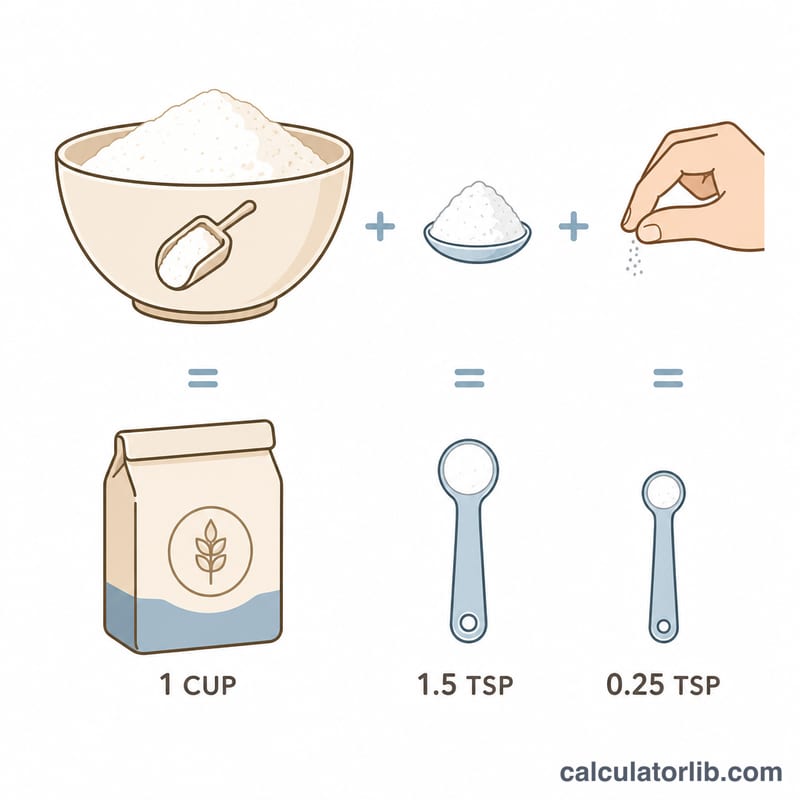
The standard ratio used by most bakers is 1½ teaspoons of baking powder and ¼ teaspoon of salt per cup of all-purpose flour:
$$\text{Baking powder (tsp)} = 1.5 \times \text{flour cups}$$$$\text{Salt (tsp)} = 0.25 \times \text{flour cups}$$This gives self-rising flour a consistent leavening strength close to the commercial product, which is ideal for biscuits, pancakes, quick breads, and muffins.
Worked Example
Suppose a biscuit recipe needs 2 cups of self-rising flour. Multiply: baking powder = \(1.5 \times 2 = 3\) teaspoons, and salt = \(0.25 \times 2 = 0.5\) teaspoon. So combine 2 cups all-purpose flour, 3 tsp baking powder, and ½ tsp salt.
FAQ
Can I leave out the salt? You can reduce it for low-sodium diets, but a little salt improves flavor and balances the leavening.
Is baking powder the same as baking soda? No. This calculator uses baking powder. Do not substitute baking soda, which is far stronger and needs an acid.
How long does homemade self-rising flour last? Use it within a few months; baking powder loses potency over time, so make smaller batches for best results.