What is sound pressure level?
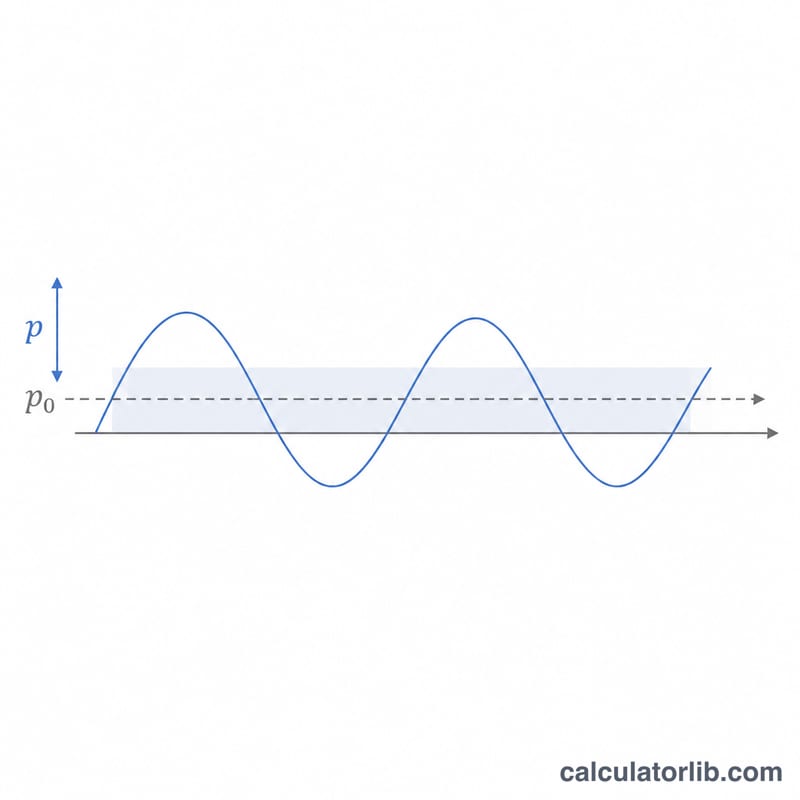
Sound pressure level (SPL) is a logarithmic measure of acoustic pressure relative to a reference of 20 micropascals, expressed in decibels (dB). Because decibels are logarithmic, you cannot simply add the levels of two noise sources together. This calculator handles the correct logarithmic combination of up to three sources and then projects the result to any distance.
How to use this calculator
Enter the SPL of each source measured at the same reference distance, then set the reference distance \(d_1\) and the target distance \(d_2\) where you want to know the level. Leave the second and third source fields blank to work with fewer sources. The tool reports the combined level at the reference point, the attenuation caused by distance, and the final SPL at the target.
The formulas explained
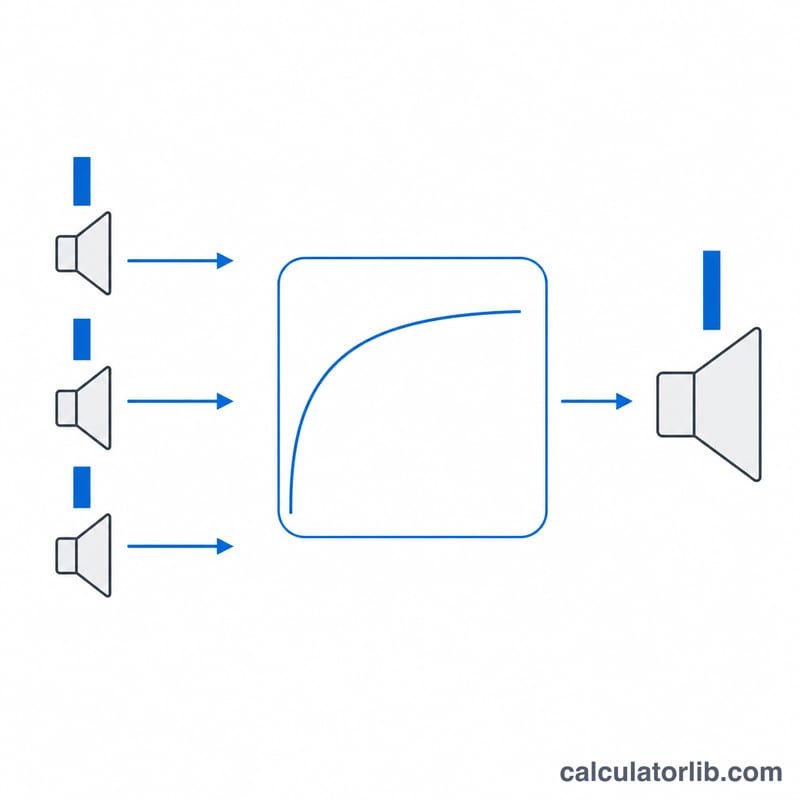
Multiple incoherent sources combine on an energy basis:
$$L_{\text{total}} = 10\,\log_{10}\left(\sum_{i=1}^{n} 10^{L_i/10}\right)$$where \(L_i\) is the level of each source in dB. For a point source radiating into free space, the level decreases as distance increases:
$$L_2 = L_1 - 20\,\log_{10}\left(\frac{d_2}{d_1}\right)$$Here \(d_1\) is the reference distance and \(d_2\) the target distance. Doubling the distance reduces the level by about 6 dB.
Worked example
Suppose two machines each produce 80 dB at 1 m. Combining them gives:
$$L_{\text{total}} = 10\,\log_{10}\left(10^{8}+10^{8}\right) = 83.01\,\text{dB}$$A single 90 dB source measured at 1 m, evaluated at 2 m, becomes:
$$L_2 = 90 - 20\,\log_{10}(2) = 83.98\,\text{dB}$$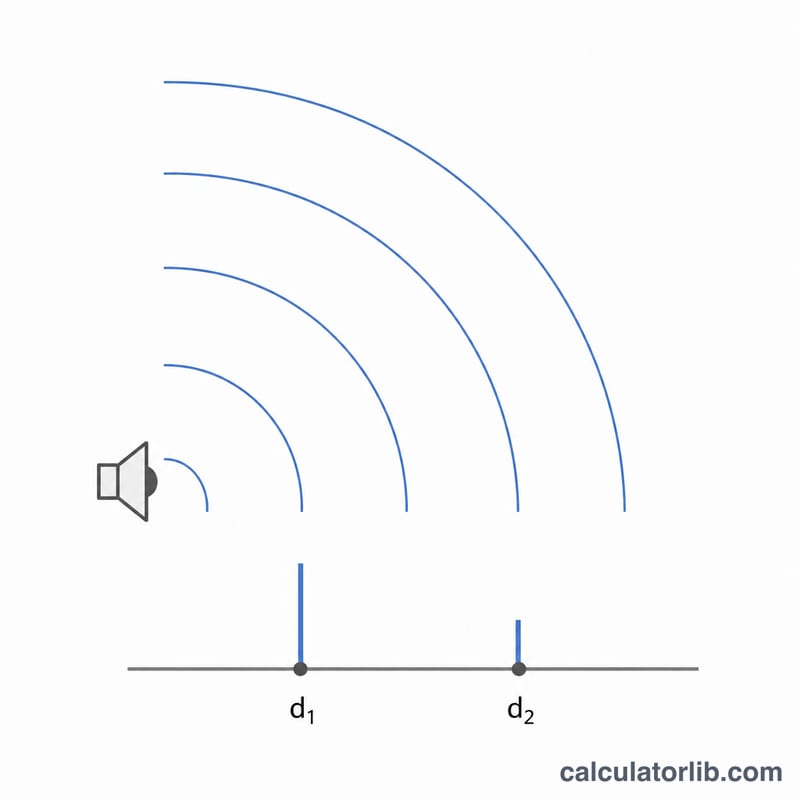
FAQ
Why do two 80 dB sources not make 160 dB? Decibels are logarithmic; two equal sources add only about 3 dB, giving roughly 83 dB.
Does this account for reflections or absorption? No. It assumes free-field, point-source propagation with no reflecting surfaces or air absorption, which is a good first approximation outdoors.
What reference is used? Levels are ordinary SPL values in dB referenced to 20 micropascals, so any consistent set of measured dB values works.