What this calculator does
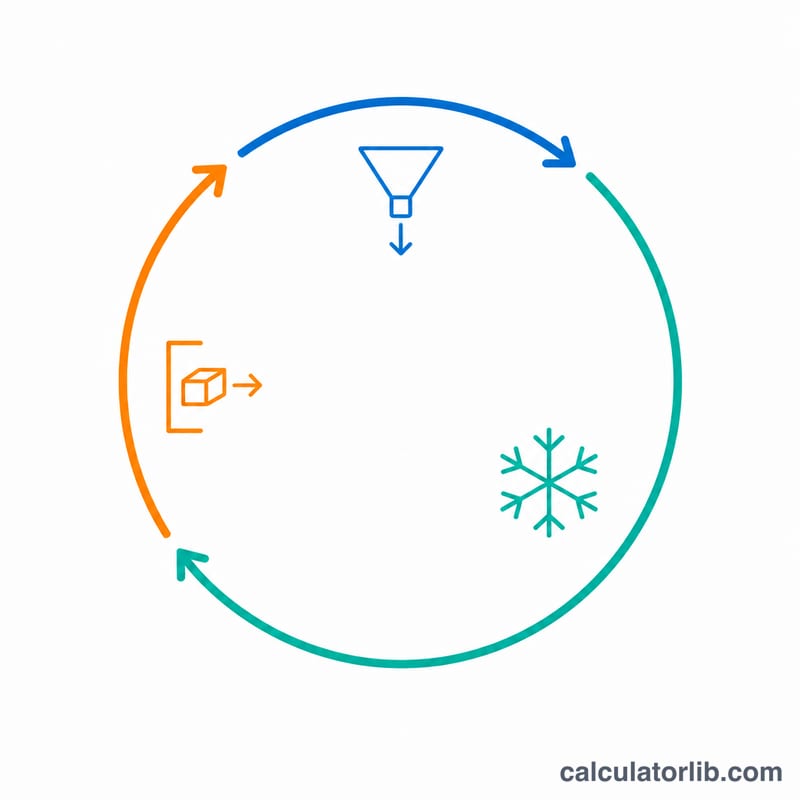
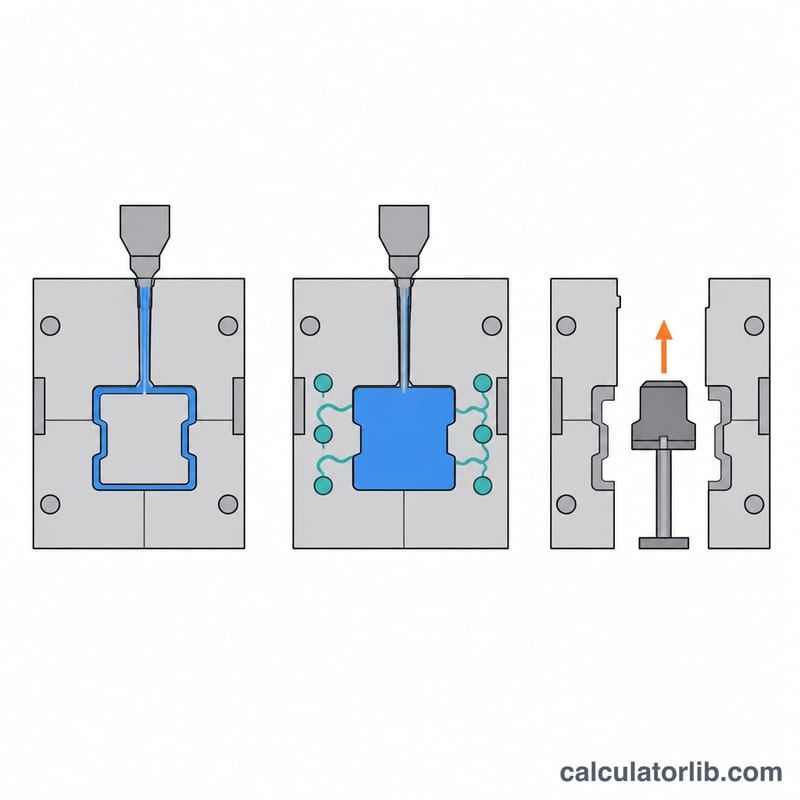
The Injection Molding Cycle Time Calculator estimates how long one complete molding cycle takes by summing the three main time phases of the process: filling (injection), cooling, and ejection together with mold open and close movement. Knowing the cycle time lets you predict throughput, quote lead times, and identify which phase dominates so you can focus optimization where it matters most.
The formula explained
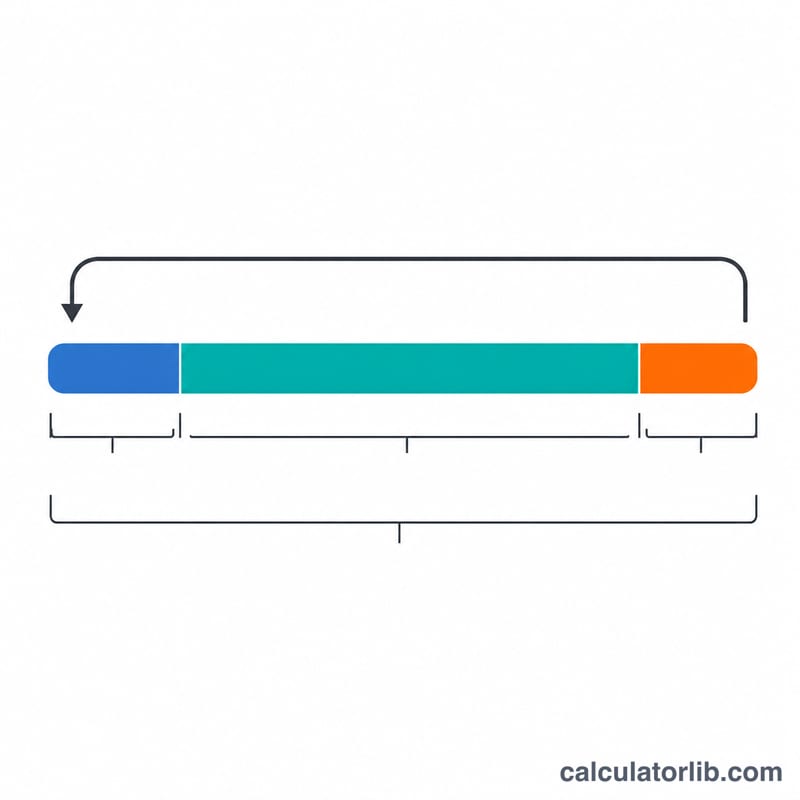
The total cycle time is simply the sum of the individual phase times:
$$t_{cycle} = t_{fill} + t_{cool} + t_{eject}$$where \(t_{fill}\) = injection/fill time in seconds, \(t_{cool}\) = cooling time in seconds, and \(t_{eject}\) = ejection plus mold open/close time in seconds. From the cycle time you can derive the theoretical hourly output of a single-cavity mold:
$$\text{PPH} = \frac{3600}{t_{cycle}}$$In practice cooling is usually the longest phase, often 50 to 80 percent of the total, because it depends on wall thickness and material thermal properties.
How to use it
Enter the measured or estimated time for each phase in seconds, then read the total cycle time and the estimated parts per hour. Use consistent units, and include any mold movement time inside the ejection field.
Worked example
Suppose \(t_{fill} = 2\) s, \(t_{cool} = 15\) s, and \(t_{eject} = 3\) s. The total cycle time is:
$$t_{cycle} = 2 + 15 + 3 = 20\,\text{s}$$The theoretical output is:
$$\text{PPH} = \frac{3600}{20} = 180 \text{ parts/hour}$$FAQ
Why is cooling time so important? It is normally the largest single component of cycle time and scales roughly with the square of wall thickness, so thinner walls cool faster.
Does this account for multi-cavity molds? The parts-per-hour figure is per cavity. Multiply by the number of cavities for total shop output.
Is the result exact? No. It is an estimate based on your phase times; real cycles vary with machine settings, material, and part geometry.