What this calculator does
The Injection Molding Cost Calculator estimates the cost per part and the total cost of an injection-molded production run. It combines the three drivers of piece-part cost: raw material consumed per shot, the machine and labor time needed to run the press, and the tooling (mold) investment spread across the order. This lets designers, buyers, and molders sanity-check quotes and compare scenarios before committing to a program.
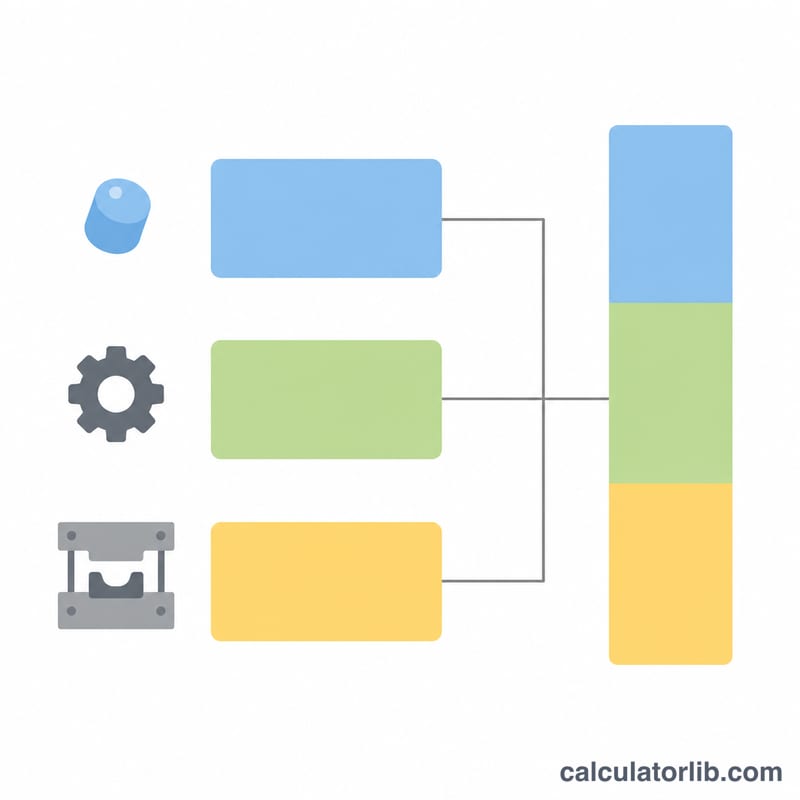
The formula explained
The core equation is:
$$\text{Cost per part} = \frac{W}{1000}\,C\,\left(1+\tfrac{s}{100}\right) + \frac{t}{3600\,n}\,(M+L) + \frac{T}{Q}$$where \(W\) = part weight in grams, \(C\) = material cost per kg, \(s\) = scrap rate in percent, \(t\) = cycle time in seconds, \(n\) = number of mold cavities, \(M\) = machine rate per hour, \(L\) = labor rate per hour, \(T\) = mold/tooling cost, and \(Q\) = total quantity. Because \(n\) parts come out of every shot, the effective machine time per part is \(t/n\). The total cost is simply \(\text{Cost per part}\times Q\).
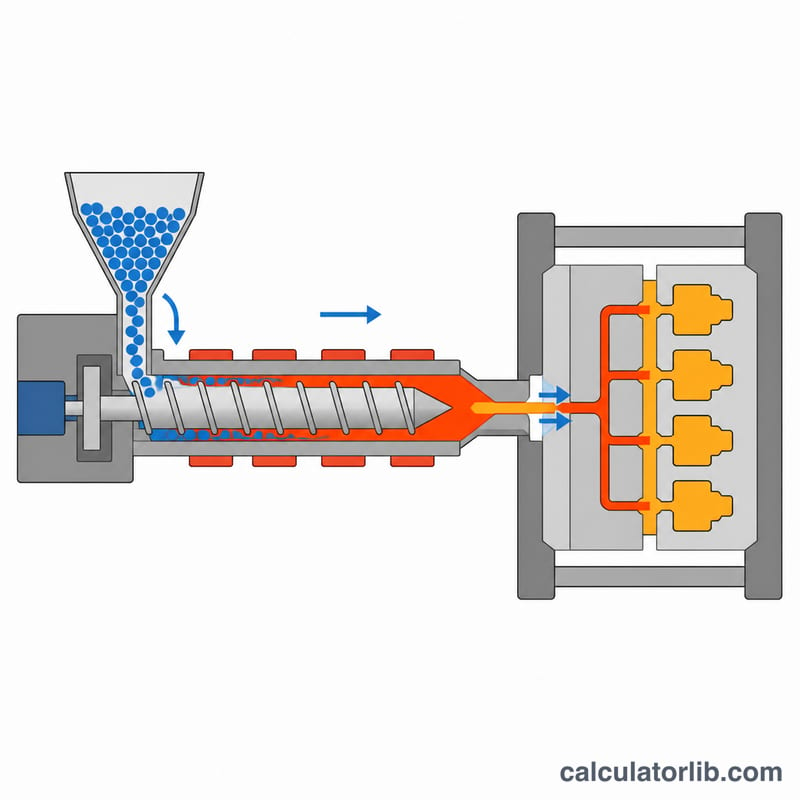
How to use it
Enter the part weight and material price, set a realistic scrap rate, then describe the process: cycle time, number of cavities, and the combined machine and labor rates. Add the amortized tooling cost and the order quantity. The result breaks the piece price into material, processing, and tooling components so you can see which lever matters most.
Worked example
Take a 50 g part at $3/kg with 5% scrap, a 30 s cycle in a 4-cavity mold, machine and labor at $40 and $20 per hour, $20,000 tooling, and 10,000 parts:
$$\text{material} = \frac{50}{1000}\times 3 \times 1.05 = \$0.1575$$$$\text{processing} = \frac{30}{3600\times 4}\times(40+20) = \$0.125$$$$\text{tooling} = \frac{20000}{10000} = \$2.00$$Adding these gives \(\$2.2825\) per part, so the total run cost is \(2.2825\times 10000 = \$22{,}825\).
Typical Material Costs, Machine Rates & Cycle Times
The tables below give indicative figures useful for a first estimate. Resin prices are volatile commodity prices (they move with oil, grade, colour, filler content and order volume), and machine rates vary widely by region, shop overhead and automation level. Treat every value here as a rough market/shop range in US dollars, not a fixed quote — confirm real numbers with your resin supplier and molder.
Common resins: typical price and density
| Resin | Typical price (USD/kg) | Typical density (g/cm³) |
|---|---|---|
| PE (polyethylene) | $1.20 – $2.00 | 0.92 – 0.96 |
| PP (polypropylene) | $1.20 – $2.00 | 0.90 – 0.91 |
| ABS | $2.00 – $3.50 | 1.04 – 1.06 |
| POM (acetal) | $2.50 – $4.00 | 1.39 – 1.42 |
| Nylon 6/6 (PA66) | $3.00 – $5.00 | 1.13 – 1.15 |
| PC (polycarbonate) | $3.00 – $5.00 | 1.19 – 1.21 |
Density matters because the calculator's material cost is driven by part mass. If you only know the part volume, estimate weight as \(\text{weight (g)} = \text{volume (cm}^3) \times \text{density (g/cm}^3)\), then use that in the part_weight field (in grams).
Typical machine hourly rate by clamp tonnage
| Clamp force | Typical machine rate (USD/hour) |
|---|---|
| 50 t | $25 – $40 |
| 150 t | $35 – $55 |
| 300 t | $50 – $75 |
| 500 t | $70 – $100 |
These are machine/press rates only; enter labour separately in labor_rate. Larger presses cost more per hour but are needed for larger parts and higher-cavity molds.
Typical cycle time by nominal wall thickness
| Nominal wall thickness | Typical cycle time (seconds) |
|---|---|
| < 1 mm | 10 – 20 |
| 1 – 2 mm | 15 – 30 |
| 2 – 3 mm | 25 – 45 |
| 3 – 4 mm | 40 – 70 |
Cooling dominates cycle time and scales roughly with the square of wall thickness, so thicker walls raise the cycle time disproportionately. Actual cycles also depend on resin, mold cooling design and part geometry, so use these ranges only as a starting point for the cycle_time field.
Practical Ways to Lower Cost per Part
The fastest wins come from attacking whichever of the three cost terms — material, processing or tooling — dominates your result. Run the calculator, read the split, then act on the biggest slice.
- When tooling dominates (typical at low volume). Because \(C_{\text{tool}} = \text{mold cost} / \text{quantity}\), the single biggest lever is order quantity: batching or committing to a larger run amortizes the mold over more parts. For prototypes or low volumes, consider lower-cost aluminum or prototype (bridge) tooling instead of hardened steel — the mold wears faster but the far lower
mold_costwins when it is spread over few parts. A single-cavity mold is also cheaper to build than a multi-cavity one. - When processing dominates (long cycles or few cavities). Raise cavitation (more cavities per shot divides processing cost per part) and shorten the cycle. Cooling is usually the longest phase, so reducing wall thickness, adding or improving cooling channels, and optimizing hold/cooling times all cut
cycle_time. Right-sizing the press to a lowermachine_ratewhere the part allows also helps. - When material dominates (heavy parts or expensive resin). Review the resin grade — an unfilled or commodity grade may meet the spec at lower
material_cost. Reduce part weight through design (thinner walls, ribbing, coring out solid sections). Where the application permits, using qualified regrind can lower effective material cost. And drive downscrap_rate: because material cost is multiplied by \(\left(1 + \text{scrap rate}/100\right)\), every point of scrap you eliminate comes straight off the material term. - Buy enough material to cover scrap. When purchasing resin for a run, order slightly more than the finished-part mass implies so that rejects, purging and startup do not leave you short. Sizing the purchase to roughly the scrap-inflated quantity — the same \(\left(1 + \text{scrap rate}/100\right)\) factor the calculator uses — avoids a second small (and often higher-priced) top-up order.
These are general operational suggestions for reducing molded-part cost; the right trade-off depends on your part, resin, tolerances and equipment. Validate any change with your molder and a quality check before committing to production.
FAQ
Why divide cycle time by cavities? A multi-cavity mold makes several parts per shot, so the same press time is shared, lowering processing cost per part.
How is tooling handled? The mold cost is amortized evenly over the order quantity; larger runs dilute tooling cost per part.
Does scrap affect only material? Here scrap inflates material usage; you can raise the scrap rate to approximate rejected parts and startup waste.