What this calculator does
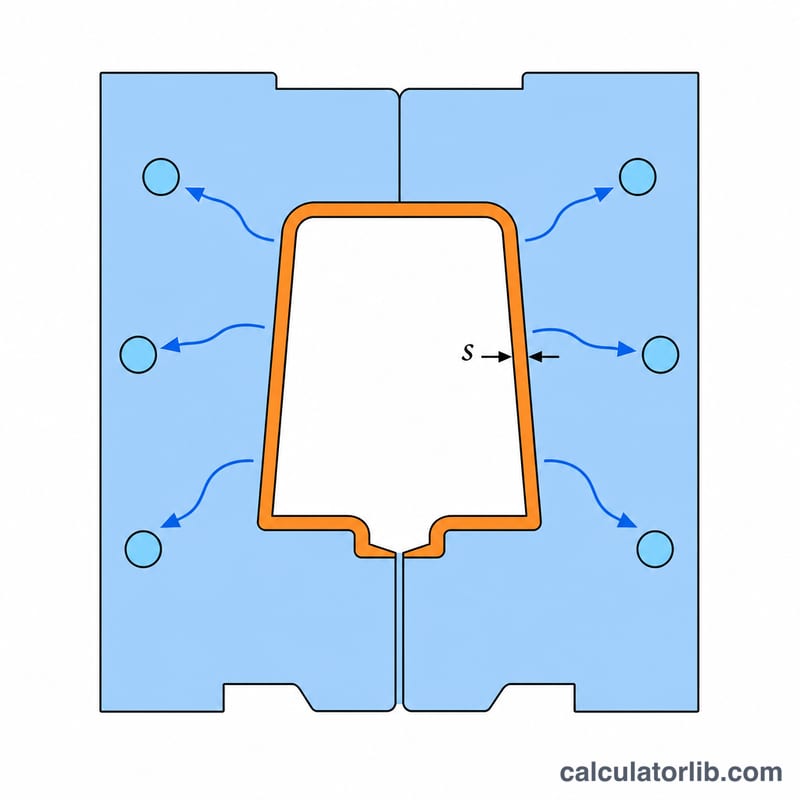
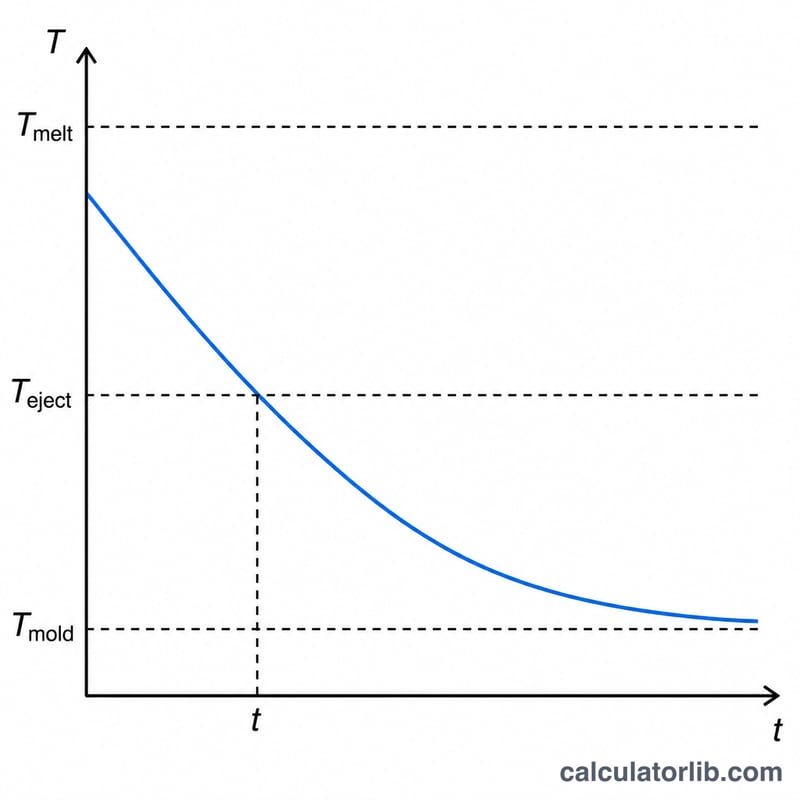
The Injection Molding Cooling Time Calculator estimates how long a molded plastic part must stay in the mold before it is rigid enough to eject. Cooling is usually the longest phase of the injection molding cycle, so a good estimate directly drives cycle time, machine throughput, and part cost. The model treats the part as an infinite flat plate cooling by one-dimensional heat conduction, which is the classic approximation used in mold and process design.
The formula explained
The cooling time is given by the plate cooling equation:
$$t = \frac{s^2}{\pi^2 \alpha} \, \ln\!\left(\frac{4}{\pi} \cdot \frac{T_m - T_w}{T_e - T_w}\right)$$where \(t\) = cooling time in seconds, \(s\) = maximum wall thickness in mm, \(\alpha\) = thermal diffusivity of the polymer in \(\text{mm}^2/\text{s}\), \(T_m\) = melt (injection) temperature, \(T_w\) = mold wall temperature, and \(T_e\) = ejection (demold) temperature. Because thickness appears squared, doubling the wall thickness roughly quadruples the cooling time.
How to use it
Enter the thickest wall of the part, the thermal diffusivity of the resin (for example about \(0.09\,\text{mm}^2/\text{s}\) for ABS), and the three temperatures. All temperatures may be in \(^{\circ}\text{C}\) as long as they are consistent. The calculator returns the estimated cooling time in seconds.
Worked example
For \(s = 2\,\text{mm}\), \(\alpha = 0.09\,\text{mm}^2/\text{s}\), \(T_m = 230\), \(T_w = 40\) and \(T_e = 90\):
$$t = \frac{2^2}{\pi^2 \times 0.09} \, \ln\!\left(\frac{4}{\pi} \cdot \frac{190}{50}\right) = 4.503 \times \ln(4.838) \approx 7.10\,\text{s}$$So the part needs about 7.1 seconds of cooling.
Thermal Diffusivity and Processing Temperatures by Resin
The table below lists typical starting values for common injection-molding resins. They are approximate ranges drawn from general handbook and datasheet ranges. Thermal diffusivity \(\alpha = k/(\rho\,c_p)\) changes with temperature, and in practice it is often given as an "effective" value averaged over the cooling range. That is why published figures for the same resin can differ. The ejection temperature column is a practical guide. It usually sits near or a little below the resin's heat deflection temperature (HDT). Use it only as a starting point.
| Resin | Thermal diffusivity α (mm²/s, approx.) | Melt temp (°C) | Mold temp (°C) | Ejection temp guide (°C) |
|---|---|---|---|---|
| ABS | 0.08–0.12 | 210–260 | 40–80 | ≈85–95 |
| PP | 0.07–0.10 | 200–270 | 20–60 | ≈80–100 |
| HDPE | 0.09–0.13 | 200–280 | 20–60 | ≈70–100 |
| LDPE | 0.08–0.12 | 180–240 | 20–50 | ≈60–80 |
| PS (GPPS) | 0.08–0.10 | 180–260 | 20–60 | ≈75–85 |
| PC | 0.10–0.13 | 280–320 | 80–110 | ≈120–135 |
| PA6 | 0.08–0.12 | 230–280 | 60–90 | ≈120–160 |
| PA66 | 0.08–0.12 | 270–300 | 60–90 | ≈140–180 |
| POM | 0.08–0.11 | 190–230 | 60–110 | ≈120–150 |
| PMMA | 0.08–0.11 | 210–260 | 50–80 | ≈85–95 |
| PBT | 0.09–0.12 | 240–270 | 40–90 | ≈120–150 |
| PET (crystalline grades) | 0.09–0.13 | 270–290 | 120–140* | ≈140–160 |
*PET for amorphous or clear parts is usually molded in a cold mold, around 10–30 °C, and is ejected well below its glass transition, which is roughly 70–80 °C.
Important: Values vary between grades. Glass fibers, mineral fillers, flame retardants and other additives can change them a lot. Filled grades often have higher diffusivity and higher allowable ejection temperatures. When the resin supplier's datasheet or processing guide gives different values, use those. For the best estimate, use the supplier's recommended mold and ejection temperatures and, if available, their effective thermal diffusivity.
How Wall Thickness and Mold Temperature Change Cooling Time
The scenarios below use ABS with \(\alpha = 0.09\) mm²/s, a melt temperature \(T_{melt} = 230\) °C and an ejection temperature \(T_{eject} = 90\) °C. Each value comes from the article's formula:
$$t = \frac{s^{2}}{\pi^{2}\alpha}\,\ln\!\left(\frac{4}{\pi}\cdot\frac{T_{melt}-T_{mold}}{T_{eject}-T_{mold}}\right)$$With a mold temperature of 40 °C, the logarithm term is \(\ln\!\left(\tfrac{4}{\pi}\cdot\tfrac{190}{50}\right) = \ln(4.8383) \approx 1.5766\). The prefactor is \(\pi^{2}\times 0.09 \approx 0.8883\). So \(t \approx 1.7749\,s^{2}\) seconds when \(s\) is in mm. For example, at 2 mm: \(t = \frac{2^{2}}{0.8883}\times 1.5766 \approx 7.10\) s.
| Wall thickness s (mm) | Mold temp (°C) | Log term | Cooling time t (s) |
|---|---|---|---|
| 1.0 | 40 | 1.5766 | 1.77 |
| 1.5 | 40 | 1.5766 | 3.99 |
| 2.0 | 40 | 1.5766 | 7.10 |
| 3.0 | 40 | 1.5766 | 15.97 |
| 4.0 | 40 | 1.5766 | 28.40 |
Cooling time grows with the square of wall thickness. Doubling the wall from 1 mm to 2 mm makes cooling four times as long (1.77 s → 7.10 s). Doubling it again to 4 mm makes it four times longer still (28.40 s).
| Wall thickness s (mm) | Mold temp (°C) | Temperature ratio \(\frac{T_{melt}-T_{mold}}{T_{eject}-T_{mold}}\) | Log term | Cooling time t (s) |
|---|---|---|---|---|
| 2.0 | 20 | 210 / 70 = 3.000 | 1.3402 | 6.04 |
| 2.0 | 40 | 190 / 50 = 3.800 | 1.5766 | 7.10 |
| 2.0 | 60 | 170 / 30 = 5.667 | 1.9762 | 8.90 |
Mold temperature has a smaller, logarithmic effect. At 2 mm, raising the mold from 20 °C to 60 °C adds about 2.9 s, roughly 47%. The higher mold temperature shrinks the gap between mold and ejection temperature, so the part takes longer to reach a safe ejection temperature. In practice, warmer molds are often still used for better surface finish, lower molded-in stress or better dimensional stability. Each scenario trades cooling time against part quality. To cut cycle time, reducing the thickest wall section usually helps far more than lowering the mold temperature.
FAQ
Why is thickness so important? Heat must conduct out through the wall, and conduction time scales with the square of thickness, so thick sections dominate cycle time.
Is the result exact? No. It is a one-dimensional estimate that ignores ribs, corners, and mold heat transfer, but it is an excellent starting point for process setup.
What ejection temperature should I use? Use the heat deflection temperature of the resin or a value where the part is dimensionally stable.