

What Is the Forex Lot Size Calculator?
The Forex Lot Size Calculator tells you exactly how large a position to open so that a losing trade never costs more than a fixed slice of your account. Instead of guessing, you size every trade around a defined dollar risk. This is the core of professional risk management: control the downside first, and let position size follow from it.
How to Use It
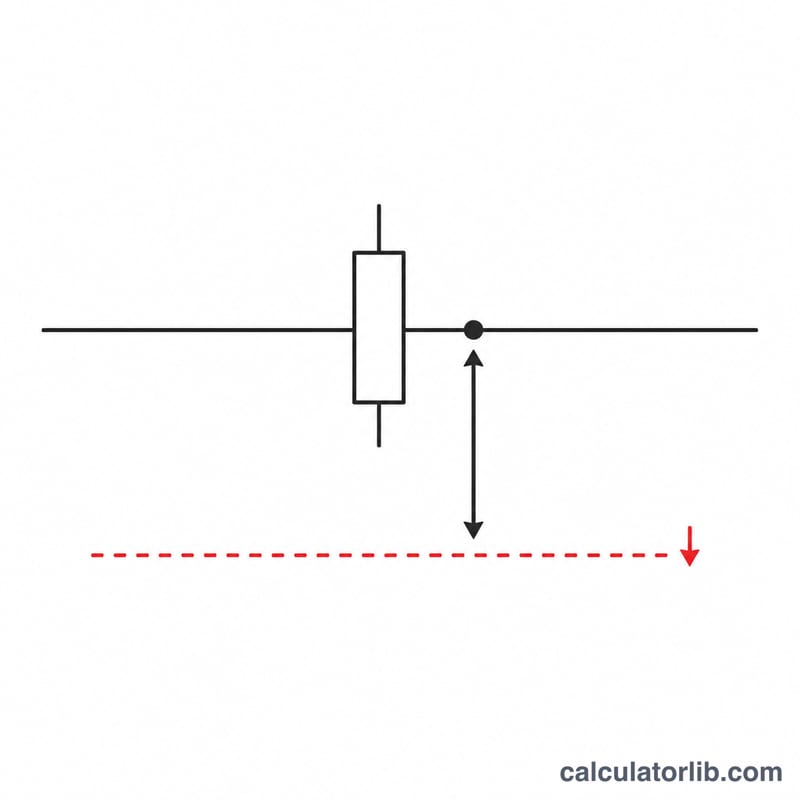
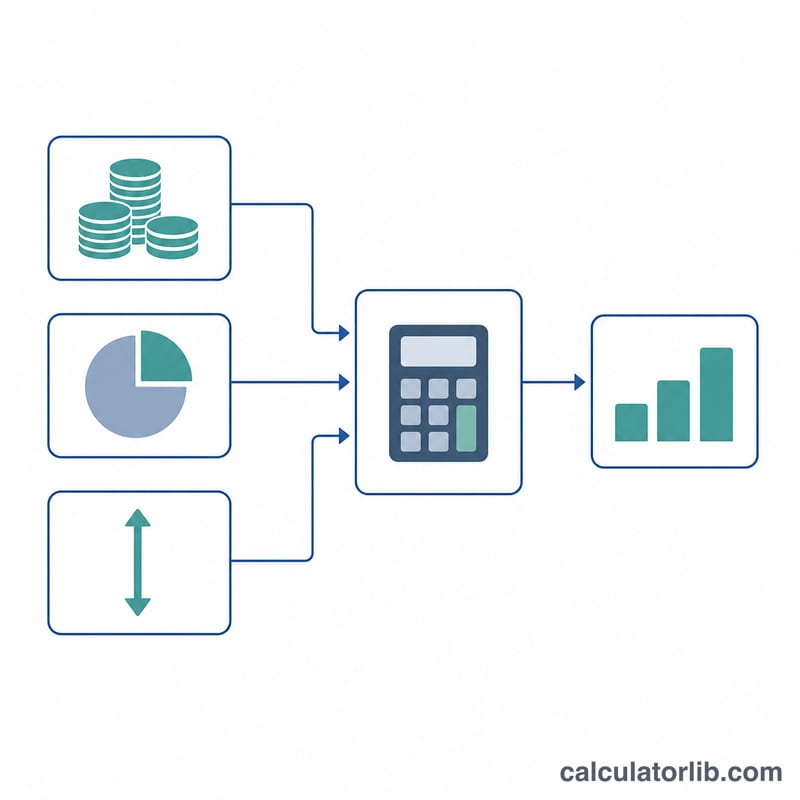
Enter four values: your account balance, the percentage of that balance you are willing to risk on this trade, your stop-loss distance in pips, and the pip value per standard lot (about \(\$10\) for most pairs quoted in USD, such as EUR/USD). The calculator returns the position size in standard lots, the equivalent units of the base currency, and the exact dollar amount at risk.
The Formula Explained
First find the money you are prepared to lose, then divide it by the loss a single lot would suffer at your stop:
$$\text{Lots} = \frac{\text{Balance} \times (\text{Risk\%}/100)}{\text{StopLoss}_{\text{pips}} \times \text{PipValue}}$$Here \(\text{Balance}\) is your account equity, \(\text{Risk\%}\) is your per-trade risk, \(\text{StopLoss}_{\text{pips}}\) is the stop distance in pips, and \(\text{PipValue}\) is the value of one pip for one standard lot. One standard lot equals 100,000 units of the base currency.
Worked Example
Suppose you have a \(\$10{,}000\) account, risk 2% per trade, use a 50-pip stop, and trade a pair with a pip value of \(\$10\). The amount at risk is:
$$\text{Risk} = 10000 \times \frac{2}{100} = \$200$$The position size is then:
$$\text{Lots} = \frac{200}{50 \times 10} = 0.40 \text{ lots}$$That equals \(0.40 \times 100000 = 40{,}000\) units of the base currency.
Pip Size and Pip Value by Pair Type
A pip is the standard smallest price step quoted for a currency pair. For most pairs it is the fourth decimal place (0.0001). For pairs quoted in Japanese yen it is the second decimal place (0.01). Pip value is what one pip of movement is worth for a given position size. This calculator asks for the pip value per standard lot (100,000 units of the base currency). The general formula is:
$$\text{Pip value (account currency)} = \frac{\text{Pip size} \times 100{,}000}{\text{Quote-to-account rate}}$$Here the "quote-to-account rate" is the price of one unit of your account currency expressed in the pair's quote currency. For a USD account trading USD/JPY, that rate is the USD/JPY price itself. If the quote currency is the same as your account currency, the rate is 1. The table assumes a USD-denominated account.
| Pair type | Examples | Pip size | Pip value per standard lot (USD account) |
|---|---|---|---|
| USD-quoted pairs (USD is the quote currency) | EUR/USD, GBP/USD, AUD/USD | 0.0001 | Fixed at $10 (0.0001 × 100,000 = 10 USD) |
| USD-base pairs (USD is the base currency) | USD/CAD, USD/CHF | 0.0001 | \(10 \div \text{exchange rate}\) in USD (10 CAD or 10 CHF converted to USD) |
| JPY pairs | USD/JPY, EUR/JPY | 0.01 | 1,000 JPY (0.01 × 100,000), converted to USD at the current USD/JPY rate |
| Cross pairs (no USD) | EUR/GBP, AUD/NZD, GBP/CHF | 0.0001 (0.01 if JPY is the quote currency) | 10 units of the quote currency, converted to USD through that quote currency's rate against USD |
Illustrative calculation (example rates only): with USD/JPY at 150, one pip on a standard lot is worth 1,000 JPY. Converted to USD:
$$\text{Pip value} = \frac{0.01 \times 100{,}000}{150} = \frac{1{,}000}{150} \approx \$6.67$$In the same way, USD/CAD at 1.35 gives \(10 \div 1.35 \approx \$7.41\) per pip. For a cross pair such as EUR/GBP, one pip is worth 10 GBP per standard lot. At an assumed GBP/USD rate of 1.25, that is \(10 \times 1.25 = \$12.50\).
Only the USD-quoted pairs have a fixed pip value for a USD account. For every other pair the pip value depends on the current exchange rate and changes as prices move, so check the live rate (or your broker's figure) before entering a pip value. A mini lot (10,000 units) has one-tenth of the standard-lot pip value, and a micro lot (1,000 units) has one-hundredth.
How Risk % and Stop Distance Change Position Size
Every row below uses a $10,000 account balance and a pip value of $10 per standard lot, as on EUR/USD for a USD account. The dollar amount at risk is the balance × risk % ÷ 100. Lots are calculated with the article's formula:
$$\text{Lots} = \frac{\text{Balance} \times \frac{\text{Risk \%}}{100}}{\text{Stop-loss (pips)} \times \text{Pip value per lot}}$$For example, 1% risk with a 20-pip stop: \(\dfrac{10{,}000 \times 0.01}{20 \times 10} = \dfrac{100}{200} = 0.50\) lots.
| Risk % | Amount at risk | 20-pip stop (lots) | 50-pip stop (lots) | 100-pip stop (lots) |
|---|---|---|---|---|
| 0.5% | $50 | 0.25 | 0.10 | 0.05 |
| 1% | $100 | 0.50 | 0.20 | 0.10 |
| 2% | $200 | 1.00 | 0.40 | 0.20 |
| 3% | $300 | 1.50 | 0.60 | 0.30 |
Within one row the dollar risk stays the same, so position size is inversely proportional to stop distance. A stop five times wider (100 pips instead of 20) gives a position one-fifth the size. Within one column, doubling the risk percentage doubles the lot size. Multiply lots by 100,000 to get units: for example, 0.20 lots = 20,000 units. These figures assume the stop is filled exactly at the stop price. Slippage, spreads and gaps can make the actual loss larger than the planned amount. This table is general information, not financial advice.
FAQ
What is a standard lot? A standard lot is 100,000 units of the base currency. A mini lot is 10,000 units (0.1 lots) and a micro lot is 1,000 units (0.01 lots).
How much should I risk per trade? Many traders cap risk at 1–2% of account equity per trade to survive losing streaks and preserve capital.
What pip value should I enter? For pairs quoted in USD, one pip on a standard lot is usually about $10. For other quote currencies, use your broker figure converted to your account currency.