What it does
This calculator reduces a number by a given percentage. It is perfect for working out sale prices, discounts, tax reductions, or any situation where you need to decrease a value by a certain percent. Enter the original number and the percentage, and the tool returns both the amount removed and the final decreased value.
The formula
To subtract a percentage \(P\) from a number \(N\), first find the portion that the percentage represents, then subtract it from the original value:
$$\text{Result} = N - \left(N \times \frac{P}{100}\right)$$Here \(N\) is the original number and \(P\) is the percentage to remove. The quantity \(N \times \frac{P}{100}\) is the amount subtracted.
How to use it
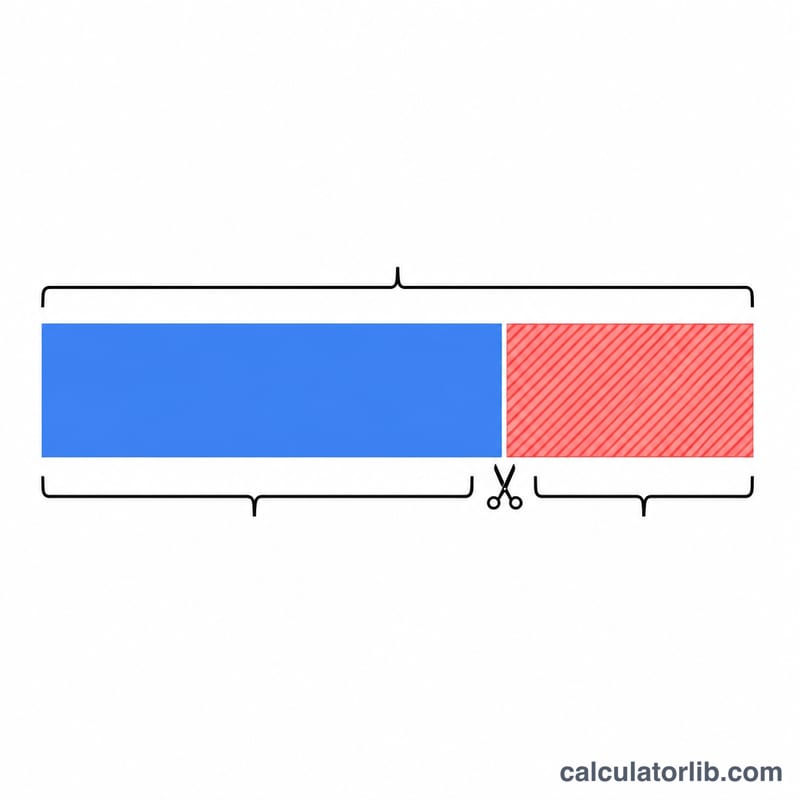
Type the starting value into the Number field and the percent you want to remove into the Percentage field. The result updates to show the final amount, and the table shows exactly how much was taken away.
Worked example
Suppose an item costs $200 and is on sale for 25% off. The discount amount is:
$$200 \times \frac{25}{100} = 50$$Subtracting that from the original price gives the sale price:
$$200 - 50 = 150$$So a 25% reduction on 200 leaves 150.
Percentage-Off Scenarios Compared
The table below starts from the same number, 200, and applies several common percentages. For each row the amount removed is calculated as \(200 \times \frac{P}{100}\), and the result is what remains after subtracting that amount: \(200 - 200 \times \frac{P}{100}\). This lets you eyeball how much a given percentage actually takes off.
| Percentage | Amount removed (\(200 \times P/100\)) | Result (200 − removed) |
|---|---|---|
| 5% | 10 | 190 |
| 10% | 20 | 180 |
| 15% | 30 | 170 |
| 25% | 50 | 150 |
| 50% | 100 | 100 |
| 75% | 150 | 50 |
Notice the pattern: removing 50% leaves exactly half, and each percentage removed is directly proportional to the starting number, so doubling the number doubles the amount removed for the same percent.
How to Subtract a Percentage by Hand
Subtracting a percentage from a number takes three short steps. The general formula is:
$$\text{Result} = N - N \times \frac{P}{100}$$where \(N\) is the starting number and \(P\) is the percentage you want to remove.
- Convert the percentage to a decimal. Divide the percent by 100: \(\frac{P}{100}\). For example, 15% becomes \(\frac{15}{100} = 0.15\).
- Multiply by the number to get the amount removed. Multiply the decimal by \(N\): \(N \times \frac{P}{100}\). With \(N = 200\), this is \(200 \times 0.15 = 30\).
- Subtract that amount from the original number. Take the amount removed away from \(N\): \(200 - 30 = 170\).
Putting the full substitution together for 200 minus 15%:
$$\text{Result} = 200 - 200 \times \frac{15}{100} = 200 - 30 = \text{}$$which gives a final answer of 170. The same three steps work for any number and any percentage.
FAQ
Can I use decimals? Yes, both the number and the percentage accept decimal values such as 12.5.
What if the percentage is over 100%? The result becomes negative, meaning you subtracted more than the original amount.
How is this different from a discount calculator? It is the same core math — subtracting a percentage is exactly how a discount off a price is computed.