What is the Anchor Scope Calculator?
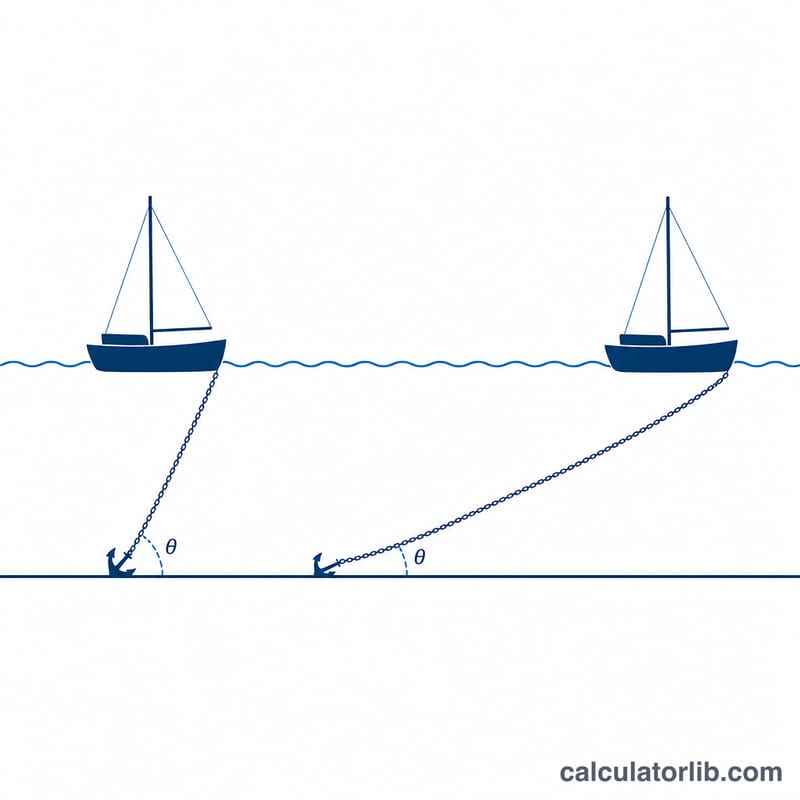
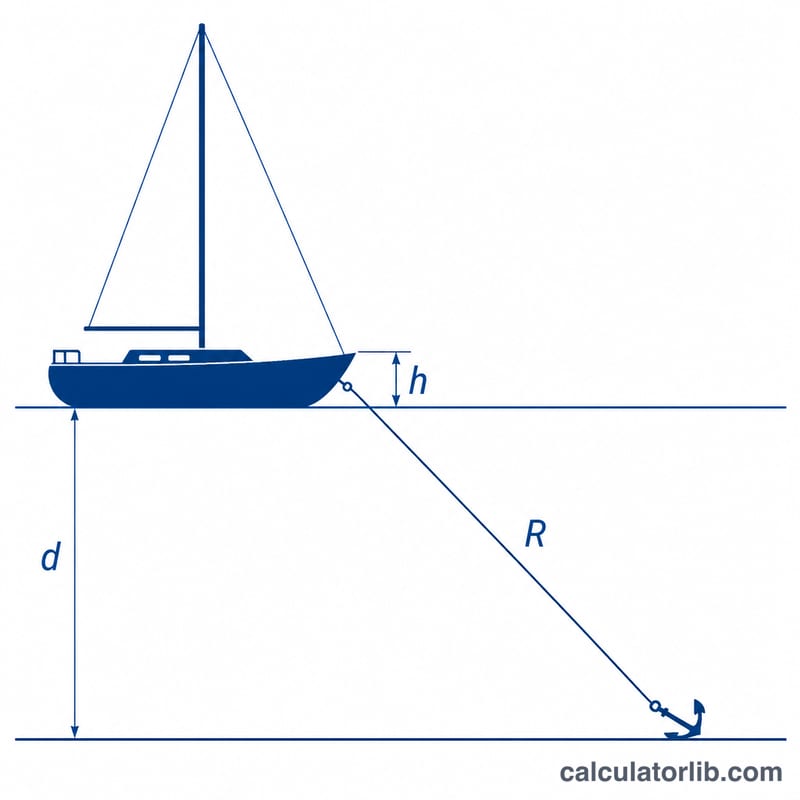
The Anchor Scope Calculator tells you how much anchor rode (chain or rope) to let out so your boat holds securely. Scope is the ratio between the length of rode deployed and the vertical distance from your bow roller down to the seabed. A larger scope lays the rode at a flatter angle, which helps the anchor dig in and hold rather than pull up and drag.
The formula explained
The rode length \(L\) is the total vertical distance multiplied by the scope ratio:
$$L = (D + H) \times S$$where \(D\) = water depth in feet, \(H\) = height of the bow roller above the water (freeboard, and any expected tidal rise), and \(S\) = the desired scope ratio. Adding \(H\) matters because the rode starts at the bow, not at the waterline. Common scope ratios range from \(5\!:\!1\) in calm conditions to \(7\!:\!1\) or more in wind and swell.
How to use it
Enter the charted or sounded water depth, your bow height above the water, and the scope ratio you want. The calculator returns the total rode to deploy. In tight anchorages, check that the resulting swing radius fits the available space.
Worked example
Suppose the depth is \(20\) ft, the bow sits \(4\) ft above the water, and you want a \(7\!:\!1\) scope:
$$L = (20 + 4) \times 7 = 24 \times 7 = 168\,\text{ft}$$You would pay out \(168\) feet of rode.
Recommended Scope Ratios
Scope is the ratio of deployed rode length to the height from the seabed to your bow roller (water depth plus bow height, also called freeboard). The values below are widely-published recreational boating guidelines and are measured from the bow roller, not from the waterline. Heavier all-chain rode holds at lower ratios than rope or rope-and-chain because the chain's weight keeps the pull on the anchor more horizontal.
| Condition / rode type | Typical scope ratio |
|---|---|
| Rope or rope-and-chain rode (general use) | ~7:1 |
| Rope or rope-and-chain rode (storm / heavy weather) | up to 10:1 |
| All-chain rode | ~4:1 to 5:1 |
| Calm conditions / short lunch stop (minimum) | ~5:1 |
These are general seamanship guidelines, not a fixed rule for every boat, anchor, or seabed. Treat higher ratios as the safer choice when wind, current, or fetch increase.
Practical Anchoring Recommendations
Use the computed rode length as a target, then adjust it with the practical checks below. This is general boating information, not professional or safety advice for your specific vessel and conditions.
- Round up to a marked length. Deploy at least the computed value, rounded up to the next whole marker on your rode (many rodes are marked every 25 ft or 10 m) so you can pay out a known amount.
- Confirm you actually carry that much rode. A 7:1 scope in deep water can call for hundreds of feet; verify your locker holds enough before you rely on it.
- Add the maximum expected tidal rise to depth first. Compute from high-tide depth, not the depth you see on arrival, so you are not under-scoped at high water.
- Check the swing radius. Your boat can swing a full circle of roughly the deployed rode length around the anchor; confirm that circle clears other boats, shallows, and hazards.
- Increase scope or anchor weight before shortening rode. If holding is marginal, let out more rode or upgrade ground tackle rather than trimming length to fit a crowded anchorage.
FAQ
Does scope differ for all-chain rode? Yes. Heavy all-chain rode holds a flatter catenary, so many boaters use \(4\!:\!1\) to \(5\!:\!1\), while rope or rope-and-chain typically needs \(7\!:\!1\).
Should I include the tide? Add the maximum expected tidal rise to your depth so you keep enough scope at high water.
What if space is limited? Reduce scope only as a last resort; increasing anchor size or using a heavier chain leader is safer than shortening rode.