
What This Calculator Does
Hotel listings usually advertise a nightly rate, but the price you actually pay is higher once occupancy taxes and one-time fees (resort fees, cleaning charges, parking) are added. This calculator takes your nightly rate, the number of nights, the tax rate, and any fixed fees and returns the full cost of your stay — along with the average cost per night and the cost split per guest.
How to Use It
Enter the nightly room rate, how many nights you are staying, the local lodging tax rate as a percentage, any one-time fees, and the number of guests sharing the room. The result shows your grand total plus a clear breakdown so you can compare hotels on a true apples-to-apples basis.
The Formula Explained
First the room subtotal is computed as rate × nights. Tax is applied to that subtotal: subtotal × (1 + taxRate). One-time fees are added afterward because they are typically not taxed per night. Finally the total is divided by the number of guests for the per-person figure, and by the number of nights for the average nightly cost.
$$\text{Total} = S + S \cdot \dfrac{\text{Tax Rate (\%)}}{100} + \text{Fees}$$ $$\text{where}\quad S = \text{Nightly Rate} \times \text{Nights}$$ $$\text{Per Person} = \frac{\text{Total}}{\text{Guests}}$$ $$\text{Avg Per Night} = \frac{\text{Total}}{\text{Nights}}$$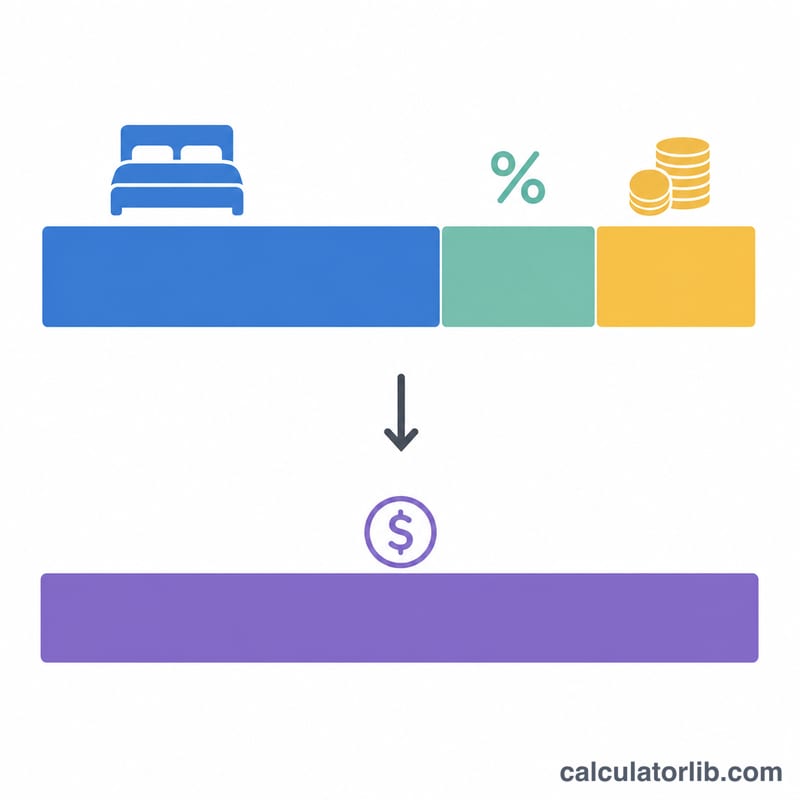
Worked Example
Suppose a room is $120 per night for 3 nights, with a 12% tax rate, $25 in fees, shared by 2 guests. The subtotal is \(120 \times 3 = \$360\). Tax is \(360 \times 0.12 = \$43.20\). Adding the $25 fee gives a total of $428.20. The average per night is \(428.20 \div 3 \approx \$142.73\), and the cost per guest is \(428.20 \div 2 = \$214.10\).
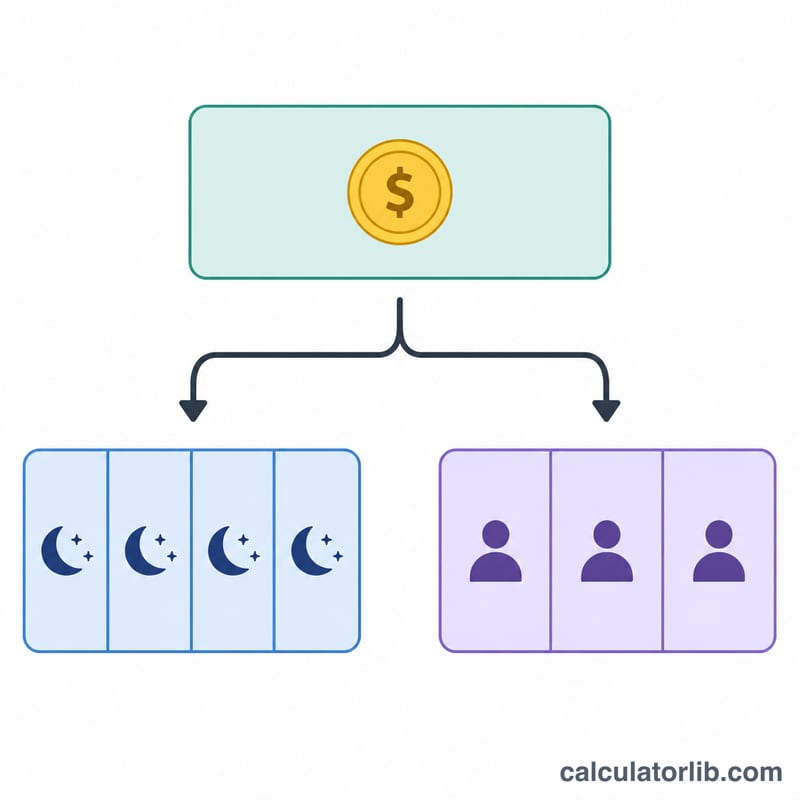
Cost Comparison Across Booking Scenarios
The four bookings below use the same calculation in every case: room subtotal = nightly rate × nights, tax applied to that subtotal at the entered percentage, then one-time fees added untaxed. Currency symbols are shown as $ for readability, but the tool is currency-agnostic — enter amounts in whatever currency your booking is quoted in, and enter the lodging tax rate that actually applies at your destination.
| Scenario | Nightly Rate | Nights | Tax Rate | One-Time Fees | Guests | Total | Avg/Night | Per Person |
|---|---|---|---|---|---|---|---|---|
| Budget motel | $90 | 4 | 10% | $0 | 2 | $396.00 | $99.00 | $198.00 |
| Mid-range hotel (resort fee) | $150 | 3 | 14% | $35 | 2 | $548.00 | $182.67 | $274.00 |
| Resort (resort + parking fees) | $220 | 5 | 15% | $175 | 4 | $1440.00 | $288.00 | $360.00 |
| Extended stay (cleaning fee) | $110 | 10 | 8% | $95 | 1 | $1,283.00 | $128.30 | $1,283.00 |
Worked check on the resort row:
$$S = 220 \times 5 = \$1{,}100 \qquad \text{Tax} = 1{,}100 \times \frac{15}{100} = \$165$$$$\text{Total} = 1{,}100 + 165 + 175 = \$1{,}440 \qquad \text{Avg/Night} = \frac{1{,}440}{5} = \$288 \qquad \text{Per Person} = \frac{1{,}440}{4} = \$360$$A lower advertised rate can cost more per night. Compare two 2-night bookings at 12% tax: Hotel A advertises $130 per night but charges a $60 mandatory fee, while Hotel B advertises $145 per night with no fees.
| Property | Advertised Rate | Subtotal (2 nights) | Tax at 12% | Fees | Total | Effective Per Night |
|---|---|---|---|---|---|---|
| Hotel A | $130 | $260.00 | $31.20 | $60 | $351.20 | $175.60 |
| Hotel B | $145 | $290.00 | $34.80 | $0 | $324.80 | $162.40 |
The cheaper-looking room is $13.20 more per night in reality, because a fixed fee spread over only two nights adds $30 per night. Over a 10-night stay the same $60 fee would add just $6 per night and Hotel A would win.
Key Terms Explained
- Nightly Rate
- The advertised room-only price for one night, before tax and before any mandatory surcharges. This is the number booking sites usually display in search results.
- Room Subtotal
- Nightly rate × nights, written \(S = R \times n\). This is the taxable base in this calculator.
- Occupancy / Lodging Tax
- A percentage levied on room revenue. In the United States it is set by state, city and county governments (often several layers stacked together) and rates differ substantially from one municipality to the next. Other countries use different mechanisms — VAT or GST on accommodation, plus in many European cities a per-person, per-night "tourist tax" that is a flat amount rather than a percentage. Enter whichever percentage rate applies to your booking; a flat per-night city tax is better entered through the fees field (amount per night × nights).
- Resort Fee
- A mandatory surcharge for amenities such as Wi-Fi, pool, gym or shuttle, charged whether or not you use them. It may be quoted daily or per stay — if it is daily, multiply by the number of nights before entering it.
- Cleaning Fee
- A one-time charge common on vacation rentals and short-term-rental platforms, covering turnover cleaning regardless of stay length.
- One-Time Fees
- In this calculator, the fees field holds fixed charges that are added after tax and are not multiplied by nights — parking, pet fees, cleaning, early check-in and similar. Note that in real invoices some of these charges are themselves taxable; this tool treats them as untaxed, so a real folio may run slightly higher.
- Grand Total
- Subtotal + tax + fees — the amount you actually pay.
- Average Cost Per Night
- Grand total ÷ nights. Because it includes tax and fees, it is always at least as high as the advertised nightly rate, and higher whenever any tax or fee applies.
- Cost Per Guest
- Grand total ÷ number of guests — an even split of the whole bill.
- ADR (Average Daily Rate)
- The hotel-industry metric for room-only revenue divided by rooms sold. ADR deliberately excludes taxes and fees, so a property's published ADR is comparable to the nightly rate input here, not to the average cost per night this tool returns.
Understanding Your Total and Per-Night Figures
Your average per night will exceed the advertised rate. Whenever a tax rate or a fee is entered, the grand total is larger than the room subtotal, so dividing it by the same number of nights necessarily produces a bigger per-night number. In the mid-range example above, a $150 advertised rate becomes $182.67 per night once 14% tax and a $35 fee are counted — a difference of nearly $33 a night that never appears in the search-results price.
The gap shrinks as the stay lengthens. The percentage tax scales with the stay, but fixed fees do not: a single fee is amortized over more and more nights. The effective markup over the advertised rate is
$$\text{Markup} = \frac{\text{Total}}{S} - 1 = \frac{t}{100} + \frac{F}{S}$$where \(t\) is the tax rate, \(F\) the one-time fees and \(S\) the room subtotal. The first term is fixed; the second falls as \(S\) grows with nights. For the extended-stay row, the markup is \(0.08 + 95/1100 = 0.1664\), or 16.64% — so \(110 \times 1.1664 = \$128.30\) per night, matching the table. Cut that same booking to two nights and the fee term becomes \(95/220 = 0.4318\), pushing the markup above 51%. This is exactly why a fee-heavy property is punishing for weekend trips and tolerable for long ones.
The per-guest figure is a plain even split. It divides the grand total by the guest count and nothing more. It does not know who shares a bed, whether a child occupies no extra space, whether one traveller arrived a night late, or whether the property charges a per-person occupancy supplement. If your group is splitting unevenly, treat the per-person number as a starting point and adjust by hand.
Your total is only as good as the tax rate you enter. Lodging tax is a local matter — in the US it is layered from state, county and city levels and varies widely between destinations; elsewhere it may be VAT/GST, a flat per-person city tax, or a combination. There is no universal default, and this calculator does not look one up for you. Take the rate from the property's own price breakdown or the booking confirmation rather than assuming a familiar figure from home. Likewise, if a resort fee is quoted per night, convert it to a stay total before entering it in the fees field.
Compare grand totals, not nightly rates. Advertised rates are the least comparable number in hospitality pricing, because different properties push different shares of the price into fees and different cities tax at different rates. Run each candidate booking through the calculator and line up the grand totals — or the average cost per night when the stays differ in length. That single figure is what leaves your account, and it is the only basis on which two bookings can be judged fairly.
This section is general information to help you interpret the arithmetic, not tax or financial advice; for the tax treatment of a specific booking or a reimbursable business trip, check the property's invoice and consult a qualified professional.
FAQ
Are fees taxed? In this calculator fees are added after tax, matching how most resort and cleaning fees appear. If your fee is taxable, simply roll it into a higher tax rate.
Can I include multiple tax types? Yes — add together all percentage-based taxes (state, city, occupancy) into the single tax rate field.
Does this work for multi-room bookings? Enter the combined nightly rate of all rooms and the total guest count to split the cost across everyone.