What is the anion gap with potassium?
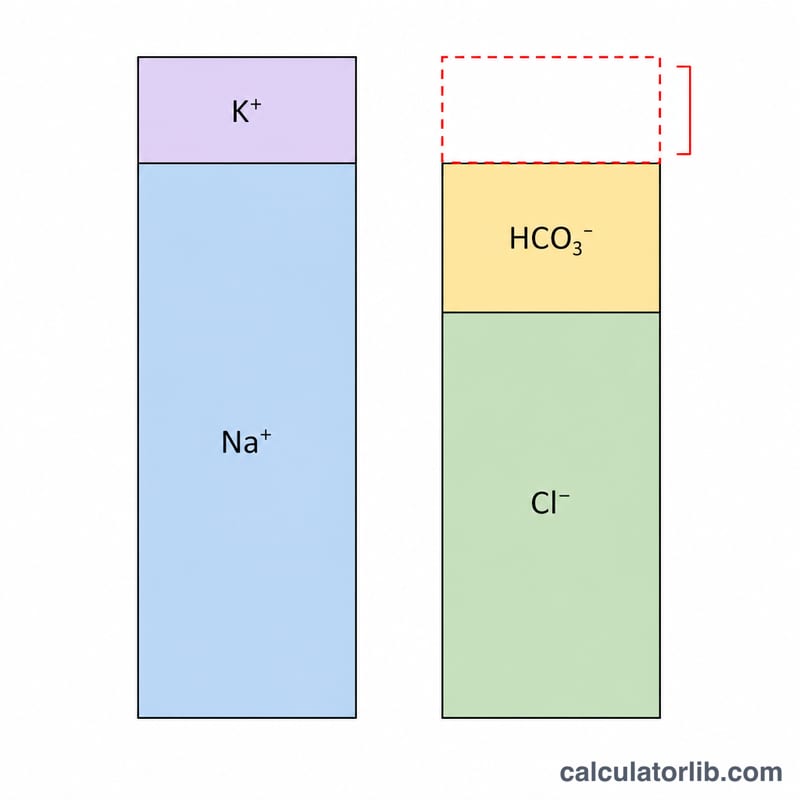
The anion gap is a calculated value that estimates the difference between the measured serum cations and anions. Because the body stays electrically neutral, this apparent gap actually reflects the unmeasured anions (such as albumin, phosphate, sulfate, and organic acids). Including potassium adds the second major cation to the calculation, which shifts the normal reference range upward to roughly 10–20 mEq/L compared with the potassium-free version.
The formula
This calculator uses the potassium-inclusive equation:
$$\text{AG} = (\text{Na}^+ + \text{K}^+) - (\text{Cl}^- + \text{HCO}_3^-)$$where \(\text{Na}^+\) is serum sodium, \(\text{K}^+\) is potassium, \(\text{Cl}^-\) is chloride, and \(\text{HCO}_3^-\) is bicarbonate, all in mEq/L.
How to use it
Enter the four electrolyte values from a basic metabolic panel and submit. The tool returns the anion gap in mEq/L along with a simple interpretation. A high gap suggests accumulation of unmeasured anions (for example lactic acidosis, ketoacidosis, or toxins), while a normal or low gap points toward other mechanisms.
Worked example
For \(\text{Na}^+ = 140\), \(\text{K}^+ = 4.0\), \(\text{Cl}^- = 104\), and \(\text{HCO}_3^- = 24\):
$$\text{AG} = (140 + 4.0) - (104 + 24) = 144 - 128 = 16\ \text{mEq/L}$$This value falls within the normal potassium-inclusive range.
Interpreting Your Anion Gap Result
The anion gap estimates the concentration of unmeasured anions in serum, such as albumin, phosphate, sulfate and organic acids. This version includes potassium:
$$\text{AG} = (\text{Na}^{+} + \text{K}^{+}) - (\text{Cl}^{-} + \text{HCO}_{3}^{-})$$Potassium adds roughly 3.5–5 mEq/L to the result. Ranges for the potassium-inclusive gap therefore run about 4 mEq/L higher than ranges for the more common formula without potassium. That formula often uses about 8–16 mEq/L, or lower on modern ion-selective electrode analyzers. Always compare your result with a range for the same formula.
General categories (K⁺-inclusive formula)
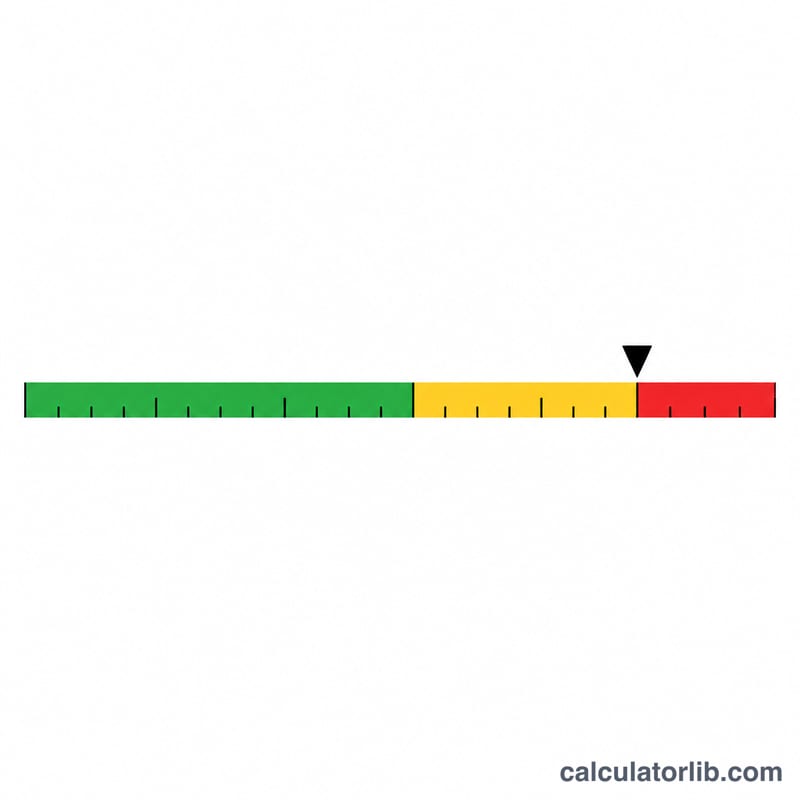
- Normal (about 10–20 mEq/L): No excess of unmeasured anions is suggested. A normal gap does not rule out a metabolic acidosis. A normal-gap (hyperchloremic) acidosis can still be present if bicarbonate is low.
- High (above about 20 mEq/L): This suggests unmeasured acids are building up, which is a high-anion-gap metabolic acidosis. Common causes are often remembered with the mnemonics MUDPILES or GOLDMARK. They include lactic acidosis, ketoacidosis (diabetic, alcoholic or starvation), toxic alcohols (methanol, ethylene glycol), salicylate poisoning, uremia from kidney failure, and others such as iron, isoniazid, 5-oxoproline (pyroglutamic acid) from long-term acetaminophen use, and D-lactate.
- Low (below about 10 mEq/L): This is uncommon. The most frequent cause is low albumin, because albumin is the main unmeasured anion. Other causes are positively charged paraproteins (for example, in multiple myeloma), raised unmeasured cations (such as calcium, magnesium or lithium), bromide or iodide interference that falsely raises the chloride reading, and laboratory or sampling error.
Normal-gap (hyperchloremic) metabolic acidosis
When bicarbonate is low but the gap is normal, chloride usually rises to replace the lost bicarbonate. Typical causes are:
- bicarbonate lost through the gut, such as diarrhea or pancreatic and biliary fistulas
- renal tubular acidosis (types 1, 2 and 4)
- large volumes of normal saline
- carbonic anhydrase inhibitors such as acetazolamide
- urinary diversions such as a ureterosigmoidostomy
Albumin correction
Low albumin lowers the measured gap and can hide a high-gap acidosis. A widely used correction adds about 2.5 mEq/L for every 1 g/dL that albumin falls below 4 g/dL:
$$\text{AG}_{\text{corrected}} = \text{AG} + 2.5 \times (4.0 - \text{albumin in g/dL})$$For example, a measured gap of 16 mEq/L with albumin at 2.0 g/dL gives \(16 + 2.5 \times (4.0 - 2.0) = 16 + 5 = 21\) mEq/L. That is above the usual range even though the uncorrected value looked normal.
Reference ranges vary
Normal ranges depend on the laboratory, the analyzer method (for example, direct or indirect ion-selective electrodes), and whether potassium is included. The 10–20 mEq/L band used here is a general approximation. Your laboratory's own range is the one that applies.
Important: This calculator and explanation are general educational information, not a diagnosis or medical advice. Acid-base problems are assessed using the whole clinical picture, including blood gases, osmolal gap, ketones, lactate and kidney function. Discuss any abnormal result with a qualified healthcare professional.
Anion Gap Across Example Scenarios
The panels below are illustrative examples only. They show how different electrolyte patterns change the potassium-inclusive anion gap. They are not real patient data, and they cannot be used to diagnose any condition. Each gap is calculated as \((\text{Na}^{+} + \text{K}^{+}) - (\text{Cl}^{-} + \text{HCO}_{3}^{-})\). Categories use the approximate 10–20 mEq/L range.
| Pattern | Na⁺ (mEq/L) | K⁺ (mEq/L) | Cl⁻ (mEq/L) | HCO₃⁻ (mEq/L) | Calculation | Anion gap (mEq/L) | Category vs 10–20 |
|---|---|---|---|---|---|---|---|
| Normal panel | 140 | 4 | 104 | 24 | (140 + 4) − (104 + 24) | 16 | Normal |
| High-gap pattern | 138 | 4.5 | 100 | 12 | (138 + 4.5) − (100 + 12) | 30.5 | High: suggests unmeasured acids, such as lactate or ketones |
| Normal-gap hyperchloremic pattern | 140 | 3.5 | 115 | 15 | (140 + 3.5) − (115 + 15) | 13.5 | Normal gap with low HCO₃⁻ and high Cl⁻, as seen with diarrhea or renal tubular acidosis |
| Low-gap pattern | 138 | 4 | 108 | 27 | (138 + 4) − (108 + 27) | 7 | Low: consider low albumin, paraproteins or lab error |
Bicarbonate is low (12 and 15 mEq/L) in both the high-gap and the hyperchloremic examples. Only the high-gap panel has a gap above the range. In the hyperchloremic panel, the rise in chloride makes up for the lost bicarbonate. This is why the gap helps tell the two main types of metabolic acidosis apart. If albumin is low, apply the albumin correction before you assign a category.
FAQ
Should I include potassium? Both conventions are valid; just apply the matching reference range. Many clinicians omit potassium because its concentration is low and tightly regulated.
Does albumin matter? Yes. Low albumin lowers the apparent gap, so a corrected anion gap may be needed in hypoalbuminemia.
Is this a diagnosis? No. The anion gap is a screening aid and should be interpreted with the full clinical picture.