What is the Injection Molding Shot Size Calculator?
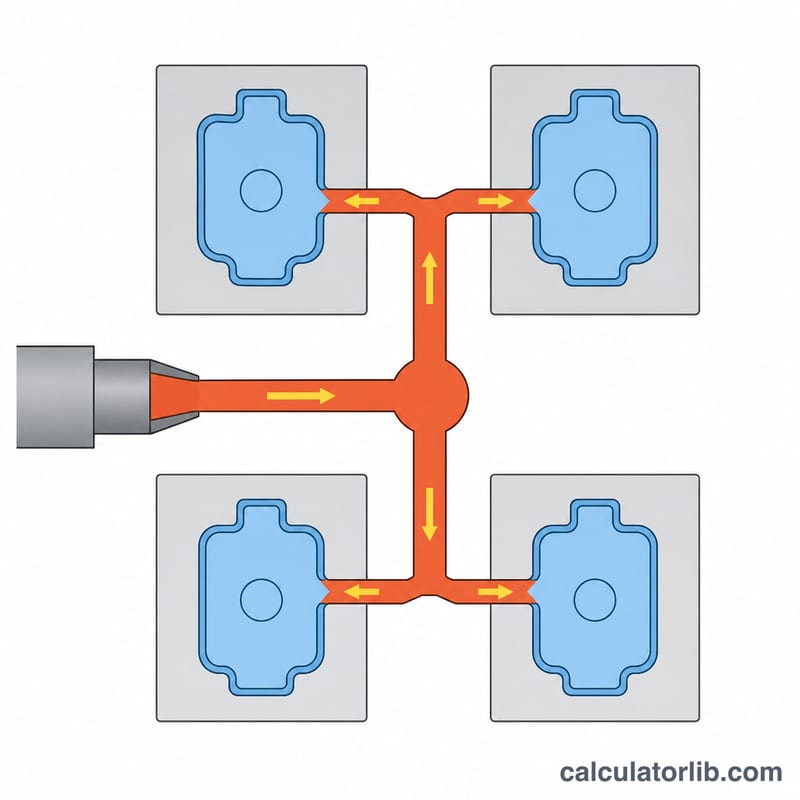
The shot size is the total amount of molten plastic a machine injects into the mold during one cycle. It includes every cavity plus the runner and sprue system. This calculator turns the part volume, cavity count, runner overhead and material density into a required shot volume, a shot weight in grams, and the percentage of your machine capacity that shot consumes. The core relationship is:
$$W_{shot} = V_{part} \times N \times (1 + r) \times \rho$$
where \(V_{part}\) = single-part volume in cm³, \(N\) = number of cavities, \(r\) = runner and sprue overhead as a fraction, and \(\rho\) = material density in g/cm³.
How to use it
Enter the volume of one molded part, the number of cavities in the tool, and a runner overhead percentage (typically 10–20% for a balanced hot or cold runner). Add the material density and your machine rated shot capacity in grams. Machine capacity is usually quoted for polystyrene (density \(1.05\) g/cm³), so the calculator scales it to your resin using \(\rho / 1.05\).
Worked example
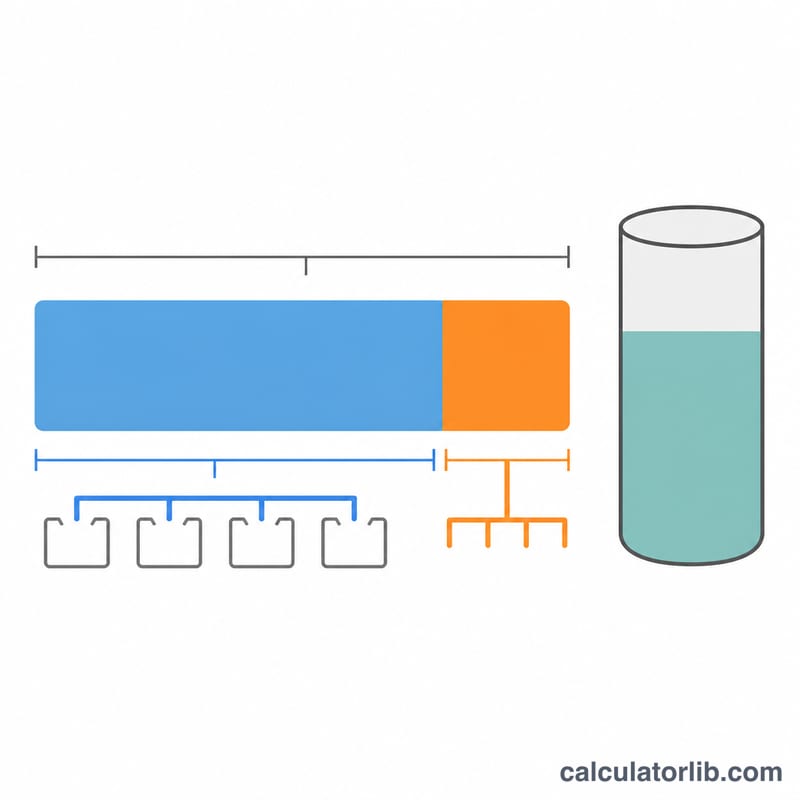
Suppose \(V_{part} = 50\) cm³, \(N = 2\), \(r = 0.15\), \(\rho = 0.95\) g/cm³ and a machine capacity of 200 g. The total part volume is \(50 \times 2 = 100\) cm³, so the shot volume is:
$$V_{shot} = 100 \times (1 + 0.15) = 115\ \text{cm}^3$$
$$W_{shot} = 115 \times 0.95 = 109.25\ \text{g}$$
The maximum shot for this resin is \(200 \times \tfrac{0.95}{1.05} = 180.95\) g, giving a utilization of \(109.25 / 180.95 \times 100 = 60.4\%\), safely inside the recommended 20–80% window.
Common Resin Densities
Shot weight is calculated from part volume, cavitation, runner overhead and material density. Because the density term scales the result directly, using the value for the grade you actually run matters. The table below lists typical solid densities (at room temperature, ISO 1183 basis) for common molding resins in g/cm³. These are representative values for general engineering estimates — always confirm the exact figure on the supplier's material datasheet, since additives, fillers and grade chemistry shift it.
| Resin | Abbreviation | Typical solid density (g/cm³) |
|---|---|---|
| Polypropylene | PP | ~0.905 |
| High-density polyethylene | HDPE | ~0.95 |
| Polystyrene | PS | ~1.05 |
| Acrylonitrile butadiene styrene | ABS | ~1.05 |
| Polyamide 6 (nylon 6) | PA6 | ~1.14 |
| Polymethyl methacrylate (acrylic) | PMMA | ~1.18 |
| Polycarbonate | PC | ~1.20 |
| Polyethylene terephthalate | PET | ~1.38 |
| Polyoxymethylene (acetal) | POM | ~1.41 |
| Glass-filled grades (e.g. PA6-GF30) | PA6-GF30 | ~1.36 (rises with glass content) |
Two practical notes. First, glass- or mineral-filled grades are denser than their unfilled base resin, and the density climbs with filler loading — a 30% glass-filled nylon sits well above neat PA6, so use the filled-grade figure, not the base-polymer figure. Second, the values above are solid densities. The polymer melt is less dense (roughly 0.8–0.9× the solid value for semi-crystalline resins), so if you are sizing to the barrel's swept (plasticizing) capacity rather than to finished part mass, check whether your machine capacity is rated in polystyrene-equivalent grams or in actual melt volume.
FAQ
Why keep utilization between 20% and 80%? Below 20% the resin dwells too long and can degrade; above 80% you risk short shots and inconsistent packing.
Do I need the runner overhead? Yes, unless you use a fully hot-runner valve-gate system. The runner and sprue add real material to every shot.
Why scale machine capacity by density? Machine shot ratings assume polystyrene. A denser resin weighs more for the same swept screw volume, so the usable gram capacity changes with \(\rho\).