What is the Hay Bale Weight Calculator?
The Hay Bale Weight Calculator estimates how much a rectangular (square) hay bale weighs based on its physical dimensions and the density of the packed hay. Knowing bale weight helps farmers plan feed rations, load trailers safely, price hay by the ton, and size storage. Because you rarely have a scale in the field, a quick estimate from the bale's size is often the most practical option.
The formula explained
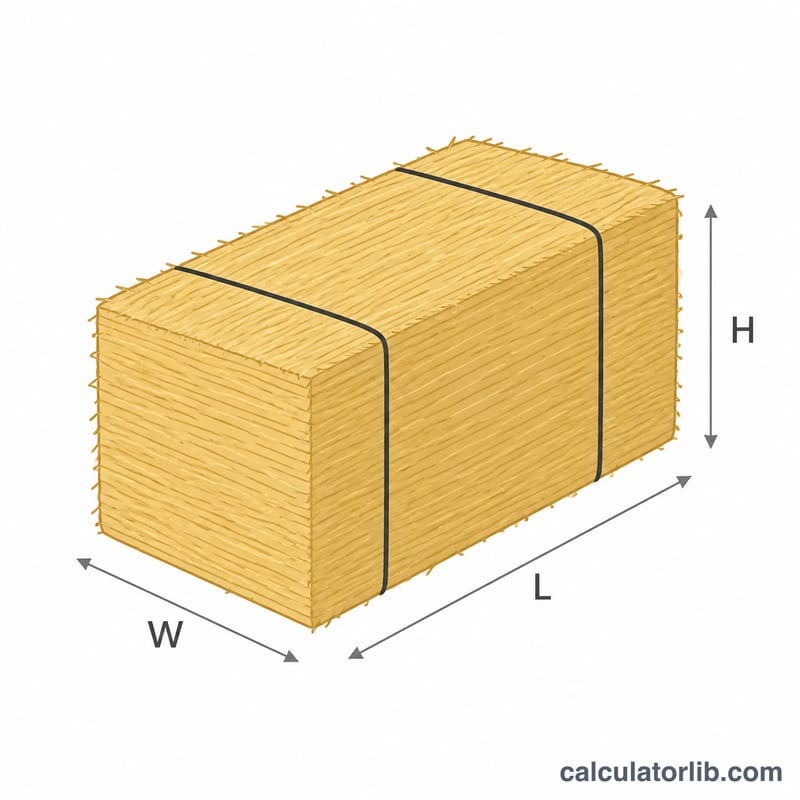
The calculator first finds the bale's volume, then multiplies by density. The volume of a rectangular bale is:
$$V = l \times w \times h$$The weight is the volume times the hay density \(\rho\):
$$\text{Weight} = l \times w \times h \times \rho$$Here \(l\), \(w\) and \(h\) are the length, width and height in feet, \(V\) is the volume in cubic feet, and \(\rho\) is density in pounds per cubic foot. Baled hay density typically ranges from about \(5\) to \(11\ \text{lb/ft}^3\) depending on how tightly it is packed and its moisture content.
How to use it
Measure the bale's length, width and height in feet and enter them. Then enter the hay density in pounds per cubic foot (use around \(10\) for a typical firm bale). The calculator returns the volume and the estimated weight in pounds.
Worked example
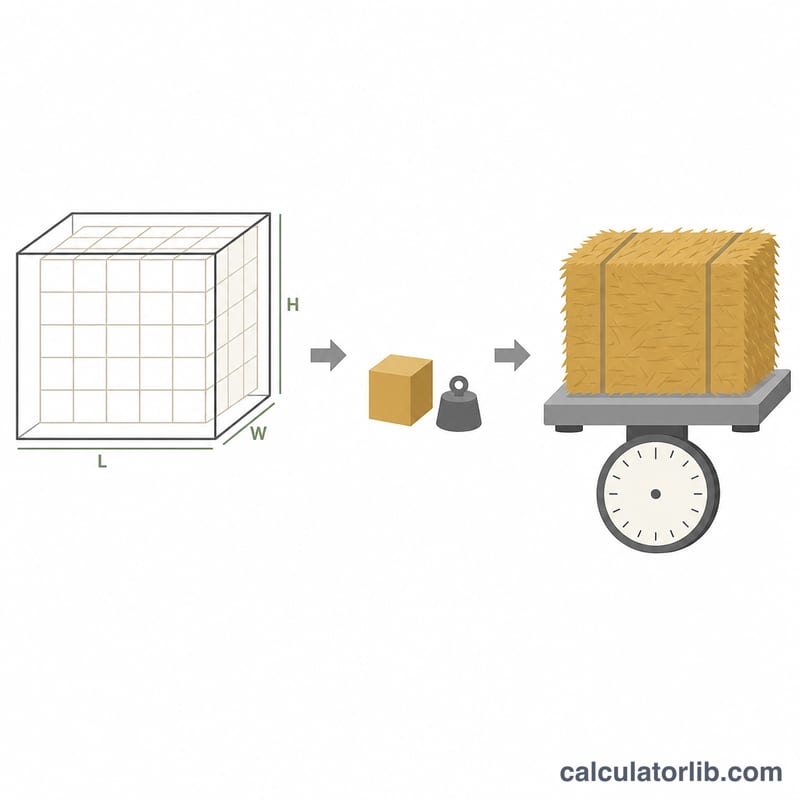
Suppose a bale measures \(3\ \text{ft}\) long, \(2\ \text{ft}\) wide and \(2\ \text{ft}\) high, at a density of \(10\ \text{lb/ft}^3\). First the volume:
$$V = 3 \times 2 \times 2 = 12\ \text{ft}^3$$Then the weight:
$$\text{Weight} = 12 \times 10 = 120\ \text{lb}$$Typical Hay Density by Type and Moisture
Baled hay weight is driven by how much material is packed into each cubic foot of the bale. In the calculator's formula \(\text{Weight} = l \times w \times h \times \rho\), the density \(\rho\) (in lb/ft³) is the value that varies most between one bale and the next. The ranges below are general estimates for packed rectangular (small‑square and large‑square) bales; they are not tied to any single national standard, and actual density depends on the crop, cut, curing and how tightly the baler was set.
| Hay type / bale style | Typical baled density (lb/ft³) | Notes |
|---|---|---|
| Loose grass hay (e.g. timothy), softly packed | ~5–7 | Stemmy, fluffy, low compression; lightest bales |
| Firm mixed grass hay | ~8–9 | Well‑cured, moderately compressed general‑purpose bales |
| Tightly packed alfalfa / dense small square | ~10–11 | Leafy legume or high‑compression baler; heaviest per cubic foot |
These figures assume hay that is dry and safely stored (commonly around 10–18% moisture for baling). Density shifts upward as moisture content rises, because water adds weight to the same volume of material: a bale baled or stored damp can weigh noticeably more than the same‑size dry bale, and the extra water also raises the risk of spoilage and heating. If you know your hay is on the wetter end, expect the effective density — and therefore the calculated weight — to land toward or above the top of these ranges.
As a worked check, a firm mixed‑grass bale measuring 3 ft long, 1.5 ft wide and 1.25 ft high at a density of 9 lb/ft³ gives \(3 \times 1.5 \times 1.25 \times 9\), so \(5.625 \text{ ft}^3 \times 9 \text{ lb/ft}^3 = \) 50.625 lb. Pick the density row that best matches your hay type, adjust upward if the bale feels heavy or was baled damp, and enter it as \(\rho\) to estimate your bale's weight.
FAQ
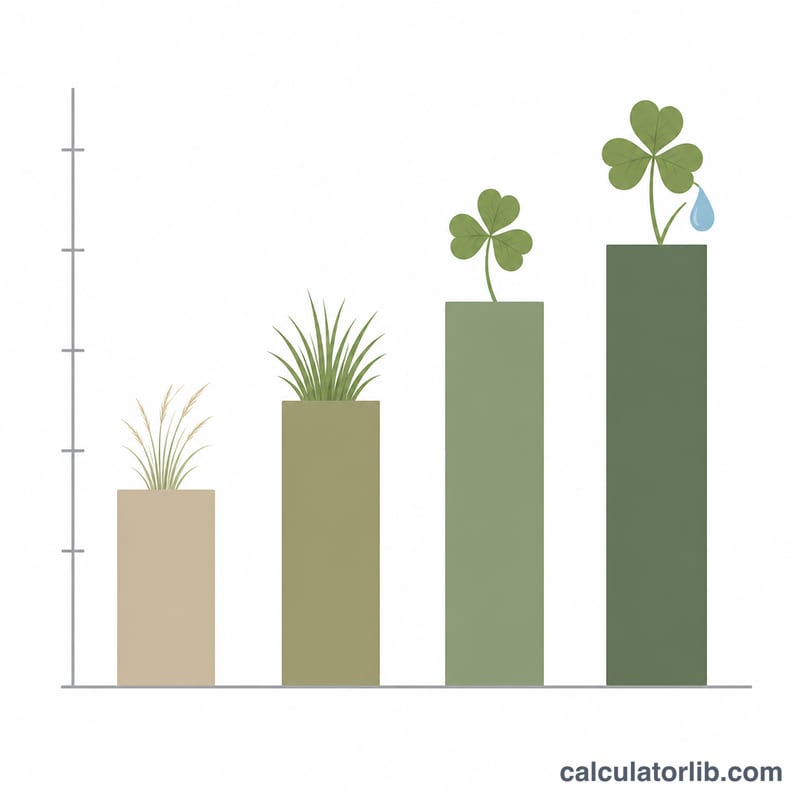
What density should I use? A loosely packed bale may be near \(5\ \text{lb/ft}^3\), while a tightly packed, drier bale can exceed \(10\ \text{lb/ft}^3\). If unsure, \(10\) is a reasonable starting point.
Does moisture affect the result? Yes. Wetter hay is denser and heavier, so higher moisture increases the effective density and the estimated weight.
Can I use it for round bales? This version models rectangular bales. For a round bale you would compute the cylinder volume separately, then multiply by density.