What this calculator does
A round bale is a cylinder of hay, so its weight depends on its size and how tightly it was packed. This calculator estimates the volume and weight of one round bale, then works out how many bales a group of animals will need over a feeding period, allowing for hay moisture and feeding waste. It uses imperial units (feet, pounds).
How to use it
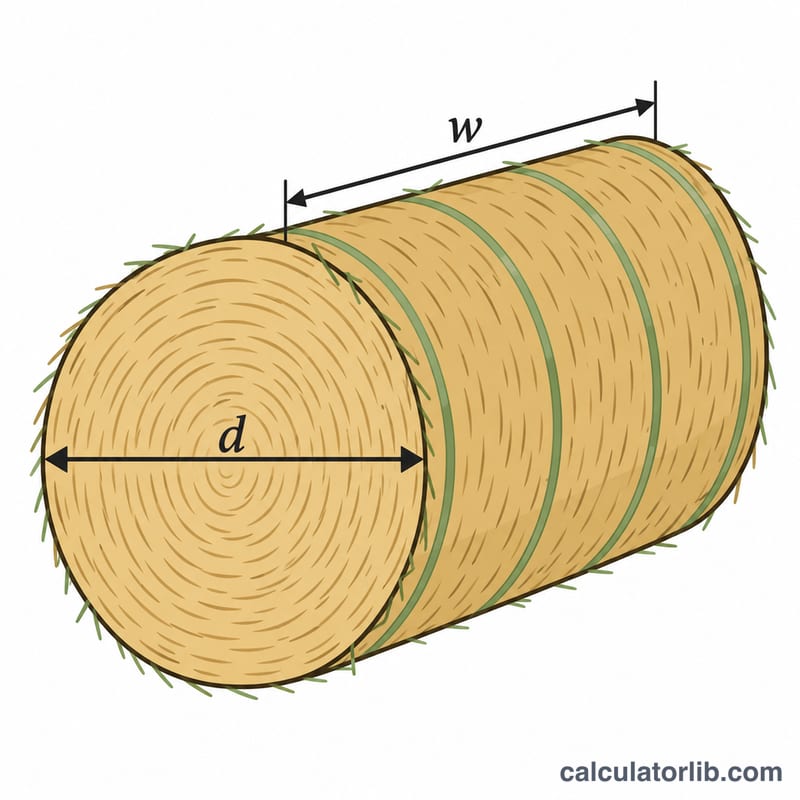
Enter the bale diameter and width in feet, the as-fed density in lb/ft³ (typically 6 to 12 for round bales), and the hay moisture percentage. Then enter the number of animals, their average weight, daily dry matter intake as a percent of body weight (often 2 to 3 percent for beef cattle), expected waste, and the number of days to feed.
The formulas
Bale volume is the volume of a cylinder, and weight is volume times density:
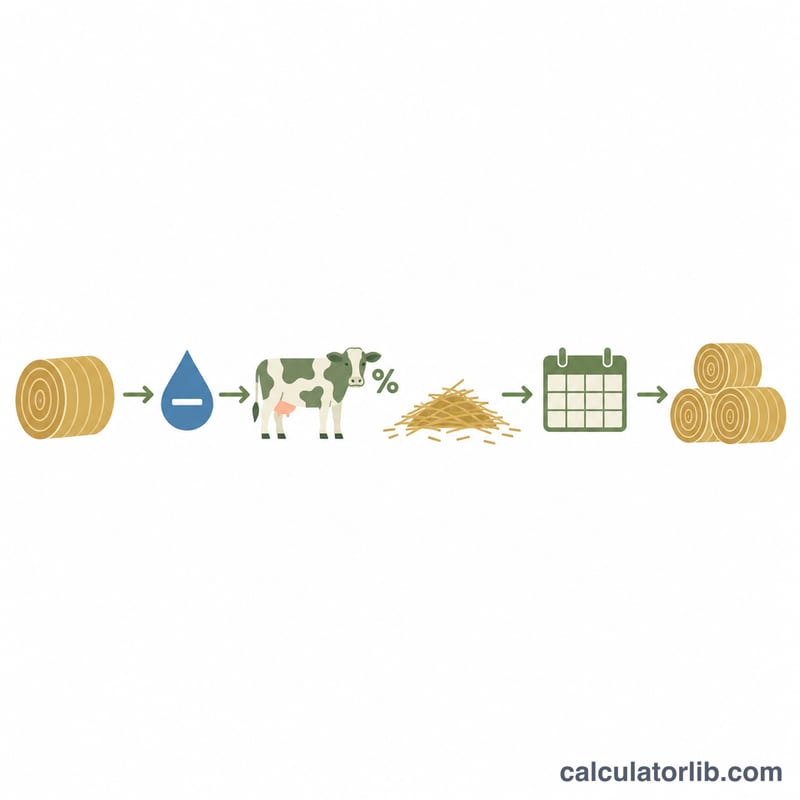
$$W_{bale} = \frac{\pi}{4} D^2 L \times \rho$$where \(D\) = diameter, \(L\) = width, and \(\rho\) = density. Dry matter is \(W_{bale}(1 - m)\) with \(m\) the moisture fraction. Daily need is \(\text{Head} \times BW \times I\), divided by \(1 - w\) to cover waste \(w\). Bales needed equal total need divided by dry matter per bale.
Worked example
A 5 ft by 4 ft bale at 10 lb/ft³ and 15 percent moisture, fed to 20 animals of 1,000 lb at 2.5 percent intake with 10 percent waste for 100 days:
$$V = \frac{\pi}{4}\times 5^2 \times 4 = 78.54\,\text{ft}^3,\quad W = 785.4\,\text{lb}$$$$DM = 785.4 \times 0.85 = 667.6\,\text{lb}$$$$\text{Daily} = \frac{20 \times 1000 \times 0.025}{0.9} = 555.6\,\text{lb}$$$$N = \frac{555.6 \times 100}{667.6} = 83.2 \approx 84\ \text{bales}$$Typical Round Bale Sizes and Weights
Round bales are cylinders, so volume is \(V = \frac{\pi}{4} D^2 L\), where \(D\) is the diameter and \(L\) is the width (length) of the bale, both in feet. Sizes below are written as width × diameter in feet. Weights are as-fed (including the moisture in the hay), calculated as volume × density, and rounded to the nearest pound. Real bales vary with the baler, the crop, the moisture and how tightly the bale was made. A scale is the only way to know the true weight. Units are US customary (ft, lb).
| Size (width × diameter, ft) | Volume (ft³) | 6 lb/ft³ (lb) | 8 lb/ft³ (lb) | 10 lb/ft³ (lb) | 12 lb/ft³ (lb) |
|---|---|---|---|---|---|
| 4 × 4 | 50.3 | 302 | 402 | 503 | 603 |
| 4 × 5 | 78.5 | 471 | 628 | 785 | 942 |
| 5 × 4 | 62.8 | 377 | 503 | 628 | 754 |
| 5 × 5 | 98.2 | 589 | 785 | 982 | 1,178 |
| 5 × 6 | 141.4 | 848 | 1,131 | 1,414 | 1,696 |
| 6 × 5 | 117.8 | 707 | 942 | 1,178 | 1,414 |
Example of the arithmetic for a 5 × 4 bale (width 5 ft, diameter 4 ft): \(V = 0.7854 \times 4^2 \times 5 = 62.83\) ft³. At 10 lb/ft³ that is \(62.83 \times 10 = 628\) lb as-fed.
Typical Dry Matter Intake and Waste Ranges
The values below are general extension-type ranges. They vary with forage quality, animal condition, weather, production stage and local recommendations, so treat them as starting points and adjust to your own situation. Intake is expressed as dry matter (DM) as a percent of body weight per day.
| Animal class | Typical DM intake (% of body weight) |
|---|---|
| Mature beef cow, maintenance | about 2 to 2.5% |
| Lactating beef cow | about 2.5 to 3% |
| Growing cattle | about 2.5 to 3% |
| Horses | about 1.5 to 2.5% |
| Sheep and goats | about 2 to 4% |
| Item | Typical range |
|---|---|
| Moisture of dry baled hay | about 12 to 18% |
| Waste, unrestricted open (free-choice) feeding on the ground | about 20 to 30% or more |
| Waste, ring feeder | about 5 to 10% |
| Waste, unrolling or limit feeding | about 5 to 10% |
Waste in the calculator is the share of hay offered that is not eaten. It is trampled, soiled or left behind. Haylage and baleage have much higher moisture than dry hay, so enter the moisture value that matches your forage.
FAQ
What density should I use?
Weigh a few of your own bales if you can. Tight net-wrapped bales may reach 10 to 12 lb/ft³, while loose or older bales are often 6 to 8.
Why account for waste?
Hay fed in the open is trampled and refused. Unrolling or using a ring feeder reduces waste, often from 20 percent or more to under 10 percent.
Is the result exact?
No. It is an estimate; hay quality, animal class and weather change intake, so keep a small safety margin.