What the Corn Bin Capacity Calculator does
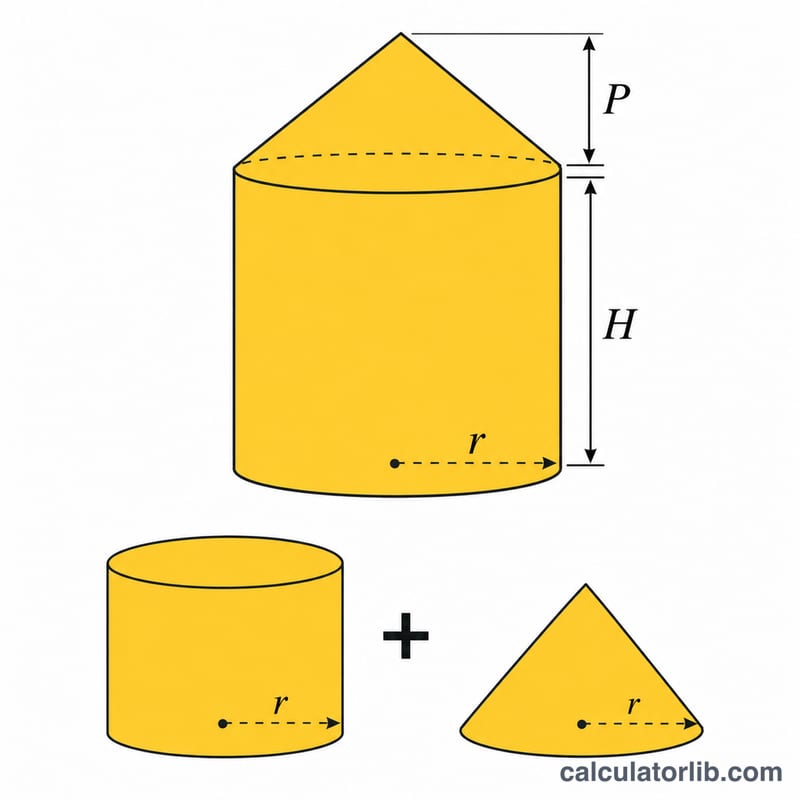
This tool estimates how many US bushels of shelled corn fit in a round, flat-bottom grain bin. Enter the bin diameter, the depth of grain along the sidewall and the height of the peak (the cone of grain heaped in the center), and it returns bushels, cubic feet and approximate weight. Units are feet and US dry bushels.
How to use it
Measure the inside diameter of the bin in feet. Enter the grain depth at the wall, which is the filled height of the cylinder. Then enter the peak height, which is the extra height of the cone above the sidewall level. Enter 0 for a level-filled bin. A typical grain peak has an angle of repose near 23 degrees, so the peak is roughly 0.2 times the diameter for a fully heaped bin.
The formula explained
The grain is modeled as a cylinder plus a cone, where \(r\) is the radius, \(h\) is the sidewall depth and \(p\) is the peak height:
$$V = \pi r^2 h + \tfrac{1}{3}\pi r^2 p$$One US bushel occupies about 1.2445 cubic feet, so multiply by 0.8036 to convert:
$$\text{Bushels} = V \times 0.8036$$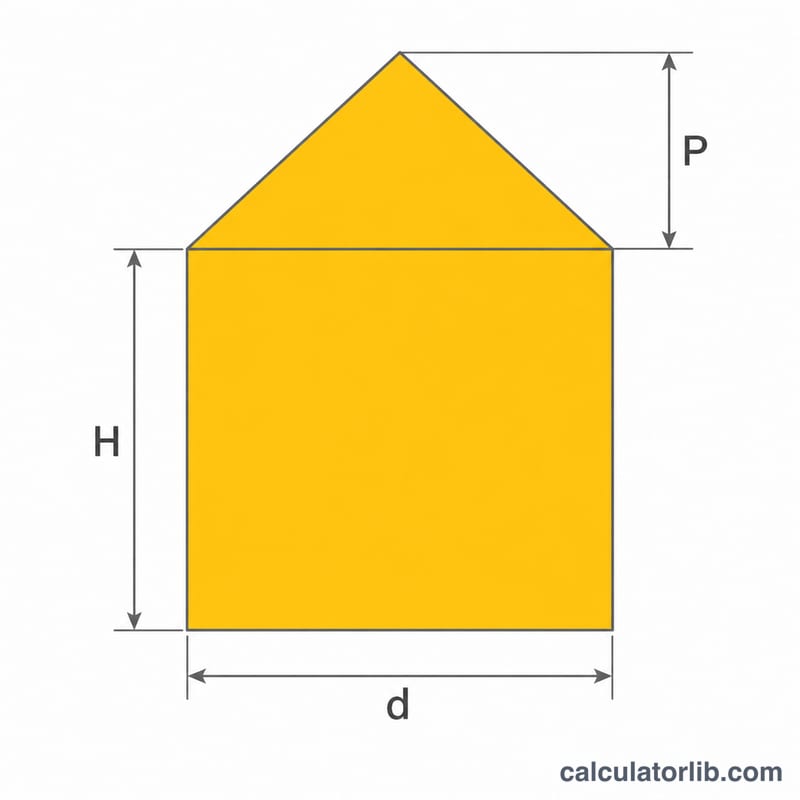
Worked example
A bin with a 24 ft diameter, 20 ft of grain at the wall and a 4 ft peak has \(r = 12\) ft:
$$V = \pi (12)^2 (20) + \tfrac{1}{3}\pi (12)^2 (4) = 9047.79 + 603.19 = 9650.97\,\text{ft}^3$$$$\text{Bushels} = 9650.97 \times 0.8036 = 7755.52$$At 56 lb per bushel, that is about 434,309 lb of corn.
Test Weight and Bushel Weight by Grain
The weights below are the standard bushel weights used in the United States. A bushel is a volume measure of about 1.2445 cubic feet, but grain is usually bought and sold by weight, so each grain has a standard weight per bushel.
| Grain | Standard weight (lb/bu) |
|---|---|
| Shelled corn | 56 |
| Soybeans | 60 |
| Wheat | 60 |
| Barley | 48 |
| Oats | 32 |
| Grain sorghum (milo) | 56 |
| Rye | 56 |
Notes: Actual test weight varies with moisture, kernel condition, variety and how the grain was handled and packed. Treat the values above as standards, not guarantees. The 0.8036 factor converts cubic feet to bushels (1 ÷ 1.2445) and is the same for every grain. Only the weight per bushel changes, so use it to estimate weight as bushels × lb/bu.
Practical Tips for Estimating Bin Capacity
- Measure the inside diameter, not the outside. Corrugated walls and stiffeners add several inches, and the error is squared in the volume calculation.
- Measure the peak height after leveling, or use about 0.2 × diameter for a full heap. If the grain is leveled flat, enter a peak of 0.
- Allow for settling and packing. Grain compacts under its own weight, especially in deep bins, so a bin may hold somewhat more than a loose-fill estimate.
- Compare against the manufacturer's rating. Rated capacities may assume specific fill levels, peak shapes and grain types.
- Leave headspace for aeration, fans, roof clearance and safe entry. Never fill right to the eave if you need to work in or on the bin.
- Treat the result as an estimate. Verify against delivery tickets or scale tickets, and use the actual test weight of your grain when converting bushels to pounds.
This is general planning information only. Grain bins can be dangerous, so follow local safety regulations and recognized safe-entry practices.
Constants and Conversion Factors Used
The calculator works in US customary units (feet) and the US dry bushel. The values below are the ones behind the formula.
| Quantity | Value |
|---|---|
| 1 US dry bushel | 1.2445 ft³ (2,150.42 in³) |
| 1 cubic foot | 0.8036 bu |
| Standard weight of shelled corn | 56 lb per bushel |
| 1 bushel in liters | 35.239 L |
| 1 cubic foot in cubic meters | 0.0283168 m³ |
| Typical angle of repose of corn | about 23° |
| Typical peak height | about 0.2 × diameter |
| Pi | 3.14159 |
With a 23° angle of repose, the peak height of a cone of grain is the radius times tan 23°, and tan 23° ≈ 0.42. So the peak is about \(0.42 \cdot r\), or roughly 0.21 × diameter. This is why 0.2 × diameter is a common default for the peak.
The volume of a cylinder plus a cone on top is \(\pi r^{2}\left(H + \frac{P}{3}\right)\) cubic feet. Multiplying by 0.8036 converts cubic feet to bushels.
FAQ
Is this accurate for corn at any moisture?
The 0.8036 factor applies to standard dry bushels. Wet corn, broken kernels and fines change packing density, so treat the result as an estimate. Grain also settles and packs under its own weight, which can increase real capacity by a few percent in tall bins.
Does it work for other grains?
The volume part is the same for any grain. Bushel weights differ, though, so the weight estimate here assumes corn at 56 lb per bushel.
Can I use it for a hopper-bottom bin?
Not directly. Calculate the hopper cone separately and add it, or use the peak height only for the top cone.