What Is the Towing Capacity Calculator?
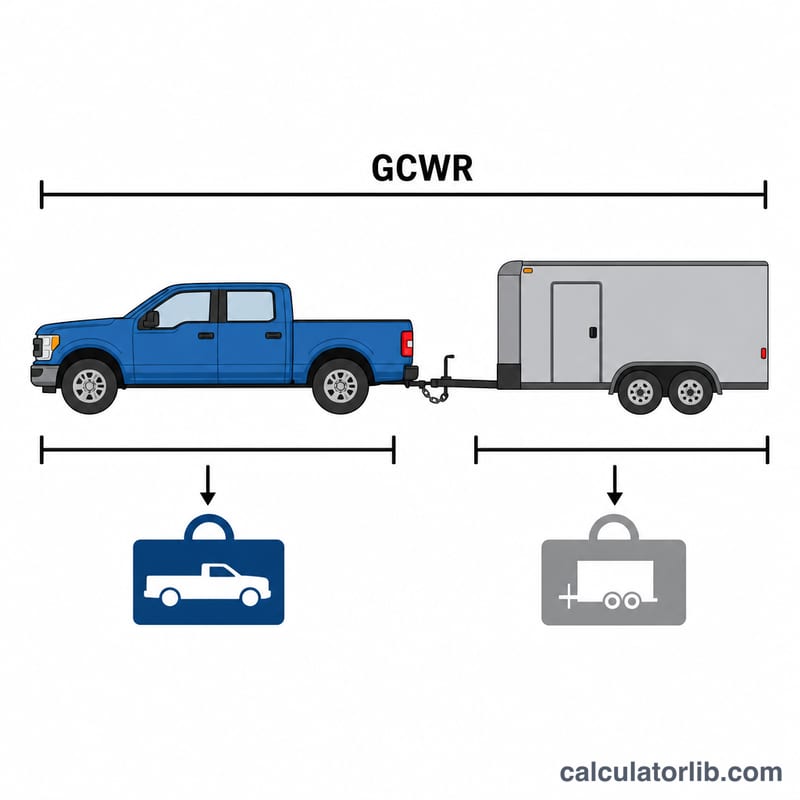
This calculator estimates the maximum trailer weight your vehicle can safely tow. It uses the Gross Combined Weight Rating (GCWR) — the maximum allowable weight of your truck, trailer, passengers, cargo, and fluids combined — and subtracts the actual loaded weight of your truck. The result is how much trailer (plus its load) you have left to work with.
How to Use It
Enter your vehicle's GCWR, found in your owner's manual or door-jamb sticker. Then enter the loaded weight of your truck — ideally weighed at a certified scale with passengers, fuel, and cargo onboard. The calculator returns your maximum trailer weight instantly. Always stay within both this figure and your hitch and tire ratings.
The Formula Explained
The core equation is simple subtraction:
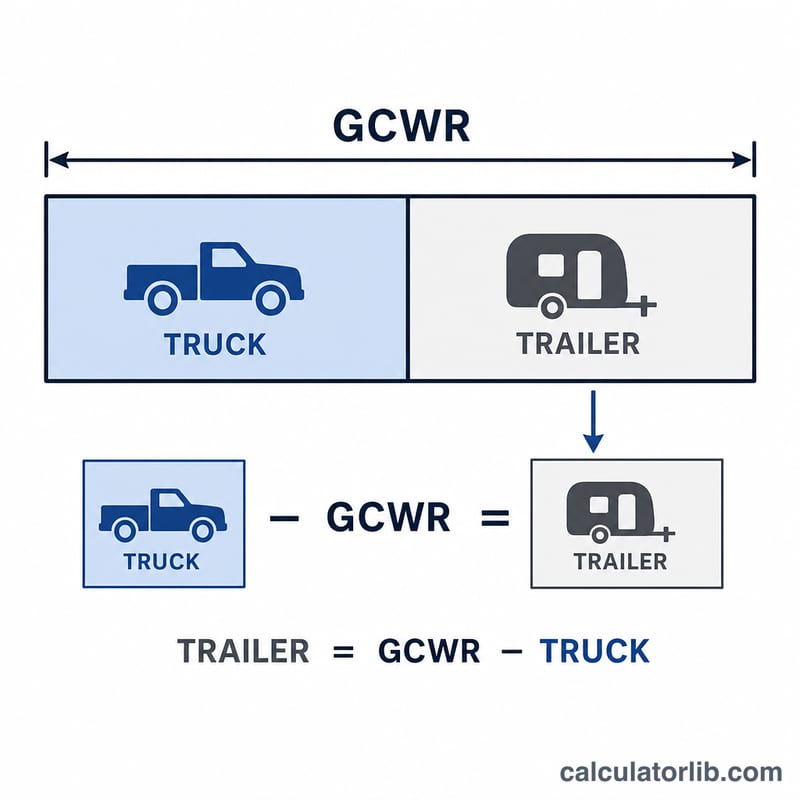
$$\text{Max Trailer} = \text{GCWR} - \text{Loaded Truck Weight}$$
Because GCWR caps the combined weight of everything, anything not consumed by your truck is available for the trailer. Adding passengers or cargo to the truck reduces the trailer weight you can pull.
Worked Example
Suppose your truck has a GCWR of 20,000 lbs and, fully loaded with fuel, gear, and people, it weighs 8,000 lbs. Then: $$20{,}000 - 8{,}000 = 12{,}000 \text{ lbs}$$ of maximum trailer weight. If you later add 1,000 lbs of cargo to the truck bed, the truck weighs 9,000 lbs and your max trailer drops to 11,000 lbs.
Towing Terms Explained: GCWR, GVWR, Payload, Tongue Weight
These terms are used by vehicle manufacturers in the US and many other countries (units here are pounds). Exact ratings for your vehicle appear on its door-jamb label and in the owner's manual.
- GCWR (Gross Combined Weight Rating): The maximum allowed combined weight of the loaded tow vehicle plus the loaded trailer. This is the first input of the calculator (gcwr).
- GVWR (Gross Vehicle Weight Rating): The maximum allowed weight of the tow vehicle itself, including the vehicle, fuel, passengers, cargo, and the trailer's tongue weight. It does not include the trailer's full weight.
- Curb weight: The weight of the empty vehicle with standard equipment and fluids, but without passengers or cargo. Adding passengers, cargo, and accessories to curb weight gives the loaded truck weight (the truck_weight input).
- Payload: GVWR minus curb weight. It is the total weight of people, cargo, hitch hardware, and tongue weight the vehicle can carry.
- Tongue weight (hitch weight): The downward force the trailer places on the hitch. It is typically about 10-15% of trailer weight for conventional (bumper-pull) trailers and about 15-25% for fifth-wheel and gooseneck trailers. It counts against payload.
- GAWR (Gross Axle Weight Rating): The maximum load allowed on a single axle (front or rear). Tongue weight loads the rear axle, so the rear GAWR can be a limiting factor.
- Towing capacity: The maximum trailer weight the manufacturer states the vehicle can tow, which depends on engine, axle ratio, brakes, cooling, and frame. It can be lower than the GCWR-based figure.
- Hitch class: A classification (Class I to V) of hitch receivers by the maximum trailer weight and tongue weight they are rated for. See the table below.
The calculator's formula is: Max Trailer Weight = GCWR − Loaded Truck Weight.
Trailer Hitch Class Ratings
The table shows typical industry ratings for receiver hitches. Actual ratings vary by manufacturer, so always check the label on the hitch itself.
| Hitch Class | Typical Max Gross Trailer Weight | Typical Max Tongue Weight |
|---|---|---|
| Class I | 2,000 lbs | 200 lbs |
| Class II | 3,500 lbs | 350 lbs |
| Class III | 8,000 lbs (up to 10,000 lbs with a weight-distributing hitch) | 800 lbs |
| Class IV | 10,000 lbs (up to 12,000 lbs with weight distribution) | 1,000 lbs |
| Class V | 12,000+ lbs | 1,200+ lbs |
The vehicle's own tow rating and the lowest-rated component in the system (hitch, ball mount, ball, coupler, safety chains, or receiver) govern the maximum. A Class V hitch on a vehicle rated for 5,000 lbs does not raise that vehicle's limit.
Interpreting Your Result
The calculator's output is a GCWR-based maximum: the weight left over after the loaded tow vehicle is subtracted from the combined rating. It is an upper bound from one rating, not a guarantee that any trailer of that weight is within limits.
The actual limit is the lowest of these values:
- The GCWR-derived capacity (the calculator result).
- The manufacturer's maximum tow rating for the vehicle.
- The hitch and receiver rating (the lowest-rated component).
- Payload and rear GAWR, once tongue weight (typically 10-15% of a conventional trailer, 15-25% of a fifth-wheel or gooseneck) is added to the cargo and passengers already in the vehicle.
- Tire load ratings on both the tow vehicle and the trailer.
Trailer weight means the loaded weight: the trailer's empty weight plus cargo, fresh and waste water, propane, batteries, and gear. Using the trailer's dry weight alone understates the real figure. Weighing the loaded rig on a certified scale gives actual values.
Exceeding GCWR can reduce braking performance, increase stopping distances, strain the engine and transmission, make sway and handling less stable, and may violate manufacturer limits and local regulations, which can have legal and insurance consequences. Rules and rating methods differ by country and by manufacturer, so check the figures specific to your vehicle and jurisdiction.
FAQ
Is towing capacity the same as GCWR? No. GCWR is the total combined limit; towing capacity is what's left after subtracting the loaded truck.
Should I use curb weight or loaded weight? Use the actual loaded weight including passengers, fuel, and cargo for an accurate, safe figure.
Does trailer tongue weight matter? Yes. Tongue weight counts toward the truck's payload and rear axle rating, so check those limits too, in addition to this calculation.