
What is this calculator?
This tool estimates the theoretical minimum network latency caused by the physical distance between two points. Data in fiber-optic cable travels at roughly two-thirds the speed of light in a vacuum, so distance imposes a hard floor on how fast packets can travel — no amount of bandwidth can beat physics.
How to use it
Enter the cable distance between the two endpoints, choose kilometers or miles, and set the fiber velocity factor (typically about 0.67 for standard single-mode fiber). The calculator returns the one-way propagation delay and the round-trip time (RTT), which is what a ping measures.
The formula explained
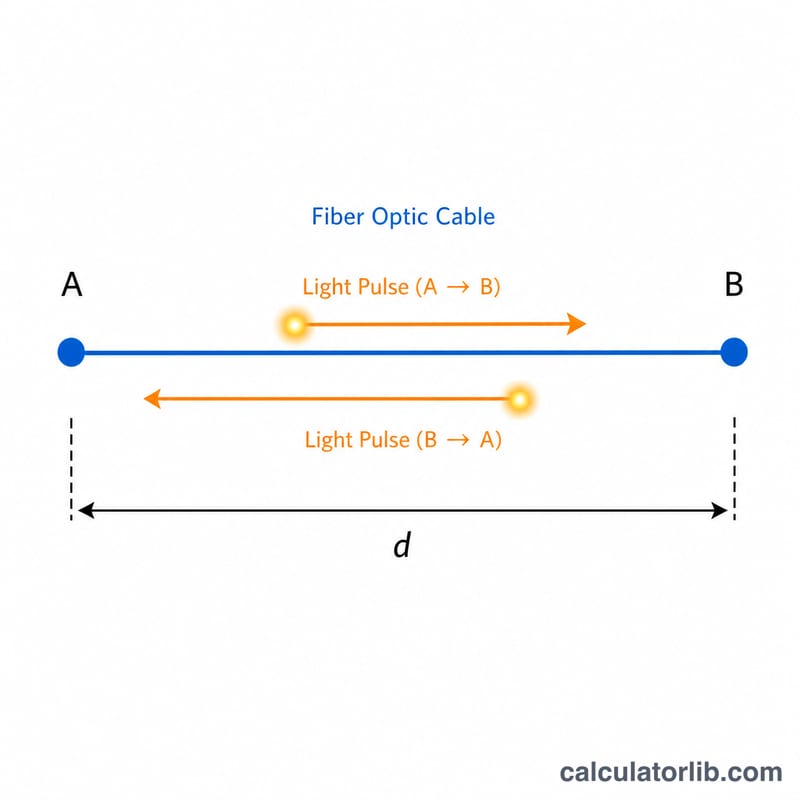
The signal travels at an effective speed of \(c \times v_f\), where \(c\) = 299,792,458 m/s and \(v_f\) is the velocity factor. One-way latency is distance ÷ effective speed; RTT doubles that to account for the return trip. Real-world latency is always higher because of routing detours, switching, and processing delays.
$$\text{RTT} = \frac{2 \cdot d}{c \cdot \text{Velocity Factor}} \times 1000$$ $$\text{where}\quad \left\{ \begin{aligned} d &= \text{Distance (km)} \times 1000 \\ c &= 299792458 \ \text{m/s} \end{aligned} \right.$$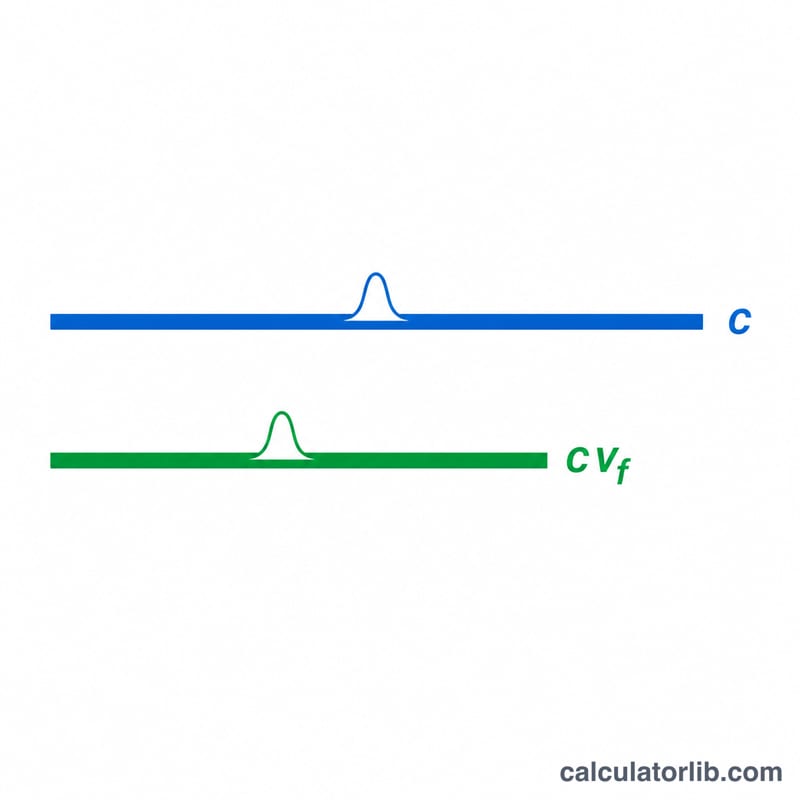
Worked example
For 1,000 km of fiber at \(v_f = 0.67\): effective speed = \(299{,}792{,}458 \times 0.67 \approx 200{,}860{,}946 \ \text{m/s}\). One-way = \(1{,}000{,}000 \ \text{m} \div 200{,}860{,}946 \approx 0.004979 \ \text{s} \approx 4.98 \ \text{ms}\). RTT ≈ 9.96 ms.
FAQ
Why 0.67? The refractive index of glass fiber (~1.47) slows light to about 67% of its vacuum speed.
Why is my real ping higher? Routers, switches, queueing, and indirect cable paths all add delay on top of this physical minimum.
Can I use it for satellite links? For free-space or vacuum paths, set the velocity factor close to 1.0.