
What Is the 3D Distance Calculator?
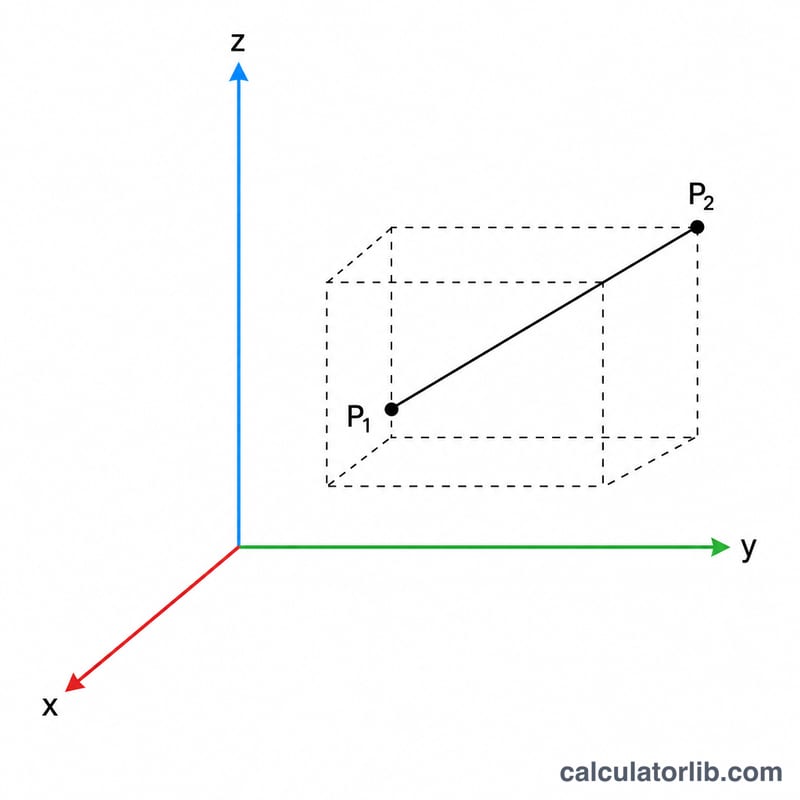
The 3D Distance Calculator finds the straight-line (Euclidean) distance between two points in three-dimensional space. Given the coordinates of point 1 (x₁, y₁, z₁) and point 2 (x₂, y₂, z₂), it returns the length of the line segment connecting them. This is the natural extension of the Pythagorean theorem from a flat plane into 3D space, and it works with any unit — meters, feet, pixels, or abstract units.
How to Use It
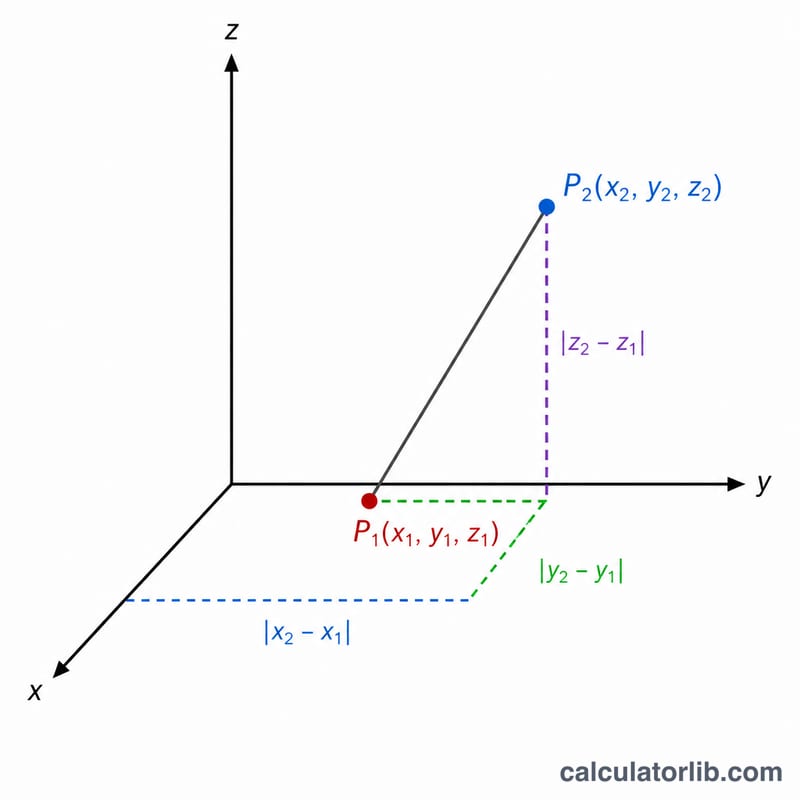
Enter the X, Y, and Z coordinates for each of the two points. Coordinates may be positive, negative, or zero, and decimals are accepted. Click calculate to see the total distance along with the component differences \(\Delta x\), \(\Delta y\), and \(\Delta z\) so you can verify each axis offset.
The Formula Explained
The distance is computed as $$d = \sqrt{\left(x_2 - x_1\right)^2 + \left(y_2 - y_1\right)^2 + \left(z_2 - z_1\right)^2}$$. Each term measures how far the points differ along one axis. Squaring removes the sign, summing combines the three perpendicular offsets, and the square root converts the sum of squares back into a single length — exactly as the Pythagorean theorem does in two dimensions.
Worked Example
Suppose point 1 is (0, 0, 0) and point 2 is (3, 4, 12). The differences are \(\Delta x = 3\), \(\Delta y = 4\), \(\Delta z = 12\). Then $$d = \sqrt{3^2 + 4^2 + 12^2} = \sqrt{9 + 16 + 144} = \sqrt{169} = 13.$$ The two points are exactly 13 units apart.
FAQ
Does it matter which point I enter first? No. Distance is symmetric, so swapping the points yields the same result; only the signs of \(\Delta x\), \(\Delta y\), \(\Delta z\) flip.
What units does the result use? The same units as your input coordinates. If you enter meters, the distance is in meters.
Can I use it for 2D distance? Yes — just set both Z values to 0 and it reduces to the standard 2D distance formula.