
What It Does
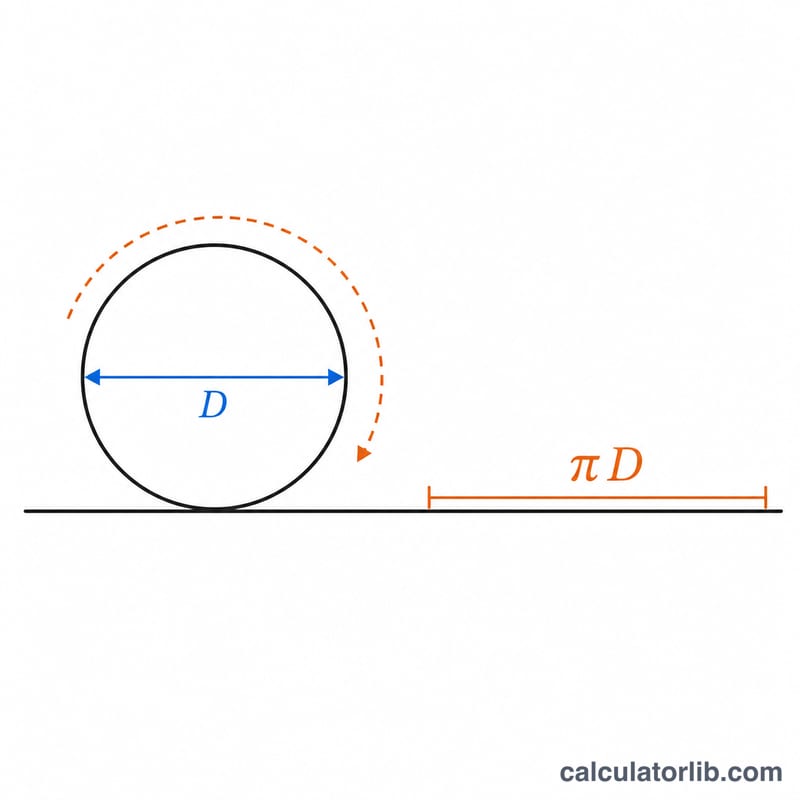
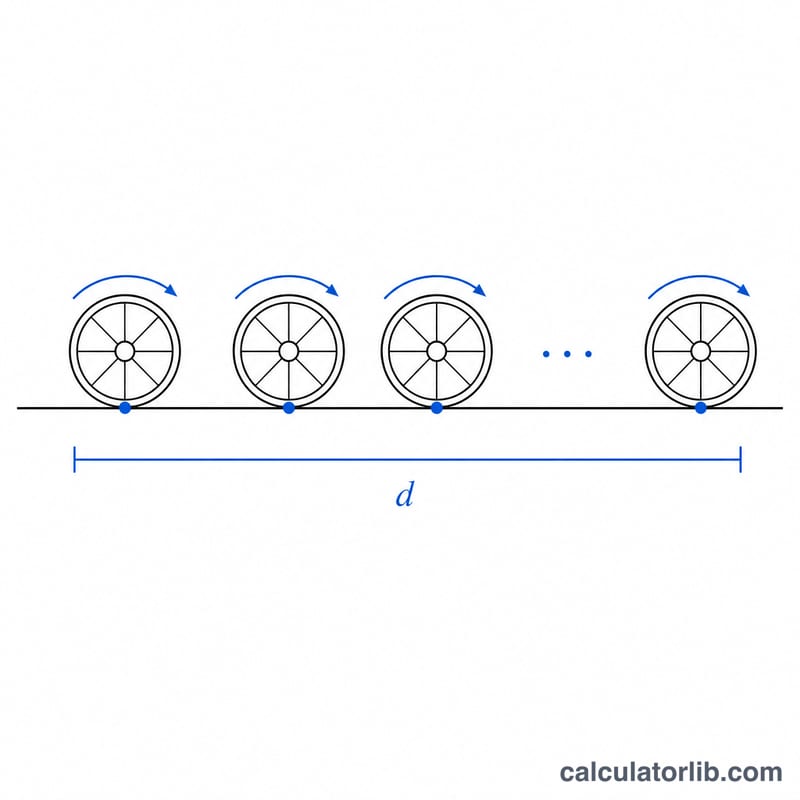
The Wheel Revolutions to Distance Calculator tells you how far an object travels based on how many times its wheel turns. Every full revolution of a wheel moves it forward by exactly one circumference — the distance around the edge of the wheel. This is the principle behind odometers, bicycle computers, rotary encoders, and conveyor systems.
How to Use It
Enter the wheel diameter and choose its unit (meters, centimeters, or inches). Then enter the number of revolutions the wheel made. The calculator returns the total distance travelled in meters, and also converts it to kilometers, miles, and feet so you can pick whichever is most convenient.
The Formula Explained
The distance is calculated as:
$$d = N \times \pi D$$
where \(N\) is the number of revolutions, \(D\) is the wheel diameter, and \(\pi D\) is the circumference (the distance covered in one turn). Multiplying the per-revolution distance by the number of revolutions gives the total distance.
Worked Example
A bicycle wheel has a diameter of 0.7 m and makes 500 revolutions. The circumference is \(\pi \times 0.7 \approx 2.199\) m. The total distance is:
$$500 \times 2.199 \approx 1{,}099.6 \text{ m}$$
or about 1.1 km.
FAQ
Do I use diameter or radius? Use the full diameter (the distance straight across the wheel). If you only have the radius, double it first.
Why use circumference instead of diameter alone? Because the wheel rolls along its outer edge, so one full turn moves it forward exactly one circumference, which is \(\pi\) times the diameter.
Does this account for tire compression or slippage? No. The result assumes a rigid wheel rolling without slipping, which is an idealized but accurate model for most uses.