
What is the distance-to-horizon calculator?
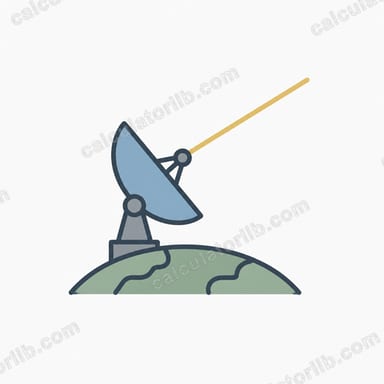
When you stand on a beach, a tower, or a mountaintop, the curve of the Earth limits how far you can see across flat, unobstructed terrain. This calculator works out the straight line-of-sight distance to the horizon from any eye height, and the area of ground or sea that is visible. It models the Earth as a smooth sphere with the WGS-84 equatorial radius \(R = 6{,}378\ \text{km}\), and includes a standard atmospheric refraction bonus of about 6%, because light bends slightly downward and lets you see a little farther than pure geometry predicts.
How to use it
Pick a preset observation location from the dropdown, or just type your own eye height in meters. The presets range from a child's eye level (1 m) up to the summit of Mt. Fuji (3,776 m). Choosing a preset auto-fills the height field; you can always override it. The result shows the distance to the horizon in kilometers and the visible circular area in square kilometers.
The formula explained
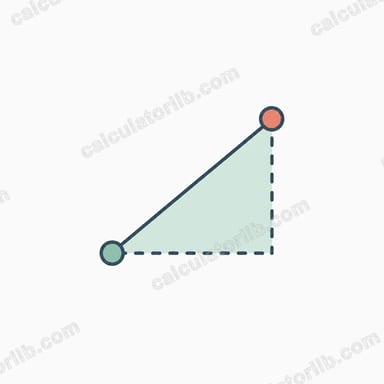
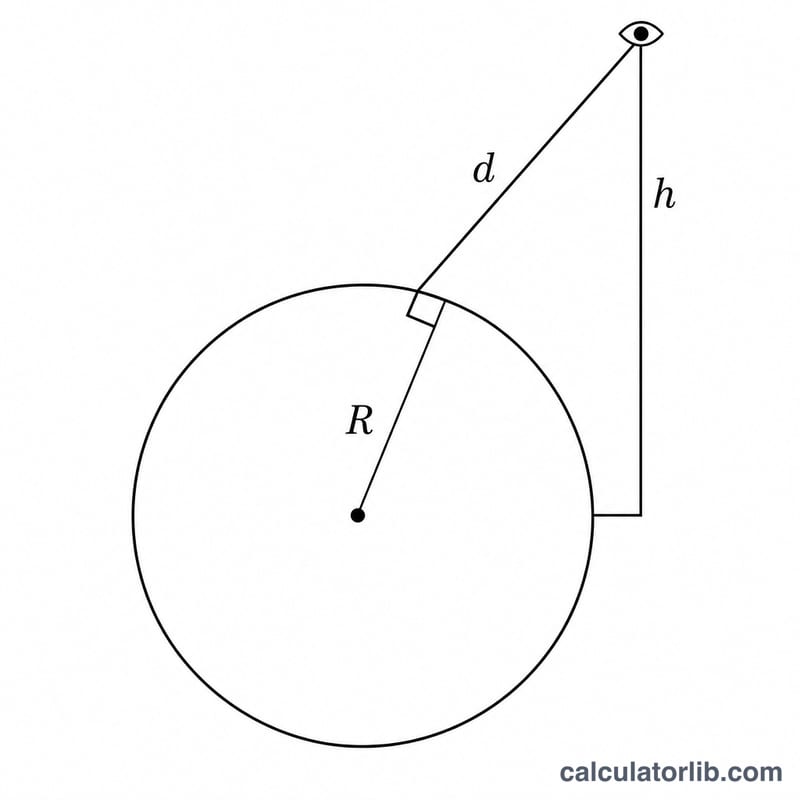
The line of sight just grazes the Earth's surface, forming a right triangle whose hypotenuse is \(R + h\) and whose other leg is \(R\). The tangent distance is therefore $$d_{\text{geom}} = \sqrt{(R+h)^{2} - R^{2}} = \sqrt{h^{2} + 2Rh}.$$ Multiplying by 1.06 adds the 6% refraction allowance, giving $$d = 1.06 \times \sqrt{h^{2} + 2Rh}.$$ The visible region is then a circle of radius \(d\), so its area is $$A = \pi d^{2}.$$ All lengths use kilometers, so an entered height in meters is divided by 1000.
Worked example
From the Tokyo Skytree 2nd Observatory at \(h = 450\ \text{m}\) (0.450 km): $$d_{\text{geom}} = \sqrt{0.450^{2} + 2 \times 6378.137 \times 0.450} = \sqrt{5740.53} = 75.77\ \text{km}.$$ With refraction, $$d = 1.06 \times 75.77 = 80.3\ \text{km}.$$ The visible area is $$A = \pi \times 80.3^{2} \approx 20{,}262\ \text{km}^{2}.$$
FAQ
Why include a 6% factor? Standard atmospheric refraction bends light toward the Earth, effectively extending the horizon by roughly 6% under typical conditions.
Does it account for the height of the object I am looking at? No. It only uses the observer's height. A tall distant object can be seen from farther away because its own height adds a second horizon distance.
Is the area exact? The area treats the visible region as a flat circle of radius \(d\). For very large heights this slightly overestimates the true spherical-cap area, but it is accurate for everyday viewpoints.