
What Is the Radar Horizon?
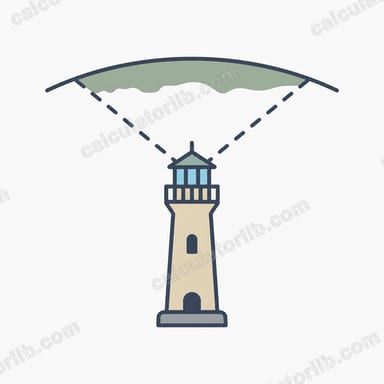
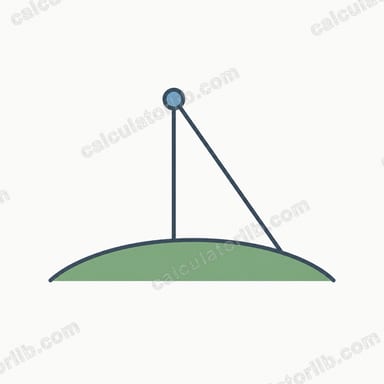
The radar horizon is the maximum line-of-sight distance at which a radar can detect an object at sea or ground level, limited by the curvature of the Earth. Because radar waves bend slightly in the atmosphere, the effective Earth radius is larger than the true geometric radius. This calculator uses the standard 4/3 Earth radius model (\(k = 4/3\)), which accounts for typical atmospheric refraction, with the true Earth radius \(R = 6{,}371{,}000\ \text{m}\).
How to Use It
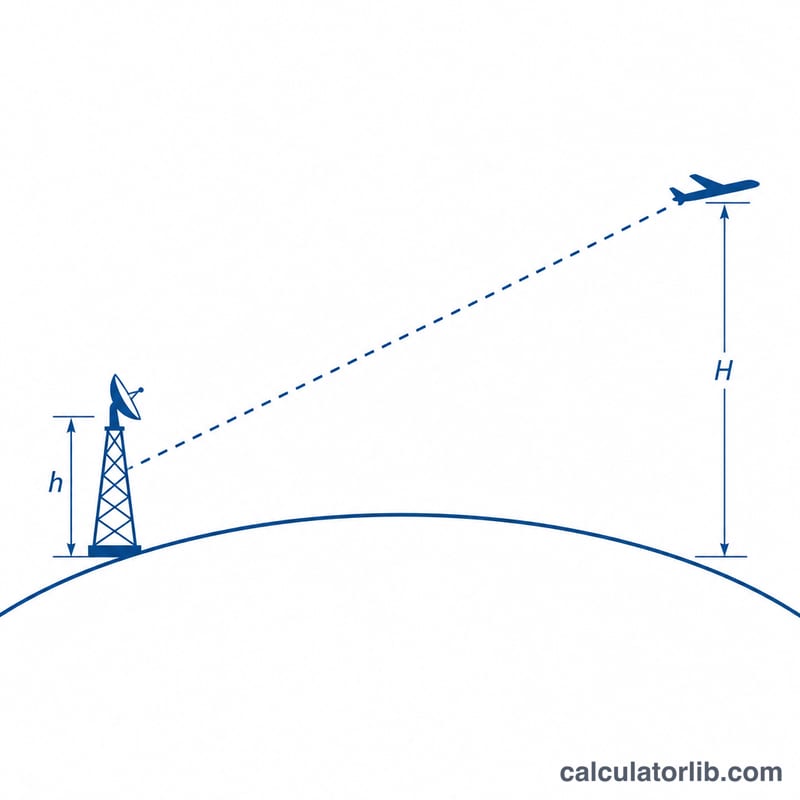
Enter the height of your radar antenna above the surface in meters. Optionally, enter the height of the target (such as a ship's mast or aircraft) to compute the combined detection range. The calculator returns the horizon distance in both meters and kilometers, plus the total line-of-sight range when a target height is given.
The Formula Explained
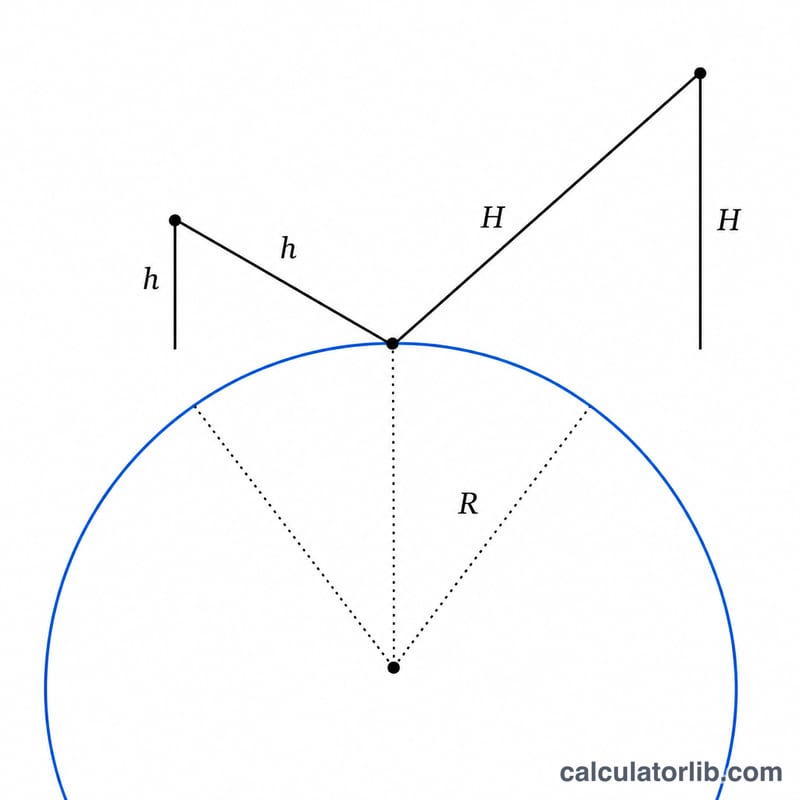
The horizon distance is $$d = \sqrt{2 \cdot k \cdot R \cdot h}$$ where \(k = 4/3\) is the refraction factor, \(R\) is the Earth's radius, and \(h\) is the antenna height. When both a radar and a target have height, each contributes its own horizon distance, and the total detection range is the sum of the two.
Worked Example
For an antenna 10 m high: $$d = \sqrt{2 \times 1.3333 \times 6{,}371{,}000 \times 10} = \sqrt{169{,}893{,}333} \approx 13{,}034\ \text{m} \approx 13.03\ \text{km}$$ If a target stands 20 m tall, its horizon is $$\sqrt{2 \times 1.3333 \times 6{,}371{,}000 \times 20} \approx 18{,}433\ \text{m} \approx 18.43\ \text{km}$$ giving a total range of about 31.47 km.
FAQ
Why use 4/3 instead of the true Earth radius? Radio waves refract downward in the lower atmosphere, effectively extending the horizon. Multiplying the radius by 4/3 closely approximates this under standard conditions.
Does target height matter? Yes. A higher target can be seen from farther away, so the total detection range adds both horizon distances.
What units should I use? Enter all heights in meters; results are shown in meters and kilometers.