
What Is Buffer Capacity?
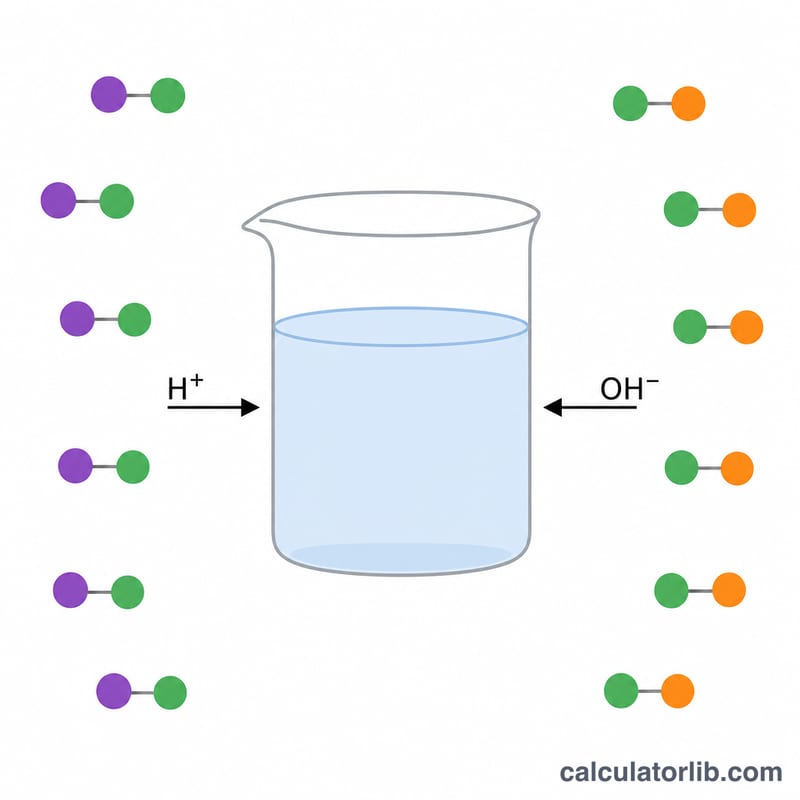
Buffer capacity (\(\beta\)) measures a buffer solution's resistance to changes in pH when a strong acid or base is added. It is defined as the number of moles of strong acid or base needed to change the pH of one liter of buffer by one unit. A higher \(\beta\) means a more robust buffer. This calculator works for a single weak acid / conjugate base pair using the standard analytical expression.
How to Use This Calculator
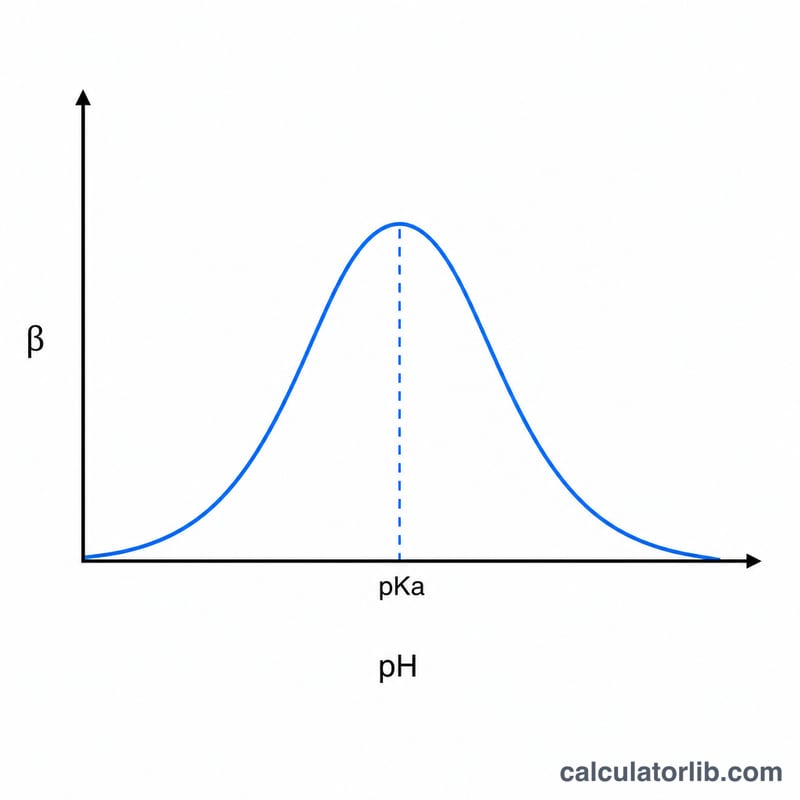
Enter the total buffer concentration C (the sum of the weak acid and its conjugate base in mol/L), the pKa of the weak acid, and the current pH of the solution. The tool converts pKa and pH into Ka and [H+], then evaluates the buffer-capacity equation. Buffer capacity is maximized when pH equals pKa.
The Formula Explained
The buffer capacity is given by:
$$\beta = 2.303 \times C \times \dfrac{K_a \cdot [H^+]}{(K_a + [H^+])^2}$$
Here \(K_a = 10^{-pK_a}\) and \([H^+] = 10^{-pH}\). The factor 2.303 comes from the conversion between natural and base-10 logarithms (ln 10). At pH = pKa, \(K_a = [H^+]\), so the fraction reduces to \(\tfrac{1}{4}\) and \(\beta = 0.5757 \cdot C\) — the maximum possible for that buffer.
Worked Example
For an acetate buffer with C = 0.1 mol/L, pKa = 4.76, and pH = 4.76: \(K_a = 10^{-4.76} \approx 1.738 \times 10^{-5}\) and \([H^+] = 10^{-4.76} \approx 1.738 \times 10^{-5}\). Since \(K_a = [H^+]\), $$\beta = 2.303 \times 0.1 \times \tfrac{1}{4} = 0.0576 \text{ mol/L per pH unit}$$ — the peak capacity for this buffer.
Common Weak Acid pKa Values
The buffer capacity formula depends directly on the acid's \(K_a\), where \(K_a = 10^{-\text{pKa}}\). A buffer is most effective when its pKa is close to the desired working pH, so choosing the right acid is the first step. The table below lists widely used buffer acids and their pKa values near 25°C.
| Buffer Acid | Conjugate Pair | pKa (25°C) |
|---|---|---|
| Formic acid | HCOOH / HCOO− | 3.75 |
| Acetic acid | CH₃COOH / CH₃COO− | 4.76 |
| Citric acid (pKa₃) | third proton | 6.40 |
| MES | zwitterionic (Good's buffer) | 6.10 |
| Carbonic acid (pKa₁) | H₂CO₃ / HCO₃− | 6.35 |
| Phosphate (pKa₂) | H₂PO₄− / HPO₄²− | 7.20 |
| HEPES | zwitterionic (Good's buffer) | 7.55 |
| Tris | Tris-H⁺ / Tris | 8.06 |
| Ammonium | NH₄⁺ / NH₃ | 9.25 |
Note that polyprotic acids such as phosphoric and citric have several pKa values; only the one nearest your target pH governs the buffering. To find the acid/base ratio needed at a given pH, use the Henderson–Hasselbalch ratio approach.
Interpreting Your Buffer Capacity
Buffer capacity \(\beta\) is expressed in moles of strong acid or base per litre needed to change the pH by one unit. A \(\beta\) of 0.05 mol·L⁻¹·pH⁻¹ means that adding 0.05 mol of strong base (e.g. NaOH) to one litre of buffer would raise the pH by roughly one unit. Larger \(\beta\) means the buffer resists pH change more strongly.
- Magnitude: \(\beta\) scales linearly with total concentration \(C\). Doubling the buffer concentration doubles its capacity. For a typical 0.1 mol/L buffer at its pKa, \(\beta \approx 0.058\); a 1.0 mol/L buffer would reach \(\approx 0.58\).
- Effective range: A buffer functions usefully only within pKa ± 1. Outside this band \(\beta\) collapses and small additions of acid or base cause large pH swings.
- Comparing two buffers: At the same total concentration, the buffer whose pKa is closest to your working pH will have the higher \(\beta\). If the pKa values are equally matched, the more concentrated buffer wins.
- Practical meaning: If you expect a process to release, say, 0.01 mol of acid per litre, a buffer with \(\beta = 0.05\) will hold pH change to about 0.01/0.05 = 0.2 pH units — usually acceptable. A buffer with \(\beta = 0.005\) would drift a full pH unit under the same load.
To predict the actual pH shift after a known addition of strong acid or base, follow up with a post-addition buffer pH calculation. This is general educational information, not a substitute for validated laboratory or clinical protocols.
FAQ
What units does \(\beta\) have? Moles per liter per pH unit (\(\text{mol} \cdot \text{L}^{-1} \cdot \text{pH}^{-1}\)).
When is buffer capacity highest? When the solution pH equals the acid's pKa, where the acid and conjugate base concentrations are equal.
Does this include water's contribution? No. This formula covers only the weak-acid buffer term; at extreme pH the self-ionization of water also contributes to total capacity.