
What is the Henderson-Hasselbalch equation?
The Henderson-Hasselbalch equation relates the pH of a buffer solution to the acid dissociation constant (pKa) of the weak acid and the ratio of the concentrations of its conjugate base [A⁻] and the undissociated acid [HA]. It is one of the most widely used relationships in chemistry, biochemistry, and pharmacology for understanding and designing buffers.
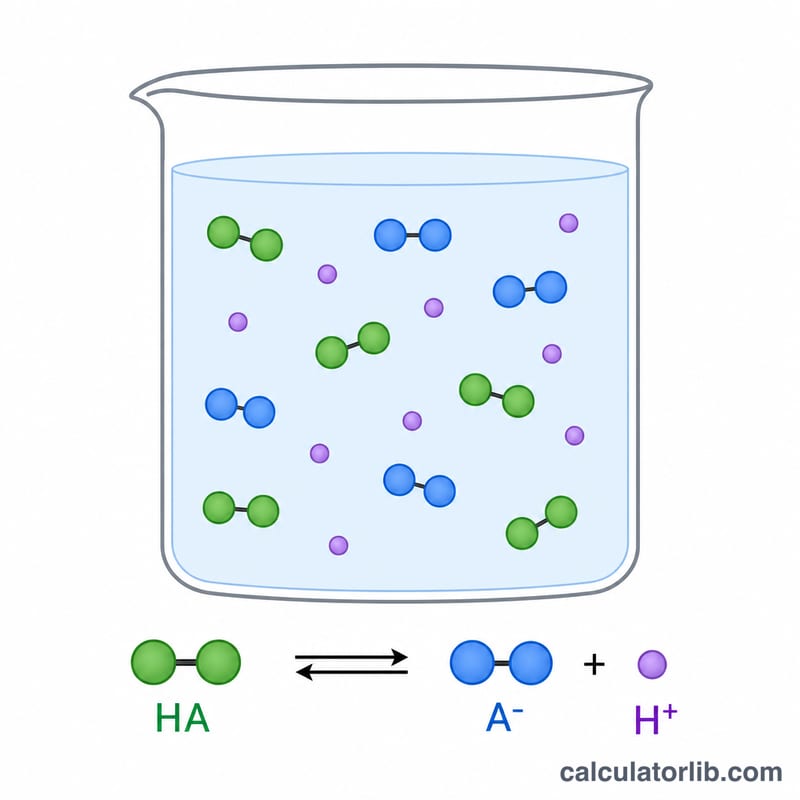
How to use this calculator
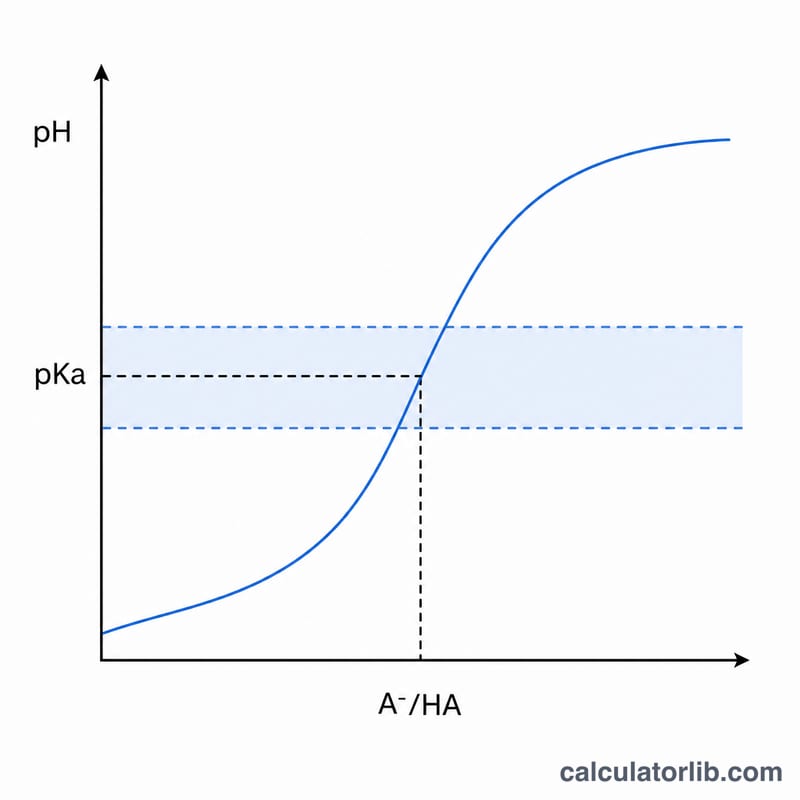
Enter three values: the pKa of your weak acid, the molar concentration of the conjugate base [A⁻], and the molar concentration of the weak acid [HA]. The calculator returns the resulting buffer pH, the base-to-acid ratio, and the corresponding pOH. When the base and acid concentrations are equal, the ratio is 1, \(\log_{10}(1) = 0\), and the pH equals the pKa — the point of maximum buffering capacity.
The formula explained
$$\text{pH} = \text{p}K_a + \log_{10}\!\left(\frac{[\text{A}^-]}{[\text{HA}]}\right)$$ The logarithmic term shifts the pH up when there is more conjugate base than acid, and down when there is more acid than base. Because the relationship is logarithmic, a tenfold change in the ratio moves the pH by exactly one unit.
Worked example
An acetate buffer uses acetic acid with \(\text{p}K_a = 4.76\). Suppose \([\text{A}^-] = 0.2\ \text{M}\) and \([\text{HA}] = 0.1\ \text{M}\). The ratio is \(0.2/0.1 = 2\), and \(\log_{10}(2) \approx 0.301\). So $$\text{pH} = 4.76 + 0.301 = 5.061.$$ The pOH is \(14 - 5.061 = 8.939\).
FAQ
What units should concentrations be in? Any consistent unit works because only the ratio matters — molarity (M) is conventional.
Why does pH equal pKa at equal concentrations? The log of 1 is 0, so the second term vanishes, leaving \(\text{pH} = \text{p}K_a\).
Are there limitations? The equation assumes ideal behavior, dilute solutions, and that the buffer components do not significantly shift each other's concentrations through dissociation.