
What This Calculator Does
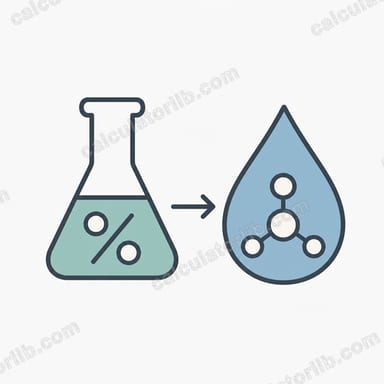
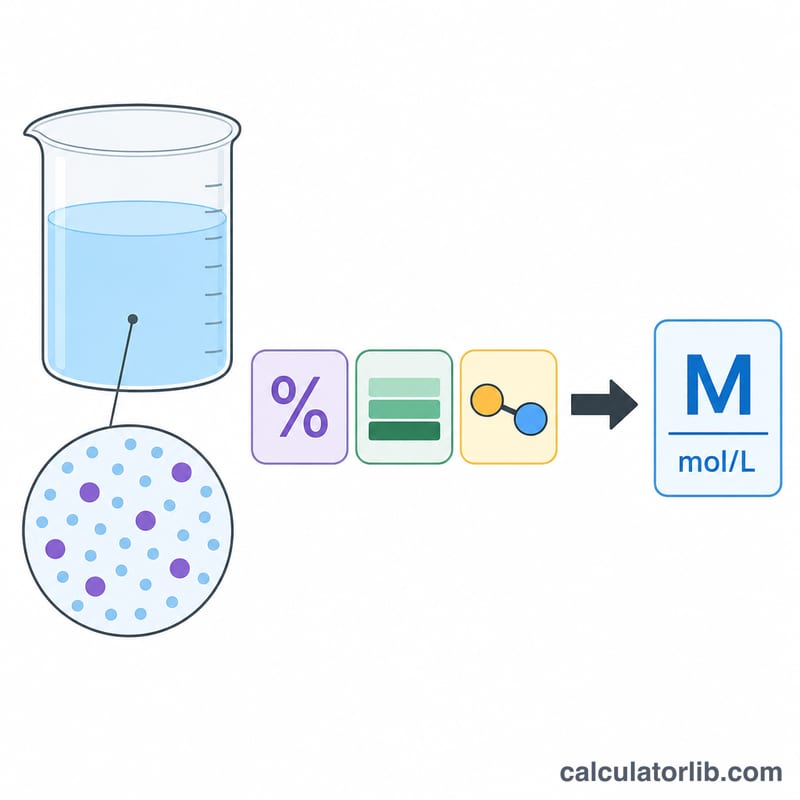
This tool converts a solution's percentage concentration by weight (% w/w) into molarity (moles per liter, mol/L). Many concentrated reagents — like hydrochloric acid, sulfuric acid, ammonia, and hydrogen peroxide — are sold and labeled by weight percent and density rather than molarity, so this conversion is essential for accurate lab work and dilutions.
The Formula Explained
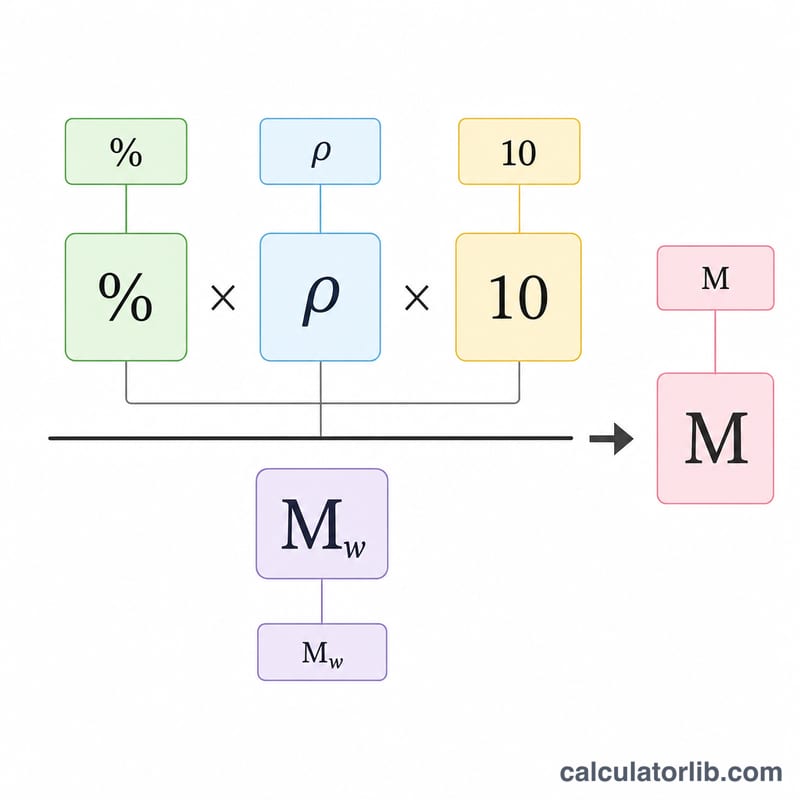
The conversion uses:
$$M = \frac{10 \times \text{Concentration (\% w/w)} \times \text{Density (g/mL)}}{\text{Molar Mass (g/mol)}}$$The factor of 10 arises from unit bookkeeping: density in g/mL multiplied by 1000 mL/L gives grams per liter, and dividing the weight percent by 100 gives the mass fraction. Combining \(1000 \div 100\) gives the 10. Multiplying the mass fraction by density gives grams of solute per liter of solution, and dividing by molar mass converts that mass to moles.
How to Use It
Enter three values: the concentration as a weight percent (% w/w), the density of the solution in g/mL, and the molar mass of the solute in g/mol. The calculator returns the molarity in mol/L.
Worked Example
Concentrated HCl is typically 37% w/w with a density of 1.18 g/mL. The molar mass of HCl is 36.46 g/mol.
$$M = \frac{10 \times 37 \times 1.18}{36.46} = \frac{436.6}{36.46} \approx 11.97 \text{ mol/L}$$— the well-known ~12 M figure for concentrated hydrochloric acid.
FAQ
What is % w/w? Weight percent (% w/w) is grams of solute per 100 grams of solution. It is independent of temperature, unlike volume-based measures.
Why do I need the density? Weight percent relates solute mass to solution mass, but molarity is per liter of volume. Density bridges mass and volume.
Where do I find molar mass? Add up the atomic masses of all atoms in the compound's formula, or look it up on the chemical's safety data sheet.