
What is a Mixing Ratio?
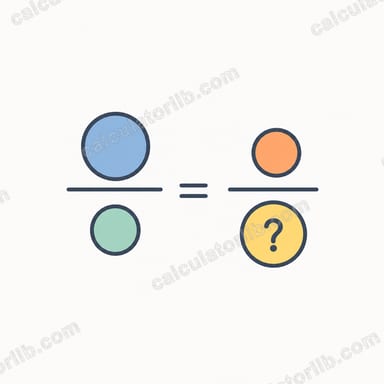
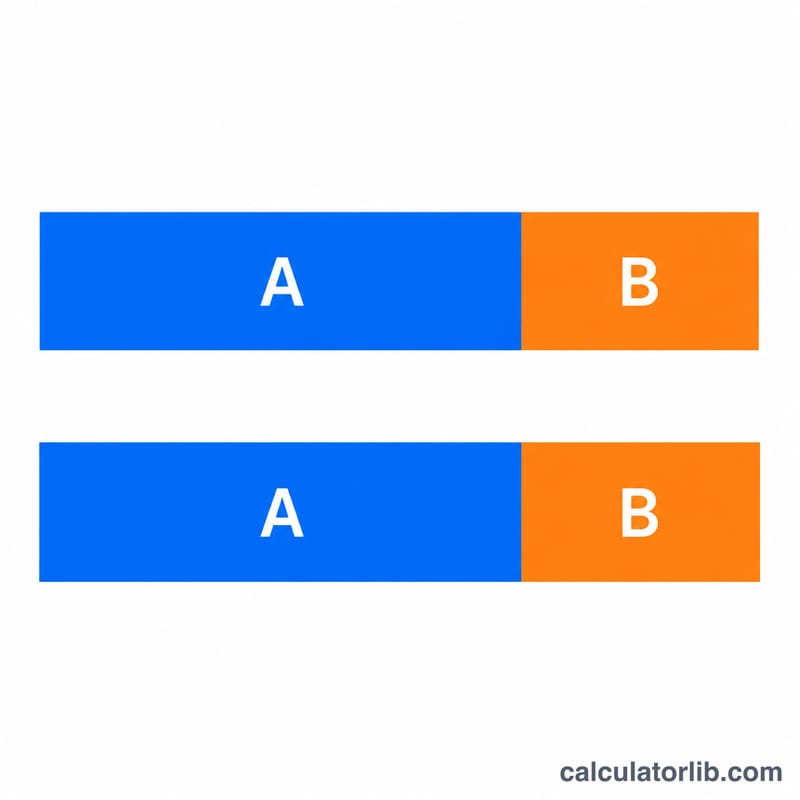
A mixing ratio describes the relative proportions in which two components are combined, written as part A : part B (for example 1:3 or 2:5). This calculator turns that ratio into easy-to-use numbers: the fraction and percentage of each part, plus the exact amount of each component required to make any total quantity you choose. It works for any unit — milliliters, liters, grams, ounces, gallons — as long as both parts use the same unit.
How to Use It
Enter the number of parts of A and B (for example 1 and 3 for a 1:3 mix). Optionally enter the total quantity you want to make. The calculator returns the simplified breakdown and tells you how much of each component to measure out.
The Formula
The fraction of a component is its parts divided by the total parts: \(f_A = \dfrac{A}{A+B}\). Multiply that fraction by 100 for a percentage, or by your total quantity to get the amount:
$$\text{amount}_A = \text{Total}\times\frac{A}{A+B}$$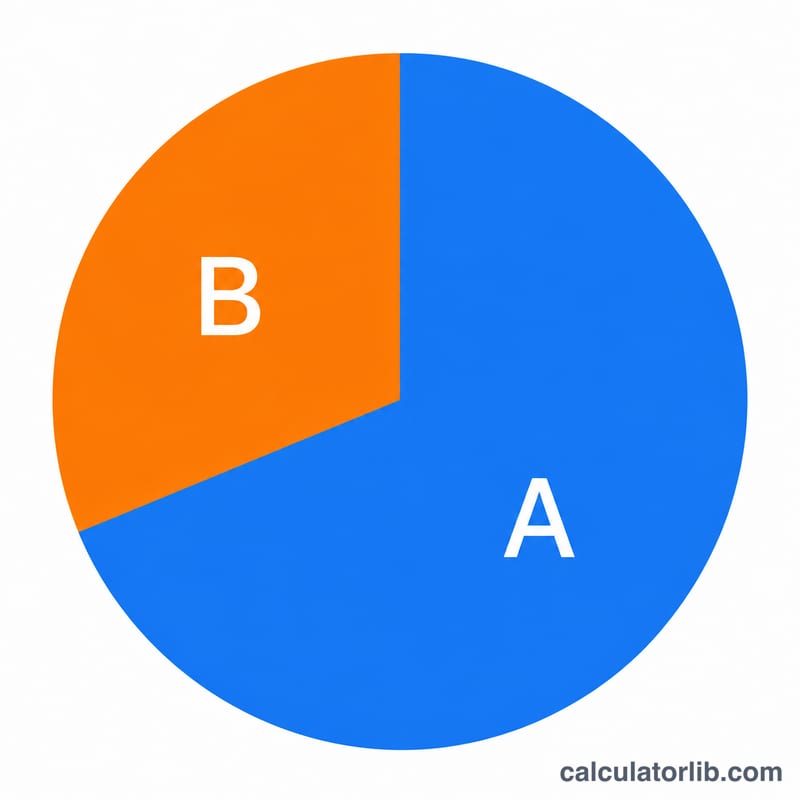
Worked Example
Suppose you want a 1:3 mix and need 1,000 ml total. The sum of parts is \(1 + 3 = 4\). Part A's fraction is \(\frac{1}{4} = 0.25\) (25%), so
$$\text{amount}_A = 1{,}000 \times 0.25 = 250\ \text{ml}$$Part B's fraction is \(\frac{3}{4} = 0.75\) (75%), so amount B = 750 ml. Mix 250 ml of A with 750 ml of B.
FAQ
Can I use any units? Yes — the ratio is dimensionless, so use whatever unit you like as long as both parts share it.
What if I leave the total blank or zero? You still get the fractions and percentages; the amount columns will simply be zero.
Does the order matter? A 1:3 ratio is not the same as 3:1 — A always comes first, so keep your components in the right boxes.