
What this calculator does
The Buffer Ratio for Target pH Calculator tells you exactly how much conjugate base you need relative to its weak acid to reach a desired pH. It rearranges the Henderson-Hasselbalch equation so that, given a target pH and the buffer pKa, you instantly get the required [base]/[acid] mole ratio plus the percentage of each species. This is universal chemistry and applies anywhere.
How to use it
Enter the pH you want your buffer to hold and the pKa of the acid-base conjugate pair you are using (for example, acetic acid pKa 4.76, phosphate pKa 7.2, Tris pKa 8.06). The calculator returns the ratio of conjugate base to acid, along with what fraction of the buffer is in each form. Multiply the ratio by your acid moles to get the base moles you must add.
The formula explained
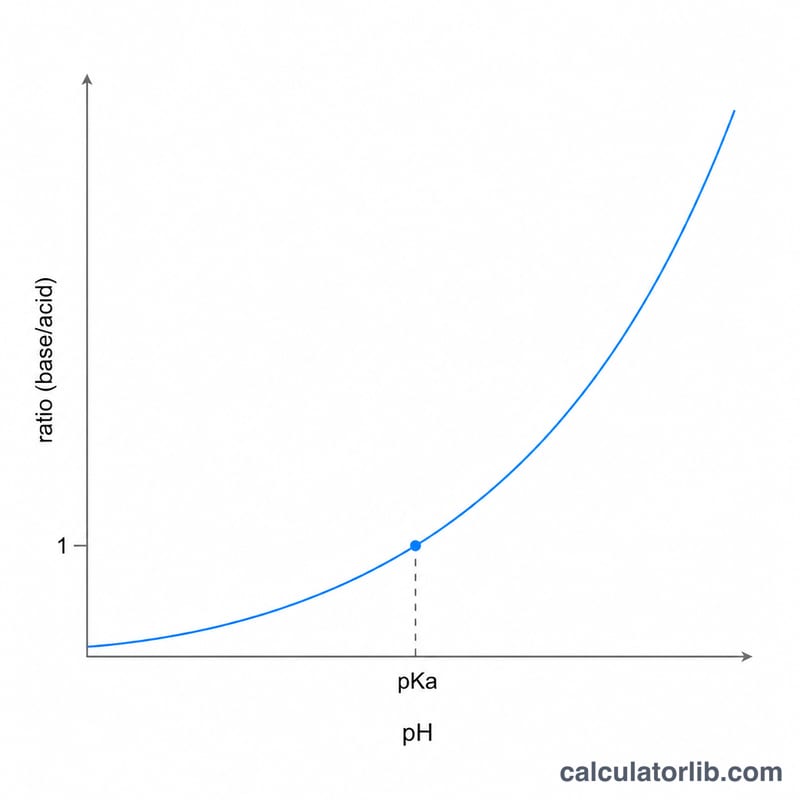
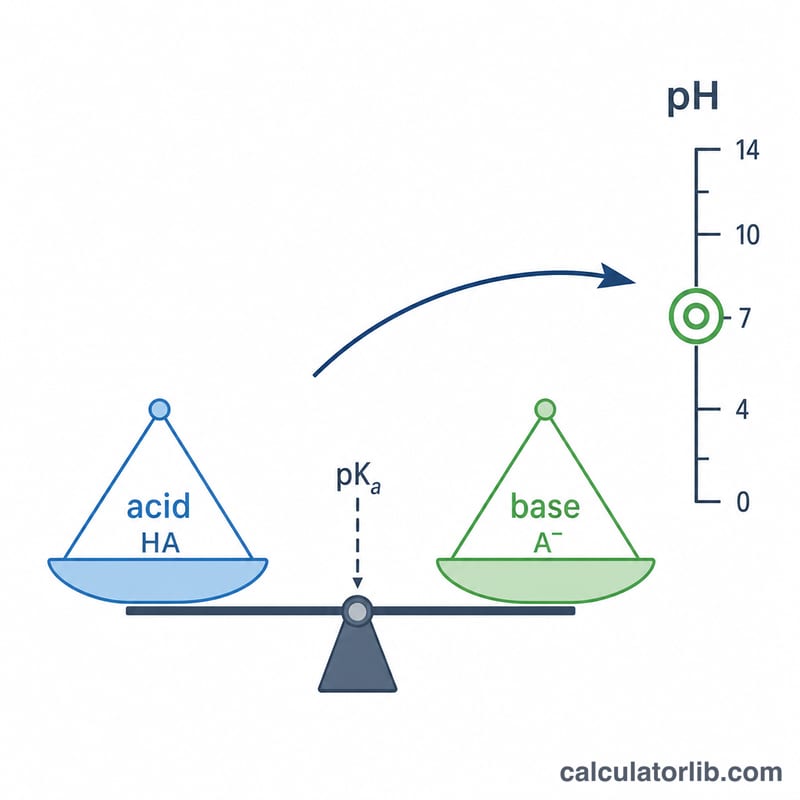
The Henderson-Hasselbalch equation states \( \text{pH} = \text{pK}_a + \log\frac{[\text{base}]}{[\text{acid}]} \). Solving for the ratio gives $$\frac{[\text{base}]}{[\text{acid}]} = 10^{\,\text{pH} - \text{pK}_a}$$ When pH equals pKa the ratio is 1 (a 50:50 mixture, the point of maximum buffering capacity). For each pH unit above pKa the ratio rises tenfold; one unit below, it falls tenfold.
Worked example
To prepare a phosphate buffer at pH 7.4 using a species with pKa 6.1, the ratio is $$10^{(7.4 - 6.1)} = 10^{1.3} \approx 19.95$$ So you need about 19.95 parts conjugate base for every 1 part acid — roughly 95.2% base and 4.8% acid.
Common Buffer pKa Values
The Henderson–Hasselbalch equation works best when the target pH is within roughly \(\pm 1\) unit of the buffer's \(\text{pK}_a\), where the conjugate base/acid ratio stays between about 0.1 and 10. The table below lists \(\text{pK}_a\) values (at or near 25 °C) for widely used buffers along with their practical buffering ranges.
| Buffer | pKa | Useful pH range |
|---|---|---|
| Citric acid (pKa1) | 3.13 | 2.1 – 4.1 |
| Acetic acid | 4.76 | 3.8 – 5.8 |
| Citric acid (pKa2) | 4.76 | 3.8 – 5.8 |
| MES | 6.15 | 5.5 – 6.7 |
| Bicarbonate (pKa1) | 6.35 | 5.4 – 7.4 |
| Citric acid (pKa3) | 6.40 | 5.4 – 7.4 |
| Phosphate (pKa2) | 7.20 | 6.2 – 8.2 |
| MOPS | 7.20 | 6.5 – 7.9 |
| HEPES | 7.55 | 6.8 – 8.2 |
| Tris | 8.06 | 7.0 – 9.0 |
| Borate | 9.24 | 8.2 – 10.2 |
| Glycine (pKa2) | 9.60 | 8.6 – 10.6 |
The useful range is approximately \(\text{pK}_a \pm 1\); outside this window the buffer has little capacity to resist pH change because one species dominates.
Base-to-Acid Ratio Across Target pH Values
Because the ratio depends only on the difference \(\text{pH}-\text{pK}_a\), a single table covers every buffer. Each step of one pH unit changes the ratio by a factor of ten. The percentages show what fraction of the total buffer exists as conjugate base \(\text{A}^-\) versus acid \(\text{HA}\).
| pH − pKa | Ratio [A−]/[HA] | % base (A−) | % acid (HA) |
|---|---|---|---|
| −2.0 | 0.01 | 0.99 % | 99.01 % |
| −1.0 | 0.10 | 9.1 % | 90.9 % |
| −0.5 | 0.316 | 24.0 % | 76.0 % |
| 0.0 | 1.00 | 50.0 % | 50.0 % |
| +0.5 | 3.16 | 76.0 % | 24.0 % |
| +1.0 | 10.0 | 90.9 % | 9.1 % |
| +2.0 | 100 | 99.01 % | 0.99 % |
At the midpoint (\(\text{pH}=\text{pK}_a\)) the base and acid are equal and buffering capacity is greatest. Beyond \(\pm 1\) unit one form makes up more than 90 % of the buffer, so capacity drops sharply.
FAQ
Why keep pH within one unit of pKa? Outside \( \pm 1 \) pH unit the buffer is over 90% one species and resists pH change poorly, so it buffers weakly.
Does temperature matter? Yes — pKa values shift with temperature (notably Tris), so use the pKa at your working temperature.
How do I turn the ratio into amounts? Pick a total buffer concentration, then split it using the base and acid fractions shown.