
What Is Heat Capacity?
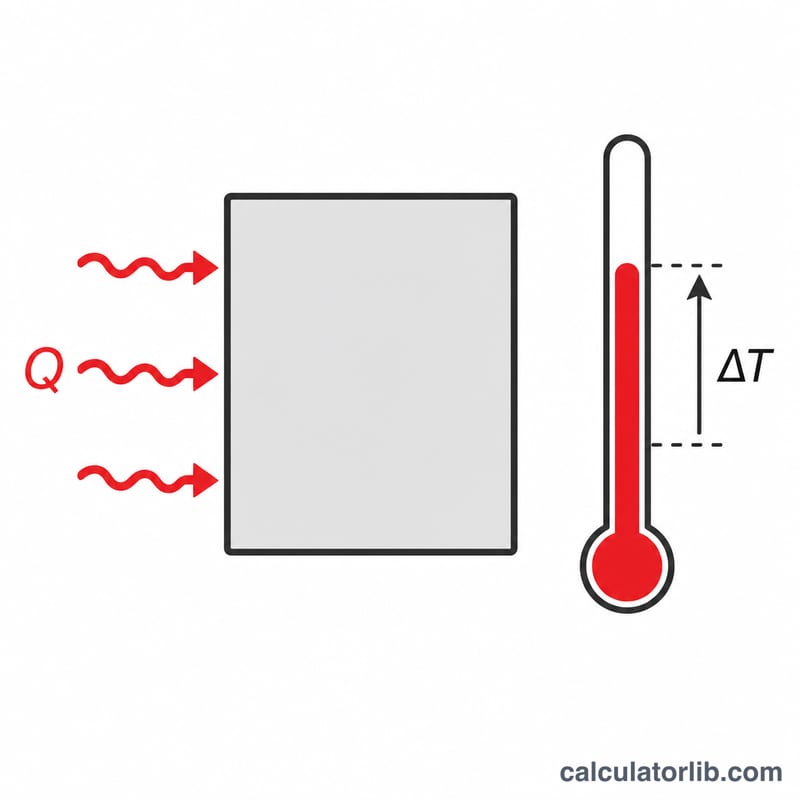
Heat capacity (C) measures how much heat energy an object must absorb to raise its temperature by one degree. It is an extensive property that depends on both the material and the amount of substance present. The standard SI unit is joules per kelvin (J/K). This calculator is universal and applies to any physical system — no country-specific assumptions are needed.
How to Use This Calculator
Enter the total heat energy (Q) supplied to the object, in joules, and the temperature change (ΔT) that resulted, in kelvin (or degrees Celsius, since a difference is numerically identical). The calculator divides Q by ΔT to return the heat capacity. Make sure the heat energy and temperature change refer to the same process.
The Formula Explained
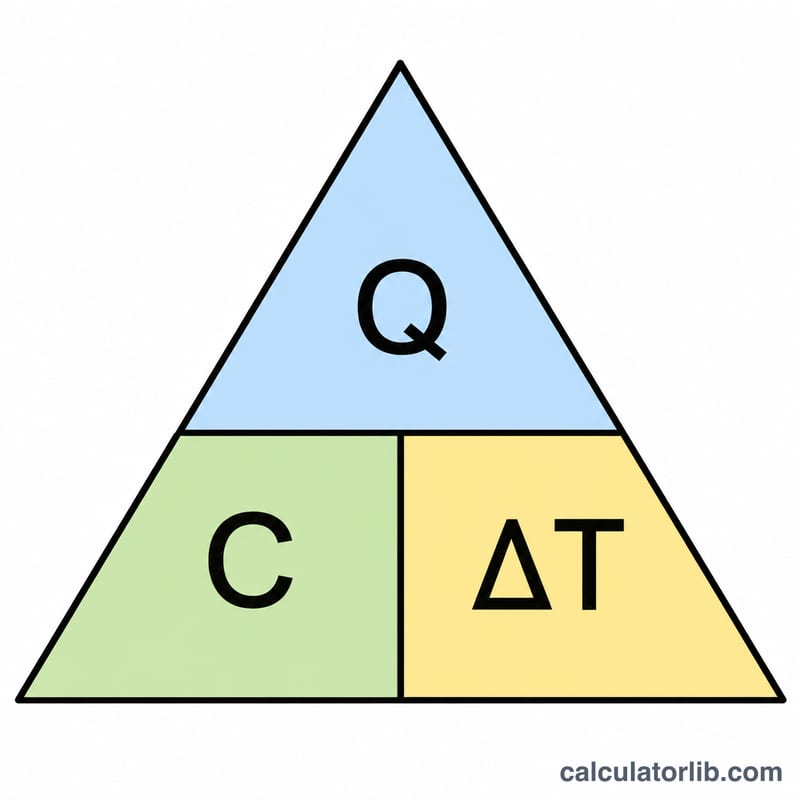
The defining equation is $$C = \frac{\text{Heat Energy }Q\text{ (J)}}{\Delta T\text{ (K)}}$$ where \(Q\) is the heat transferred and \(\Delta T = T_{\text{final}} - T_{\text{initial}}\). A large heat capacity means the object resists temperature change — it can soak up a lot of energy for only a small rise in temperature. To find the specific heat capacity instead, divide C by the mass: \(c = C / m\).
Worked Example
Suppose 5,000 J of heat raises an object's temperature by 10 K. Then $$C = \frac{5000}{10} = 500 \text{ J/K}.$$ If that object had a mass of 2 kg, its specific heat capacity would be \(500 / 2 = 250\ \text{J/(kg}\cdot\text{K)}\).
FAQ
What units should I use? Use joules for Q and kelvin (or °C difference) for ΔT to get C in J/K. Keep units consistent.
What is the difference between heat capacity and specific heat? Heat capacity (C) is for a whole object; specific heat capacity (c) is per unit mass. Divide C by mass to get c.
Can ΔT be negative? If the object is cooled, both Q and ΔT are negative, so C remains positive. A zero temperature change is undefined and is guarded against here.