
What is enthalpy?
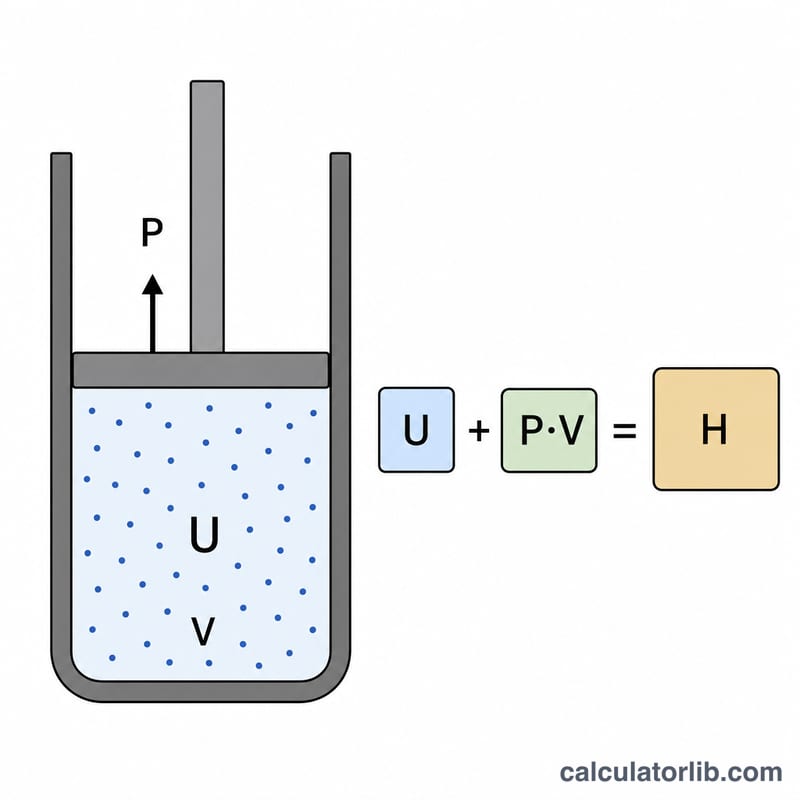
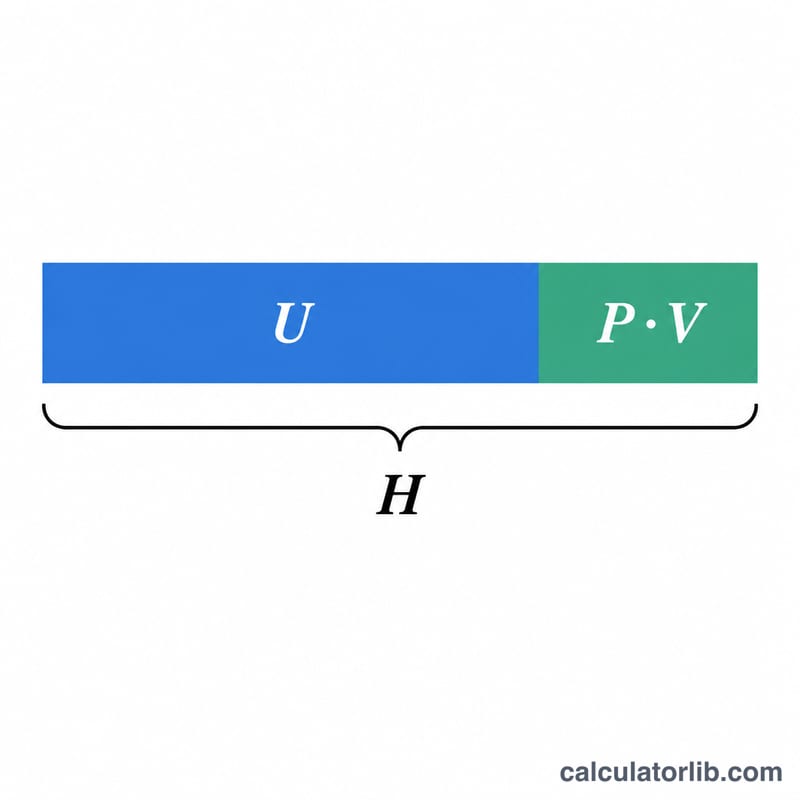
Enthalpy (H) is a thermodynamic state function that measures the total heat content of a system. It is defined as the system's internal energy (U) plus the product of its pressure (P) and volume (V). Enthalpy is especially useful in chemistry and engineering because, at constant pressure, the change in enthalpy equals the heat exchanged with the surroundings.
How to use this calculator
Choose a mode. Use Enthalpy (H = U + PV) to find the absolute enthalpy from a system's internal energy, pressure and volume. Use Change in enthalpy (ΔH = ΔU + PΔV) for a constant-pressure process — here enter the change in internal energy and the change in volume. Enter values in SI units: internal energy in joules (J), pressure in pascals (Pa) and volume in cubic metres (m³). The result is returned in joules.
The formula explained
The defining equation is $$H = U + P\cdot V$$ The term \(P\cdot V\) represents the flow work — the energy needed to make room for the system at pressure \(P\). For a process at constant pressure the differential form becomes $$\Delta H = \Delta U + P\cdot \Delta V$$ which is why \(\Delta H\) is the heat of reaction at constant pressure.
Worked example
Suppose a gas has internal energy \(U = 1000 \text{ J}\) at pressure \(P = 101{,}325 \text{ Pa}\) occupying volume \(V = 0.01 \text{ m}^3\). The pressure-volume term is $$101{,}325 \times 0.01 = 1013.25 \text{ J}$$ so the enthalpy is $$H = 1000 + 1013.25 = \mathbf{2013.25 \text{ J}}$$
FAQ
What units should I use? Use SI units (J, Pa, m³) for a result in joules. If you mix units (e.g. atm and litres) you must convert first.
Why can enthalpy values be large? Because pressures in pascals are large numbers; \(1 \text{ atm} \approx 101{,}325 \text{ Pa}\), so even small volumes produce significant \(P\cdot V\) terms.
Does ΔH equal heat? At constant pressure with no non-expansion work, \(\Delta H\) equals the heat absorbed or released by the system.