
What is the food cost ratio?
The food cost ratio (also called food cost percentage) is one of the most important metrics in restaurant and foodservice management. It expresses how much of your sales revenue is consumed by the cost of the ingredients you use. A lower ratio leaves more room for labor, overhead, and profit. This is a universal financial ratio — it works in any currency, as long as cost and sales are entered in the same currency.
How to use this calculator
Enter the total Cost of the food and ingredients consumed, then enter the total Sales (revenue) for the same period. The calculator instantly returns your cost ratio as a percentage. Conceptually, cost equals the ingredient purchase price multiplied by the quantity actually consumed.
The formula explained
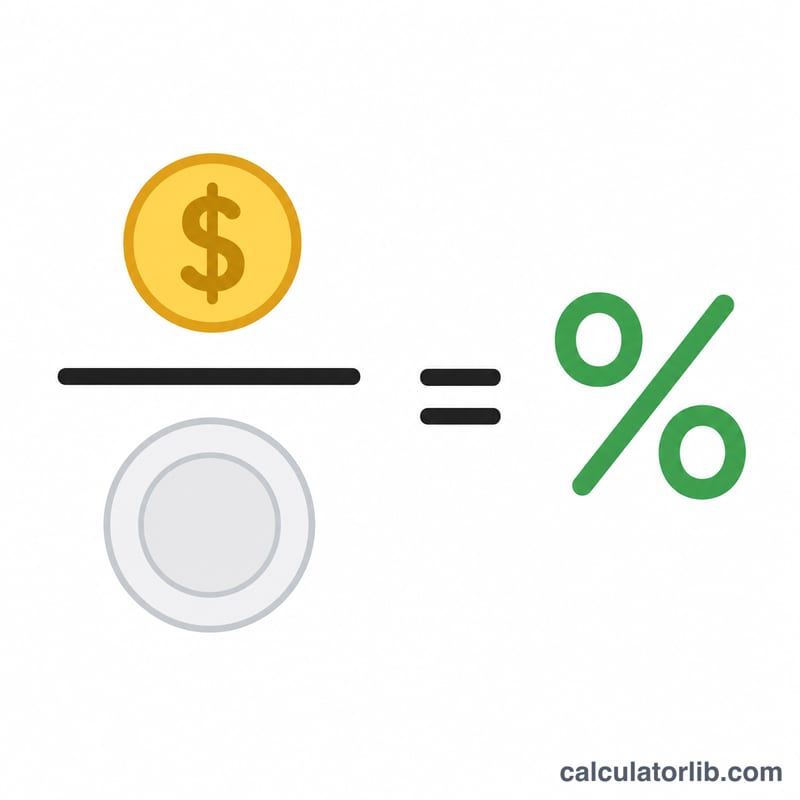
The math is simple: $$\text{Cost Ratio} = \frac{\text{Cost}}{\text{Sales}} \times 100$$ Dividing cost by sales gives the fraction of revenue spent on ingredients, and multiplying by 100 converts it to a percentage. If sales are zero the ratio is undefined, so the tool requires sales greater than zero.
Worked example
Suppose ingredient cost is 300 and sales are 1000. Then $$\text{Cost Ratio} = \frac{300}{1000} \times 100 = 30\%$$ — 30% of sales is spent on ingredients, which sits inside a typical healthy range. For a second case, cost 450 and sales 1200 give \(\frac{450}{1200} \times 100 = 37.5\%\), a relatively high ratio worth reviewing.
FAQ
What is a good food cost ratio? Most restaurants aim for roughly 25%–35%, though it varies by concept and region.
Why is my ratio rising? Common causes include portion over-use, food waste or spoilage (poor first-in-first-out inventory control), a heavier mix of high-cost menu items, and rising ingredient prices.
Can the ratio exceed 100%? Yes — a ratio above 100% means ingredient costs exceed sales, indicating a loss on goods sold.