
What this calculator does
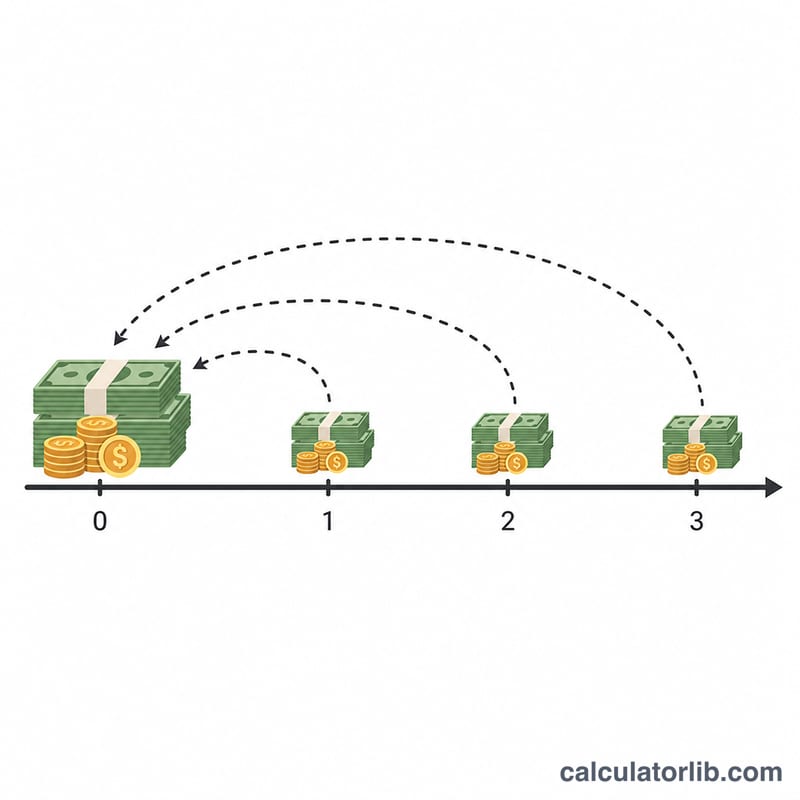
Jurisdiction: Japan. This tool builds the four standard coefficient tables used in Japanese personal-injury damages practice to deduct interim interest (the "chukan rishi kojo" deduction) when future income or care costs are paid today as a present-day lump sum. For each year from 1 to N it computes the Leibniz coefficient (compound-interest present value), the Hoffmann coefficient (simple-interest present value), and the cumulative annuity present-value coefficients for both methods. The underlying mathematics is universal time-value-of-money; only the legal convention and the statutory discount rate are Japan-specific.
How to use it
Enter the period (number of years N), the interest rate as a percentage, the number of decimal places to display, and a rounding mode (round half up, ceiling, or truncate). The statutory rate in Japan was 5% before the 2020 Civil Code revision and is 3% for causes occurring on or after 1 April 2020 — but the calculator does not pick the rate for you; enter the one that applies to your case.
The formulas explained
With \(r = \text{rate}/100\) and year index \(k\), the Leibniz single-year factor is \(\dfrac{1}{(1+r)^{k}}\) and the Hoffmann single-year factor is \(\dfrac{1}{1 + r\cdot k}\). Compound discounting (Leibniz) shrinks faster than simple-interest discounting (Hoffmann), so for \(k \ge 2\) the Hoffmann factor is always the larger of the two. The annuity (cumulative) factors are simply the running sums of the single-year factors; the Leibniz annuity also has the closed form \(\dfrac{1-(1+r)^{-k}}{r}\) when \(r > 0\).
$$L_n = \sum_{k=1}^{n} \frac{1}{(1+r)^{k}} \qquad H_n = \sum_{k=1}^{n} \frac{1}{1 + r\,k}$$ $$\text{where}\quad \left\{ \begin{aligned} n &= \text{Period (years)} \\ r &= \dfrac{\text{Interest rate (\%)}}{100} \end{aligned} \right.$$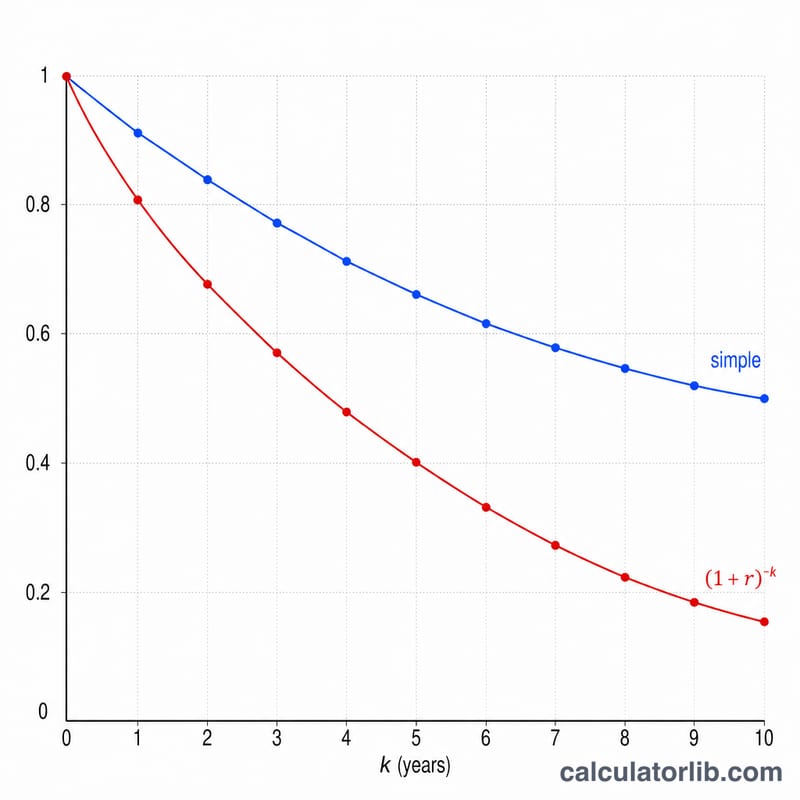
Worked example
At rate 5% (\(r = 0.05\)): Year 1 Leibniz \(= \dfrac{1}{1.05} = 0.95238095\); Year 2 Leibniz \(= \dfrac{1}{1.05^{2}} = 0.90702948\), so the Leibniz annuity at year 2 is \(1.85941043\). The Hoffmann factor for year 2 is \(\dfrac{1}{1.10} = 0.90909091\), giving a Hoffmann annuity of \(1.86147186\). For \(N = 30\) at 5%, the classic Leibniz annuity coefficient is about \(15.37245103\).
FAQ
Which method do Japanese courts use? Modern practice generally favours the Leibniz (compound) method, though the Hoffmann (simple) figures are provided for comparison and historical reference.
What rate should I enter? 3% for causes on or after 1 April 2020, otherwise the older 5% statutory rate, unless your case directs another figure.
Why are year-1 factors equal? At \(k = 1\) compound and simple interest produce the same discount, \(\dfrac{1}{1+r}\), so both methods coincide for the first year only.