

What This Calculator Does
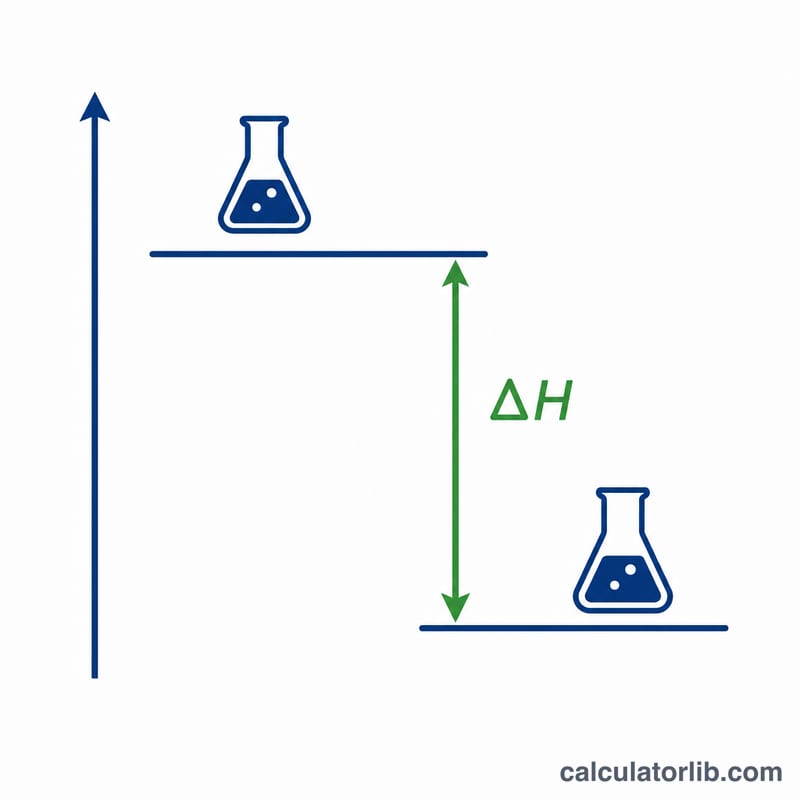
This tool computes the standard enthalpy of reaction (\(\Delta H^{\circ}_{rxn}\)) using Hess's law of constant heat summation. By subtracting the total standard enthalpy of formation of the reactants from that of the products, you obtain the net heat change of a chemical reaction under standard conditions (1 bar, 298.15 K). A negative result means the reaction is exothermic; a positive result means it is endothermic.
How to Use It
For each side of the balanced equation, multiply every species' standard formation enthalpy (\(\Delta H_f^{\circ}\), in kJ/mol) by its stoichiometric coefficient, then add them up. Remember that pure elements in their standard reference state (such as O₂, N₂, or solid C as graphite) have \(\Delta H_f^{\circ} = 0\). Enter the product sum in the first field and the reactant sum in the second, then read off \(\Delta H^{\circ}_{rxn}\).
The Formula Explained
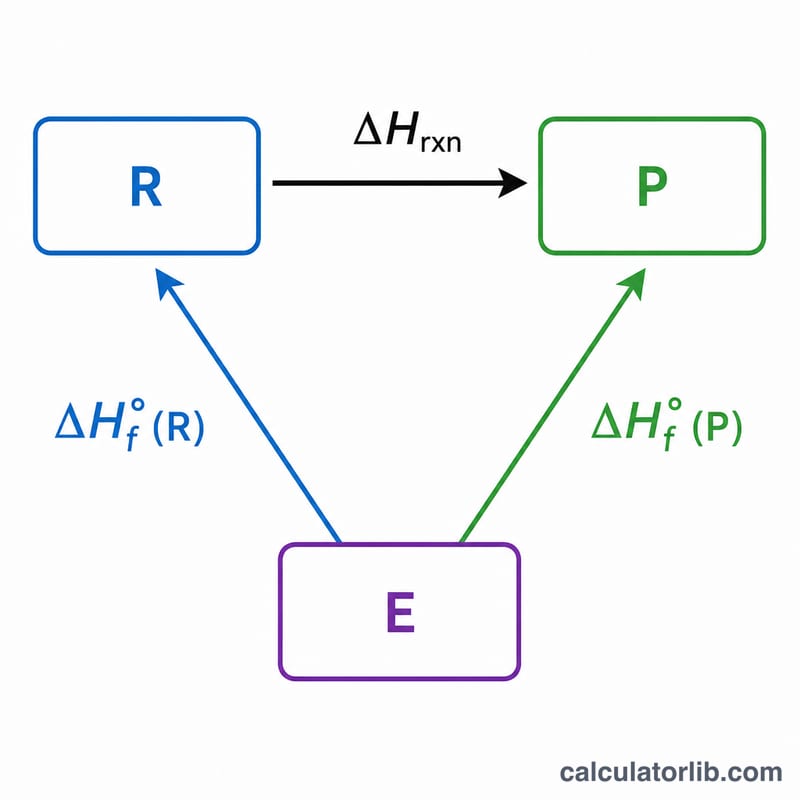
The governing equation is $$\Delta H^{\circ}_{rxn} = \sum \Delta H_f^{\circ}\,\text{Products} - \sum \Delta H_f^{\circ}\,\text{Reactants}$$ Because enthalpy is a state function, the path taken between reactants and products does not matter — only the initial and final states. This lets us treat tabulated formation enthalpies as building blocks and combine them algebraically.
Worked Example
Consider combustion of methane: CH₄ + 2O₂ → CO₂ + 2H₂O(l). Products: \(\Delta H_f^{\circ}(\text{CO}_2) = -393.5\) plus $$2 \times (-285.8) = -393.5 - 571.6 = -965.1\ \text{kJ/mol}$$ Reactants: \(\Delta H_f^{\circ}(\text{CH}_4) = -74.8\) plus \(2 \times 0\) (O₂) \(= -74.8\ \text{kJ/mol}\). So $$\Delta H^{\circ}_{rxn} = -965.1 - (-74.8) = -890.3\ \text{kJ/mol}$$ a strongly exothermic reaction.
FAQ
Why is the formation enthalpy of O₂ zero? By definition, the standard formation enthalpy of any element in its most stable form at standard conditions is zero, serving as the reference point.
What does a positive \(\Delta H^{\circ}_{rxn}\) mean? The reaction absorbs heat from the surroundings (endothermic).
Must I include stoichiometric coefficients? Yes — multiply each species' \(\Delta H_f^{\circ}\) by its coefficient before summing each side, or your result will be incorrect.