
What Is the Reaction Quotient?
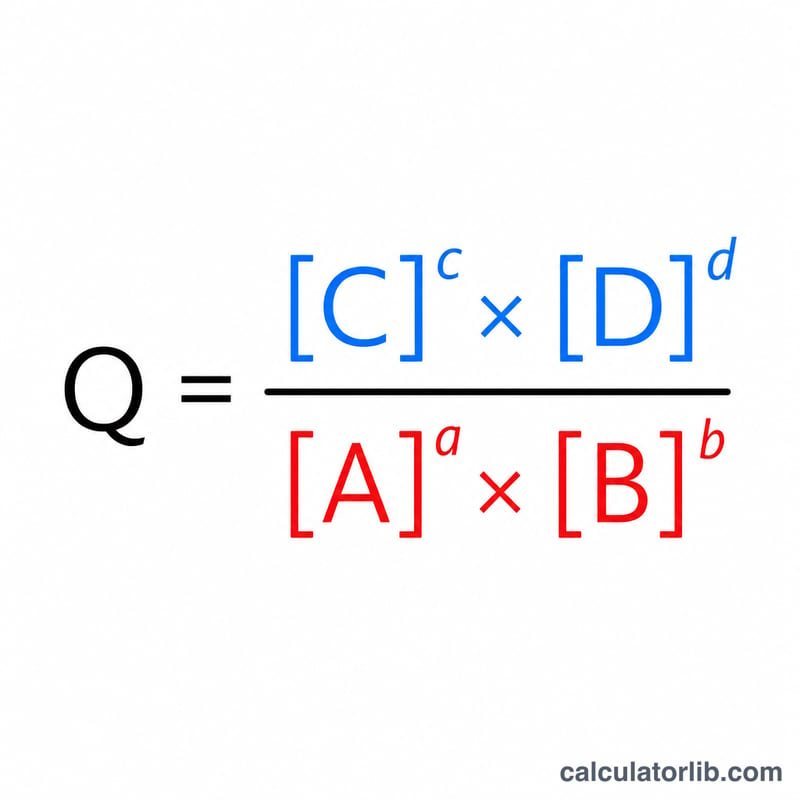
The reaction quotient, Q, measures the relative amounts of products and reactants present in a reaction at any given moment — not just at equilibrium. For the general reversible reaction aA + bB ⇌ cC + dD, Q is calculated exactly like the equilibrium constant K, but with current (non-equilibrium) concentrations.
How to Use This Calculator
Enter the molar concentration of each species ([A], [B], [C], [D]) and its stoichiometric coefficient (a, b, c, d) from the balanced equation. The calculator raises each concentration to the power of its coefficient, multiplies the product terms, and divides by the product of the reactant terms. If a species is absent from your reaction, set its concentration and coefficient so that its term equals 1 (e.g. concentration 1, coefficient 0).
The Formula Explained
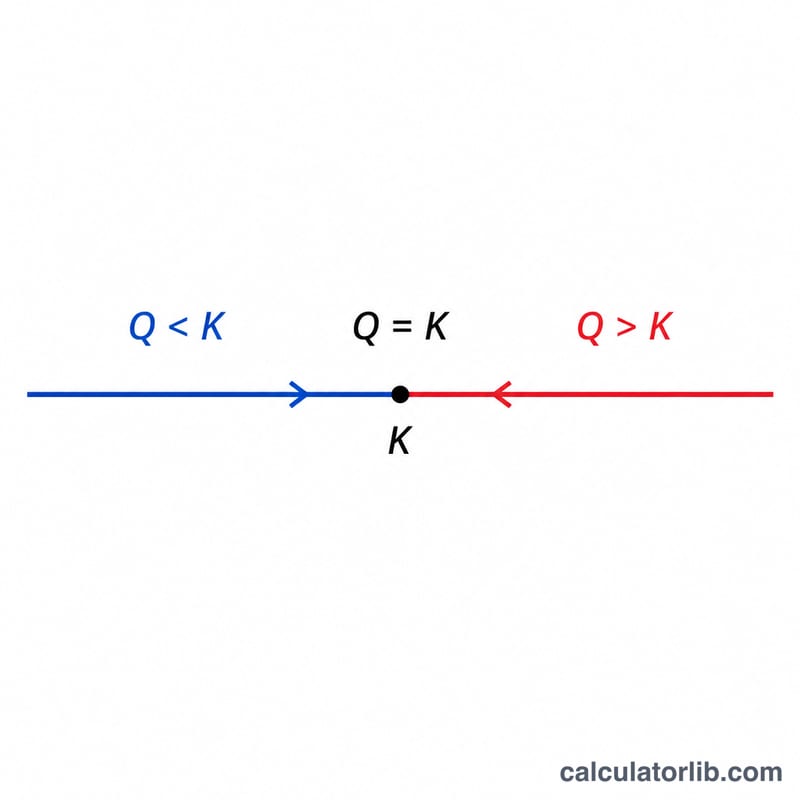
$$Q = \dfrac{[C]^c\,[D]^d}{[A]^a\,[B]^b}$$ The exponents come directly from the balanced chemical equation. Comparing Q to the equilibrium constant K predicts reaction direction: if Q < K the reaction proceeds forward (toward products); if Q > K it proceeds in reverse; if Q = K the system is at equilibrium.
Worked Example
For N₂ + 3H₂ ⇌ 2NH₃, suppose [N₂] = 0.5 M, [H₂] = 2 M, [NH₃] = 1 M. Then $$Q = \frac{1^2}{0.5^1 \times 2^3} = \frac{1}{0.5 \times 8} = \frac{1}{4} = \mathbf{0.25}.$$
FAQ
Is Q the same as K? They use the same expression, but K applies only at equilibrium while Q applies at any instant.
What units does Q have? Q is treated as dimensionless when computed from activities; here it is reported as a unitless number.
How do I handle pure solids or liquids? Their activity is 1, so leave them out by giving their term a value of 1.